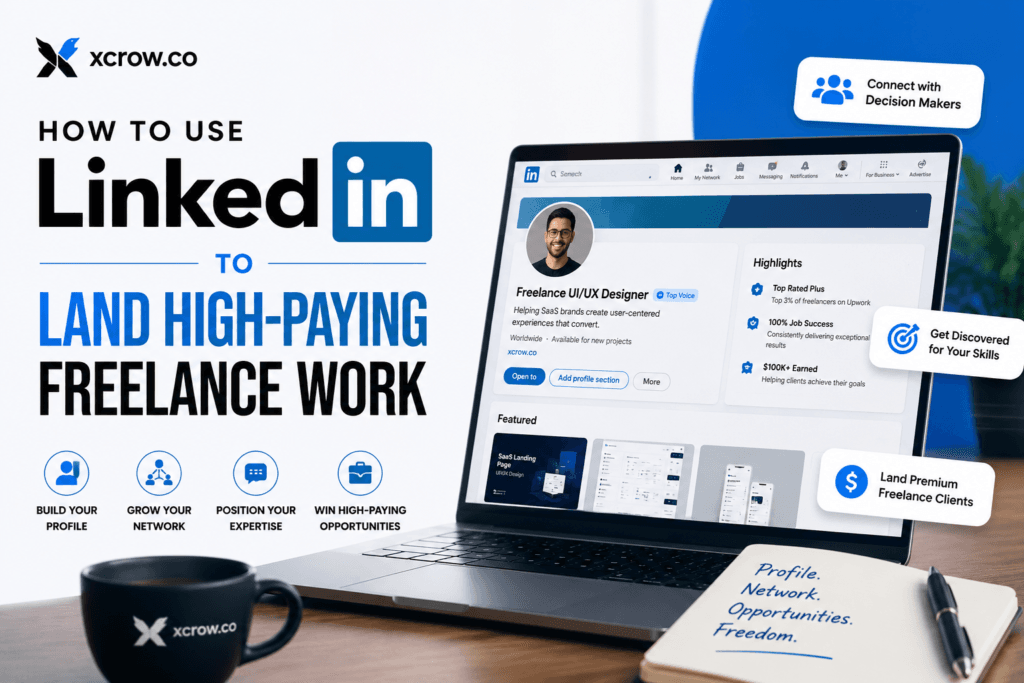
LinkedIn can help freelancers become easier to discover, demonstrate expertise, and build professional relationships. It is not a guaranteed source of clients or high income. Results depend on factors such as your niche, experience, offer, portfolio, network, market demand, consistency, and how well you qualify opportunities.
This guide presents a practical approach based on observable marketing and sales principles: make your offer clear, provide verifiable evidence, communicate with relevant people, and measure outcomes instead of relying on follower counts or unsupported success claims.
What LinkedIn Can—and Cannot—Do
LinkedIn gives professionals a place to present their experience, publish ideas, participate in industry discussions, and contact potential clients. Those activities can support lead generation, but platform activity does not guarantee replies, contracts, income, or a particular fee.
Use LinkedIn as one part of a broader business-development system. Referrals, a portfolio website, professional communities, repeat clients, and other relevant channels may also contribute to your pipeline.
Define a Specific Service and Audience
Start by identifying three things:
- the service you provide;
- the type of client you want to help; and
- the business problem or deliverable involved.
“I provide freelance services” gives prospects little context. A clearer description might be “I write technical documentation for software companies” or “I design onboarding flows for early-stage SaaS teams.” A specific position helps visitors decide whether your experience is relevant; it does not guarantee that they will hire you.
Make Your Profile Verifiable and Client-Focused
Your headline and About section should explain what you do, who you serve, and what a potential client can review. Use ordinary language and relevant terms naturally rather than filling the profile with broad claims such as “best,” “guaranteed,” or “six-figure.”
Use the Featured section for work samples, case studies, presentations, or useful resources. For each case study, separate facts from interpretation:
- Context: What was the client trying to accomplish?
- Your contribution: What work did you personally complete?
- Evidence: What changed, and how was it measured?
- Limitations: What factors were outside your control?
Only publish results you can substantiate and that you are permitted to disclose. If client information is confidential, describe the project without inventing numbers or implying that your work was the only cause of an outcome.
Publish Useful, Accurate Content
Content can show how you approach problems before a prospect contacts you. Choose topics that are relevant to the clients you want, such as process explanations, annotated examples, checklists, lessons from completed work, and analysis of common mistakes.
Avoid presenting personal experience as universal evidence. Phrases such as “in my experience” or “this approach may help” are more accurate than promises that a tactic will produce clients, leads, or a particular income. If you cite a statistic, link to the original source, state its date and population, and explain whether it applies to freelancers in your niche.
Build Relationships Without Spam
Follow relevant companies and professionals, read their public work, and add specific comments where you can contribute something useful. Thoughtful participation may increase familiarity, but it does not create an obligation to respond or buy.
When sending a connection request or message, explain the relevant reason for contacting the person. Do not disguise a mass pitch as personalization. Respect a lack of response, avoid repeated unwanted follow-ups, and do not claim knowledge of a company’s problems without evidence.
Qualify Opportunities Before Proposing Work
If someone expresses interest, ask questions before recommending a solution:
- What outcome or deliverable is needed?
- What has already been tried?
- What is the timeline and who makes the decision?
- What constraints, dependencies, or approval steps exist?
- What budget range is available?
A discovery call is not proof that a project will close. Treat it as a way to determine whether the project, expectations, timing, and working relationship are suitable for both sides.
Use Clear Proposals and Written Terms
A proposal should describe the scope, deliverables, assumptions, milestones, timeline, fee, payment schedule, revision process, and next steps. Before beginning, use written terms that also address ownership, confidentiality, cancellation, late payment, and how additional work will be approved. Consider obtaining legal advice for contracts or arrangements that carry significant risk.
Describe what you will deliver rather than promising a result controlled by many other factors. For example, a content writer can commit to research, drafts, and revisions; they cannot guarantee search rankings, traffic, or revenue without controlling the full system that affects those outcomes.
Measure the Pipeline, Not Just Reach
Track numbers that relate to your business goal: relevant profile visits, qualified conversations, discovery calls, proposals, acceptance rate, project value, repeat work, and time spent. Record the period and source so that comparisons are meaningful.
These measures still do not prove that LinkedIn alone caused a sale. A prospect may encounter you through several channels before making a decision. Use the data to form cautious hypotheses, then adjust one part of your process at a time.
A Sustainable Weekly Routine
- Publish one or two useful pieces that address client-relevant questions.
- Participate in relevant discussions with specific, helpful comments.
- Send a small number of genuinely relevant connection requests.
- Improve one portfolio item or case study using evidence you can verify.
- Review active conversations and follow up professionally.
There is no universally correct posting frequency, outreach volume, price, or time-to-client. Start with a manageable routine and evaluate the quality of opportunities it produces.
Frequently Asked Questions
Can LinkedIn guarantee freelance clients?
No. LinkedIn can support visibility and relationship-building, but client acquisition depends on multiple factors and outcomes vary.
How often should I post?
Choose a schedule you can maintain without reducing quality. Relevance and usefulness are more important than a promised posting frequency.
Should I send cold messages?
Targeted outreach can be appropriate when it is relevant, honest, concise, and respectful. Avoid mass messaging and stop if the recipient does not engage.
How quickly will LinkedIn produce work?
There is no reliable universal timeline. Track qualified conversations and proposals over time rather than treating a specific number of days as a promise.
Final Takeaway
Use LinkedIn to make your expertise understandable, show evidence you are allowed to share, and develop professional relationships. Avoid guaranteed-income language, unsupported statistics, fabricated case studies, and claims that one tactic works for everyone. A clear offer, credible proof, careful qualification, written terms, and measured experimentation provide a more realistic foundation for finding freelance work.
Freelance Burnout: Warning Signs, Causes, and Practical Recovery Steps
How Platform Economies Work and Who Captures the Most Value

Israel Otoijamun is a digital business strategist, technology entrepreneur, and the founder of Xcrow, a platform connecting businesses with top remote talent.
With more than 15 years of experience across online platforms, technology, and digital payments, Israel regularly publishes insights on freelancing, tech job opportunities, remote workforce strategies, and modern hiring ecosystems.
Read more about Israel Otoijamun.