I want to tell you about a mistake I have watched dozens of talented freelancers make, sometimes for years before they finally corrected it. They land a client, deliver genuinely excellent work, receive glowing feedback, and then watch that client tell someone else about them. The referral reaches out, budget comes up, and the freelancer quotes the same low rate they have been charging since they started. Not because the market demands it. Not because the work is not worth more. But because somewhere along the way, charging what they are actually worth started to feel dangerous.
That fear is the root of almost every undercharging story I have encountered. Not a lack of skill. Not a lack of opportunity. Just a persistent, quiet anxiety about what happens if the number on the invoice is too high.
Here is what I have learned from watching this pattern and from living parts of it myself: the fear of charging too much almost always does more damage than the reality of it ever would. And the sooner you understand the math, the psychology, and the positioning behind setting a rate that actually works for you, the sooner freelancing starts feeling like a sustainable business rather than a treadmill you cannot quite get off.
This guide covers all of it, from the raw numbers to the mindset shifts to the practical tactics for raising your rates without losing the clients you want to keep.
Why Undercharging Is So Expensive and So Common
Most freelancers undercharge by 30 to 50% in their first year because they forget to account for non-billable time, taxes, benefits, and equipment. Set rates too low and 60-hour weeks still do not cover expenses. Alliance Virtual Offices
That statistic lands differently when you run the math on your own situation. A freelancer charging $30 per hour who works 50 hours a week is not earning $78,000 a year. They are earning significantly less, once you subtract the hours spent on proposals, invoicing, client communication, skill development, and every other hour of work that never gets billed. They are also paying self-employment taxes that an employee does not see because an employer handles them. And they are covering their own software, equipment, and any professional development out of that same income.
The biggest pricing mistake freelancers make is taking an old salary and dividing it by 2,080 hours, which is 40 hours multiplied by 52 weeks. This ignores three critical factors: you will not bill 40 hours a week, realistically billing closer to 25 to 30 hours; you need to cover your own benefits and taxes; and you have business expenses your employer used to pay. An $80,000 salary does not translate to $38 per hour freelance. It translates to $70 to $90 per hour minimum. Osdire
When you underprice, the most immediate consequence is obvious: you make less money. But the less obvious consequences are worse. When you underprice, you attract clients who are price-sensitive, which means they are also likely to be demanding, slow to pay, and quick to scope-creep. These clients take more of your time per dollar than premium clients do. This means you have less time to pursue better work. You are not just earning less. You are actively prevented from earning more. Jobbers
Underpricing also communicates a message to the market. Price is a signal. A low price signals risk in a way that most freelancers do not realize. Sophisticated clients, the ones with real budgets, are not looking for the cheapest option. Jobbers
Working for rates that feel unjust is demoralizing. Over time, it breeds resentment toward clients, toward the work itself, toward the entire endeavor. Burnout among freelancers is almost never purely about volume of work. It is about the mismatch between effort and return. Jobbers
The underpricing trap is sticky precisely because it feels safe. Raising rates feels like risk. What if the client says no? What if you price yourself out of the market? These fears are understandable, but as I have seen again and again, they are based on a fundamental misreading of how premium markets work. The clients who are worth working with are not eliminated by higher prices. In many cases, they are attracted by them.
The Psychology Behind Why Freelancers Undercharge
Before getting into the numbers, it is worth spending a moment on the psychological dimension of pricing, because understanding why you are tempted to go low is the first step to resisting it.
Service providers undercharge for predictable psychological reasons, not because they lack business sense. The first is cost anchoring to time instead of value. If you think in terms of hourly rates, you unconsciously benchmark against wages, what employees earn in your industry. But you are not an employee.
You carry overhead, insurance, marketing costs, equipment, software, taxes, and the risk of running a business. An employee making $40 per hour costs their employer $55 to $70 per hour in total compensation. Your rates need to reflect the full cost of running a business, not just the labor. The second is comparison to the wrong competitors. Infotech Wayout
Many freelancers price by looking at the lowest rates they can find on platforms like Fiverr or Upwork and positioning just slightly above them. This is a race to the bottom dressed up as competitive research. The freelancers charging rock-bottom rates on those platforms are generally not your competition if you are doing quality work and presenting it professionally. They are competing in a different market segment for different clients.
Service providers suffering from imposter syndrome lose an average of $30,000 or more annually by undercharging. 67% of consultants struggle with pricing confidence, often undercharging by $100 to $300 per hour compared to their actual value delivery. Capital on Tap
Most new freelancers undercharge out of fear of losing the job, lack of confidence, or comparing themselves to low-rate platforms. It feels safer to quote low, but it attracts price-sensitive clients and makes raising rates later much harder. FreeUp
Recognizing these patterns in yourself is the first productive step. The goal is not to ignore them but to develop a pricing methodology that is grounded in real numbers and real market data rather than in anxiety.
Step One: Calculate Your Minimum Viable Rate
Your minimum viable rate is the floor below which freelancing literally loses money. It is not your target rate. It is the lowest you can charge and still cover all your real costs, pay your taxes, and actually take home a sustainable income.
The formula is straightforward: minimum hourly rate equals annual expenses plus desired profit divided by billable hours per year. For most freelancers, billable hours are 50 to 60% of total work hours. Gloroots
Let me walk through that calculation with real numbers.
Start with your desired annual take-home income. Let us say you want to clear $60,000 after taxes. In most markets, freelancers pay a combined income and self-employment tax of somewhere between 25% and 40% of gross income. To take home $60,000 at a 30% effective tax rate, you need to earn approximately $85,700 gross.
Now add your annual business expenses. This includes software subscriptions, professional development, equipment, any insurance you carry, and any platform fees. A realistic total for most freelancers is somewhere between $3,000 and $8,000 per year. Let us use $5,000 for this example. Your target gross income is now approximately $90,700.
Now divide by realistic billable hours. Add vacation time, sick days, and slow periods, and most freelancers realistically bill 1,000 to 1,200 hours per year. Using 2,080 as your divisor means undercharging by roughly 40 to 50%. Upwork
Using 1,100 billable hours: $90,700 divided by 1,100 hours equals approximately $82 per hour.
That is your minimum viable rate. Not $30. Not $40. For a freelancer targeting $60,000 take-home in most developed markets, $82 per hour is the floor, not the ceiling.
Beginners should calculate their minimum viable rate using this formula. The result typically lands between $40 and $75 per hour depending on location and expenses. Gloroots
Run this calculation honestly for your own situation. The number that comes out the other end might be higher than what you are currently charging. That gap is the cost of undercharging, expressed in hours of your life that are buying less than they should.
Step Two: Benchmark Against the Real Market
Once you know your floor, you need to understand what the actual market will support for your skill and experience level. Your minimum viable rate tells you what you need. Market rates tell you what you can charge.
In 2026, the average freelancer charges $20 to $50 per hour depending on skill, but the top 20% earn $80 to $200 per hour by mastering pricing strategy. The gap is not skill. It is pricing confidence and positioning. U.S. Chamber of Commerce
In developed markets like the United States, experienced freelancers typically charge between $75 and $150 per hour. Beginners often start between $30 and $60 per hour depending on skill level. WorkMotion
AI skills command a 30 to 50% premium in 2026. If you can use AI to deliver faster and better results for clients, charge for that capability rather than treating it as a background efficiency gain that only benefits you. Business.com
The most reliable way to benchmark your rates is to research what actual practitioners in your specific skill and niche are charging, not what the cheapest profiles on platforms advertise but what the mid-to-senior tier is actually earning. Look at job postings for full-time roles equivalent to your freelance work, because those often list salary ranges that translate directly to what employers value that skill at. Read community discussions in professional groups for your industry. Talk to other freelancers in your network.
Upwork’s rate research tools provide aggregated data on what freelancers in different skill categories are earning across the platform, which is one of the most useful free benchmarking resources available. Industry-specific salary surveys, professional association reports, and the Bureau of Labor Statistics for US-based freelancers round out the picture.
Do not benchmark against the lowest rates you find. Benchmark against the rates the best-reviewed, most consistently hired professionals in your skill area are charging. That is the tier you should be aiming for, not the entry-level floor.
Step Three: Understand the Three Pricing Models and When to Use Each
Choosing between hourly, project-based, and value-based pricing is one of the most impactful decisions you make as a freelancer, and most people default to hourly without considering whether it actually serves them.
Hourly Pricing
Hourly pricing is the simplest model and the right starting point for most new freelancers. It is easy to communicate, easy for clients to understand, and provides a natural way to track your time and learn how long different types of work actually take you.
Start with hourly rates to build predictability, move to project rates after accurately estimating time on 10 to 20 similar projects, then shift to value-based pricing once clients see the work as an investment rather than a cost. Gloroots
The limitation of hourly pricing becomes apparent as you get better at your craft. When you are highly skilled, you work faster. A task that takes a junior freelancer four hours might take you one. Under hourly billing, getting better at your job actually reduces your income per project. That is a fundamentally broken incentive structure.
The better you get at coding, or any craft, the faster you work, and the less you earn. That is backward. Hourly billing also forces clients to micromanage. They watch the clock. They question every minute. CareerBldr
Use hourly pricing for ongoing work with unclear scope, for new client relationships where you are still learning how to estimate their projects, and for work that varies significantly in complexity from project to project.
Project-Based Pricing
Project-based pricing sets a fixed fee for a defined deliverable. Once you have completed enough similar projects to estimate your time accurately, this model almost always produces better outcomes than hourly billing.
Project-based pricing gives you control. You define the scope, you estimate the time, and you quote a fixed fee. If you finish early, you keep the profit margin. If you hit unexpected roadblocks, you have already accounted for buffer time in your estimate. This approach builds trust because clients know the total cost upfront. CareerBldr
When calculating a project price, estimate your hours honestly and then multiply by 1.5 as a buffer. This accounts for scope creep, revision cycles, and the inevitable unexpected complications that arise in real projects. A project you estimate will take 20 hours should be priced at 30 hours of your rate at minimum.
The scope of work clause in your contract is what makes project pricing work safely. Without a precise, written definition of what is included and excluded, project pricing exposes you to unlimited revision requests and expanding deliverables that erode your effective rate below what hourly billing would have produced. Read our guide on freelance contract templates and what every freelancer needs to include for the exact scope language that prevents this.
Value-Based Pricing
Value-based pricing is the most advanced model and the one that produces the highest income for experienced professionals. Instead of calculating your price from your costs or your time, you calculate it from the value the work creates for the client.
The biggest pricing mistake freelancers make is pricing based on what feels comfortable rather than the value they deliver. If a project saves the client $50,000, a $5,000 fee is already a bargain. Price based on outcomes, not time. Osdire
Successful creatives and consultants are shifting from hourly rates to value-based project pricing, often increasing revenue by 200 to 400%. Capital on Tap
To implement value-based pricing, you need to understand the business impact of what you are doing. Before quoting, ask questions that reveal the stakes. What revenue does this website generate? What is the cost to the business of the problem you are solving? What would happen if this project was not completed? The answers tell you the value envelope within which your price is a rational investment rather than an arbitrary cost.
A landing page that will generate $10,000 in monthly revenue for a client is not a $500 writing project. A data system that saves a company 20 hours of manual work per week is not a $1,000 development project. The pricing should reflect what the work is worth to the client, not how many hours it took you to produce it.
The True Freelance Rate Formula
For a clear, practical calculation you can apply to your own situation right now, here is the complete formula with all the variables that most freelancers miss.
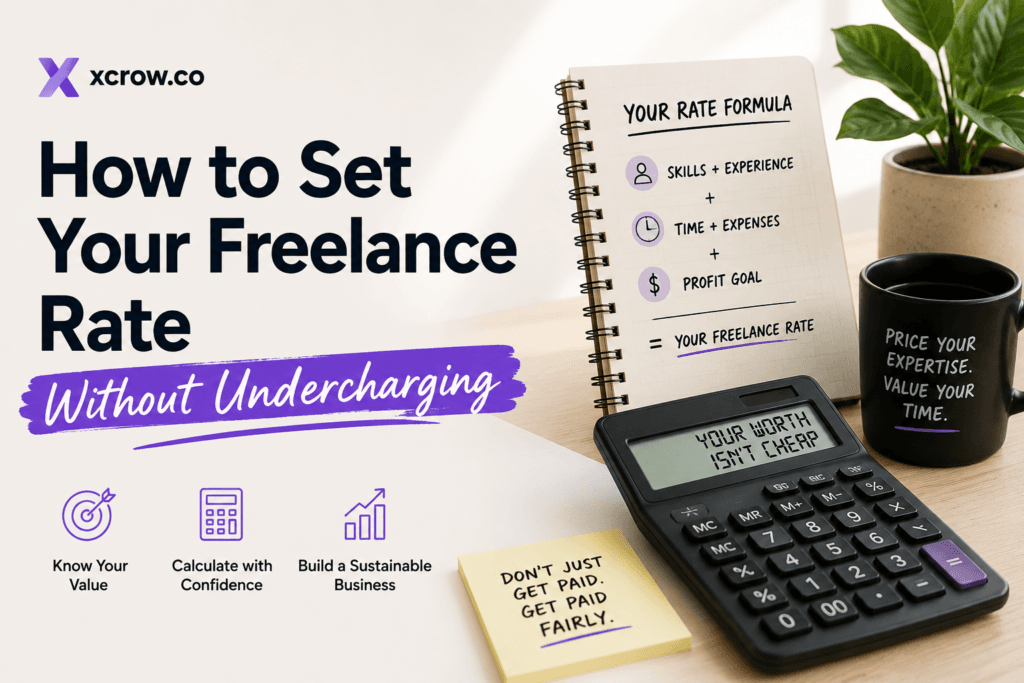
Target gross income equals desired take-home income divided by one minus your effective tax rate. If you want $60,000 net and your tax rate is 30%, your target gross is $60,000 divided by 0.70, which equals $85,714.
Add annual business expenses: software, equipment, professional development, insurance, platform fees. A realistic estimate is $3,000 to $8,000 for most freelancers. Add $5,000 for this example. Total needed: $90,714.
Calculate realistic billable hours: total working weeks per year, minus vacation and sick time, multiplied by realistic billable hours per day. Most freelancers work 46 weeks per year after time off. If you bill six hours of a typical eight-hour day, that is 46 weeks multiplied by five days multiplied by six hours, which equals 1,380 hours. But account for slow periods and project gaps. A realistic annual billable total for most independent freelancers is 1,000 to 1,200 hours.
Using 1,100 hours: $90,714 divided by 1,100 equals $82.50 per hour minimum viable rate.
Pricing is the most critical decision you will make as a freelancer. Charge too little and you will burn out chasing volume. Charge too much without justification and you will lose opportunities. The difference between a struggling freelancer and a thriving one in 2026 often comes down to one skill: knowing how to set and raise your rates with confidence. iHire
How Specialization Multiplies Your Rate
One of the most reliable ways to command higher rates without changing anything about the quality of your work is to specialize more deeply.
Generalists compete on price. Specialists compete on unique value. A copywriter for SaaS companies can charge two to three times more than a generalist copywriter because they understand the industry’s specific challenges, terminology, and conversion drivers. U.S. Chamber of Commerce
I have seen this play out in nearly every service category. A developer who builds React applications is competing with thousands of developers. A developer who builds React applications specifically for fintech startups that need to pass security audits is competing with dozens. The same skills, applied with industry-specific context and positioned around a specific problem, justify a dramatically different rate structure.
Specialization works for two reasons. First, it reduces your competition from everyone with your skill to only those with your specific combination of skill and industry knowledge. Second, it allows you to accumulate relevant experience faster, which means your results improve faster, which means your case studies become more compelling faster.
The fastest way to find your profitable niche is to look at your existing client base. Which types of clients have been most enjoyable to work with? Which ones have seen the most significant results from your work? Which industries have you built genuine knowledge of through repeated projects? The intersection of your strongest work and your most engaged clients is usually where your most defensible specialization lives.
How to Raise Your Rates With Existing Clients
Raising rates with existing clients is where most freelancers feel the most anxiety, and it is also where most of the opportunities to significantly improve income live for established practitioners.
The fear of raising rates is bigger than the actual risk. Most freelancers who raise rates 20 to 30% lose fewer than 10% of clients, and those tend to be the most difficult ones. Business.com
You should raise your rates when you are consistently booked more than eight weeks in advance, when you have not adjusted rates in over 12 months, when you have added new skills or certifications, or when your cost of living has increased. A good guideline is to raise rates 10 to 20% annually. Useme
Being booked out is the clearest signal that your rates are below market. If you have more inquiries than you can take on, the market is telling you that your price does not reflect your value. Raise the rate until you reach a balance where you are consistently at comfortable capacity, not overloaded and not hunting for work.
The mechanics of communicating a rate increase are simpler than most people expect. For new clients, simply quote the new rate. No explanation needed, no apology, no lengthy justification. For existing clients, give 30 to 60 days notice and frame it positively.
Something like this works well in almost every situation: “I have really valued working with you on [projects]. I wanted to give you advance notice that starting 2026, my rate will be moving to [new rate]. I have genuinely enjoyed our work together and wanted to make sure you have time to plan for this adjustment.”
That message is professional, warm, and direct. It does not over-explain or apologize. It treats the client as the business professional they are and extends the courtesy of advance notice.
For new clients, simply quote the new rate. No explanation needed. For existing clients, give 30 to 60 days notice and frame it positively. Clients who are worth keeping almost always stay. Upwork
Responding to Price Objections Without Dropping Your Rate
Learning to handle price objections without immediately discounting is one of the most valuable skills you can develop as a freelancer. The default response to “that is too expensive” is to lower the price. The better response is almost always something else.
Clients will ask for discounts. How the response is framed determines whether the freelancer is seen as a professional or a commodity. Dropping the price immediately signals that the original number was arbitrary. Questions create a productive conversation instead. If a client has $8,000 and the quote was $12,000, removing features to fit the budget keeps the rate intact. “For $8,000, the project would include X and Y. To include Z, the full $12,000 is needed. Which makes more sense for this phase?” Discounts signal that the original price was inflated. Scope adjustments show that price reflects the amount of work delivered. Alliance Virtual Offices
The scope adjustment approach is the cleanest way to respond to a budget constraint without undermining your pricing. You are not lowering your rate. You are reducing the deliverables to match the budget. This maintains your rate integrity while giving the client a path to work with you.
Another effective response to price objections is to reframe the conversation around value and return rather than cost. If a client says your web development quote of $5,000 is too high, ask them what they expect the new site to generate in additional revenue over the first year. If the honest answer is $40,000, then the conversation about whether $5,000 is a lot or a little changes immediately.
You can also offer payment structures that make the total more manageable without reducing it. Breaking a project into milestone payments spreads the cash flow burden for the client while keeping the total fee intact. This is particularly effective with smaller businesses where cash flow is a genuine constraint rather than a negotiating tactic.
The Three Pricing Tiers Strategy
One of the most effective tools for converting more proposals at higher rates is presenting clients with three structured options rather than a single price.
Beyond hourly and project-based pricing, freelancers now adopt performance-based pricing linking income to results like cost per lead or ROI. Subscription models are rising with recurring monthly fees. Hybrid pricing combines base retainers with performance bonuses, balancing stable income and incentive-driven growth. Upwork
The three tiers approach works by shifting the client’s decision from “should I hire this person?” to “which option should I choose?” That is a fundamentally more favorable mental frame for the freelancer.
Structure your options so the middle tier is what you most want to deliver at a rate that works well for you. The bottom tier should be limited in scope, priced meaningfully below the middle, and clearly missing features or capacity that most clients will want. The top tier should be comprehensive, priced significantly above the middle, and genuinely valuable for clients with bigger needs or budgets.
Most clients choose the middle tier. A meaningful proportion choose the top tier, which increases your average project value. Very few choose the bottom tier, but its existence makes the middle tier feel reasonable by comparison. This anchoring effect is one of the most reliable pricing psychology principles available and it costs you nothing to implement.
When to Work for Less and When That Is the Wrong Call
There are legitimate situations where working at below your standard rate makes strategic sense. Early in your career, when you are building a portfolio in a specific niche where you have no samples yet, accepting one or two projects at a reduced rate in exchange for a strong case study and testimonial is a reasonable short-term investment.
Accepting lower rates is also sometimes appropriate when a project offers significant learning, prestigious brand association, or access to a network that would otherwise be difficult to enter. The key is being conscious that you are making an investment with a specific expected return, not establishing a precedent for how that client or type of work is priced.
What is never strategically sound is accepting lower rates out of fear or desperation and then maintaining those rates indefinitely because raising them feels uncomfortable. That pattern, and it is extremely common, is how talented freelancers end up years into their careers still charging what they charged when they were starting out.
The moment that resonates with me most from conversations about pricing is the moment a freelancer realizes they have been undercharging someone by 60% for eighteen months, not because the client would have pushed back on a higher rate but simply because they never asked. The client would have paid more. They just were not going to volunteer the information.
Practical Rate Benchmarks by Skill Category in 2026
To give you a concrete reference point for where different skill categories are currently trading, here are the realistic rate ranges for intermediate to experienced practitioners in several major freelance categories. These are not entry-level numbers and not top-of-market premium rates. They are the rates that a competent, well-positioned professional with a solid portfolio should be targeting.
Copywriting and content strategy sits at $65 to $150 per hour or $500 to $3,000 per project for well-scoped deliverables like sales pages, email sequences, and brand messaging frameworks.
Web development in modern frameworks like React or Next.js sits at $75 to $150 per hour for front-end work and $90 to $175 for full-stack development. E-commerce development on Shopify ranges from $60 to $120 per hour.
SEO and digital marketing strategy commands $60 to $120 per hour at the intermediate level, with senior SEO strategists handling complex accounts charging $150 to $200.
Graphic design and branding work ranges from $50 to $100 per hour for execution-focused work and $75 to $150 for strategic brand development projects.
Data analysis and visualization sits at $65 to $125 per hour for intermediate practitioners and $100 to $200 for senior analysts working with complex business intelligence systems.
Video editing and production ranges from $40 to $80 per hour for standard social content editing, scaling to $75 to $150 for higher-production commercial work.
AI skills command a 30 to 50% premium across all categories. If your work incorporates meaningful AI capability, that premium is justified and should be captured in your rates. Business.com
These are ranges, not ceilings. The most important factor in where within any range you can position yourself is not just your skill level but your positioning specificity, your portfolio quality, and the clarity with which you communicate the value of your work.
Protecting Your Rates With the Right Client Infrastructure
Setting the right rate is only part of the equation. Getting paid at that rate, reliably and on time, requires the right operational infrastructure around your client engagements.
Clear contracts with precise scope of work definitions protect your project pricing from the scope creep that silently erodes your effective rate. Every additional request that falls outside the defined scope should trigger a change order conversation, not a quiet extra hour of work. Our guide on freelance contract templates and what every freelancer needs to include walks through every clause you need.
Milestone-based payment schedules protect you from the most common form of rate erosion: delivering work and then not getting paid. Requiring a deposit before you start, tying subsequent payments to deliverables, and never proceeding to the next phase until the previous payment is received keeps your cash flow aligned with your work output.
For international clients and new client relationships, escrow-based payment protection removes the financial risk from the equation entirely. Xcrow holds client funds securely until the agreed work is delivered and confirmed, which means you know the money is there before you invest your time. This is particularly valuable for larger projects and for clients based in different countries where payment enforcement through other channels is complicated. Read our full explanation of how escrow protects buyers and sellers online to understand exactly how this works.
The Mindset That Makes All of This Work
I want to end with something that the formulas and the benchmarks cannot fully capture, because it is the thing that actually determines whether the rate you set is the rate you hold.
Freelance pricing psychology is about understanding how clients perceive your rates, how your pricing affects their behavior, and how your own mindset influences the numbers you quote. It is about perceived value, anchoring, and confidence rather than just calculating costs. Look at the results you deliver for clients, not just the time you spend. Track past projects where your work increased revenue, saved time, or solved big problems. Your worth is tied to the business impact you create, combined with your experience and market demand for your skills. FreeUp
The freelancers who charge well and hold their rates are not universally more skilled than the ones who underprice. They have simply internalized a different relationship to the question of their value. They have stopped treating every pricing conversation as a test of whether they deserve the work and started treating it as a business negotiation between two professionals.
That shift does not happen overnight. But it does happen, and the trigger is almost always the same: doing the math honestly, realizing how badly the current rate is serving you, and deciding that the discomfort of asking for more is smaller than the cost of staying where you are.
Run your numbers. Do the benchmarking. Build the three-tier options. Set the rate the math supports. And the next time a client pushes back, adjust the scope before you adjust the rate.
Your work is worth more than you are charging for it. The question is whether you are going to let that stay true.
Related reads you might find useful:
How to Write a Freelance Proposal That Actually Wins Projects
Freelance Contract Template: What Every Freelancer Needs to Include
How to Get Your First Client on a Freelance Marketplace: Step by Step
Leave your comment