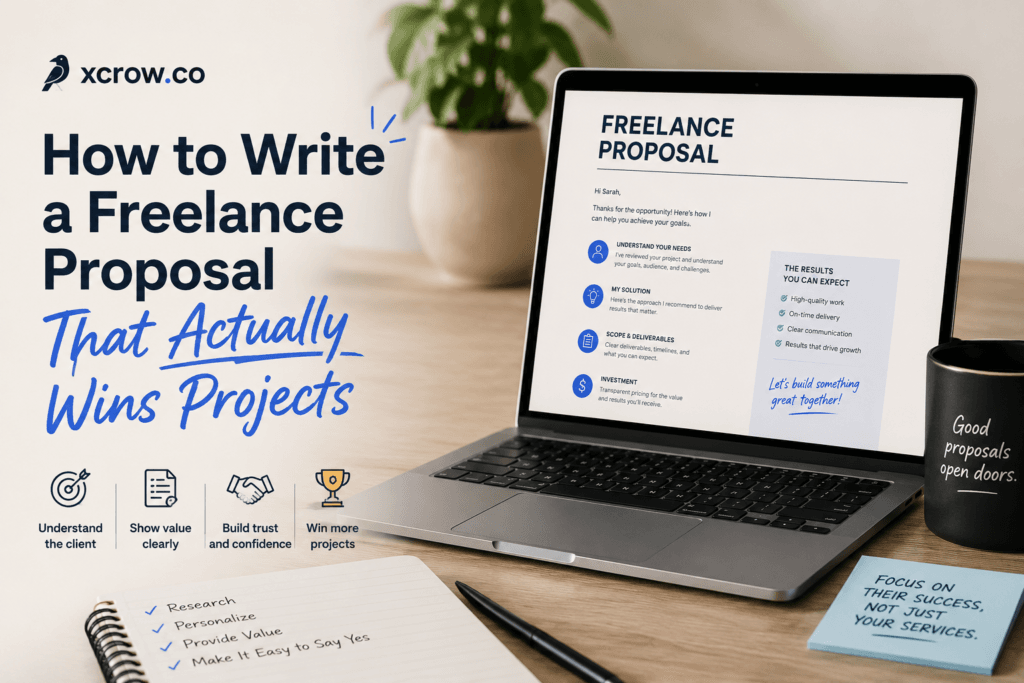
How to Write a Freelance Proposal That Actually Wins Projects.

Every freelancer has been there. You spend time crafting what feels like a solid pitch, you hit send, and then nothing. No reply. No acknowledgment. Just silence. And somewhere across the internet, another freelancer just landed that same project, probably not because they were more talented, but because they wrote a better proposal.

The freelance proposal is one of the most underestimated skills in the entire independent work ecosystem. Most people treat it like a formality, a quick message to confirm their interest and state their price. But clients do not experience it that way. To them, your proposal is the first real demonstration of how you think, how you communicate, and whether you are genuinely the right person for their problem. It is a sales document first, and a service description second.

The average proposal close rate sits at 43%, which means more than half of every proposal a freelancer writes ends up as wasted effort. Most losing proposals share the same problem: they focus on listing skills and services instead of showing the client exactly how their specific problem gets solved. The gap between a 20% win rate and a 60% win rate often comes down to structure, specificity, and timing. fiverr

This guide is going to change how you approach every proposal you write from here on out. Not with generic advice, but with a clear, practical framework for creating proposals that get opened, get read, and get accepted.


Why Most Freelance Proposals Fail Before They Are Even Read

Before getting into what a good proposal looks like, it is worth understanding clearly what is going wrong with most of them. The pattern is remarkably consistent across industries, skill sets, and experience levels.

The most common failure mode is also the most preventable one: the proposal is written entirely from the freelancer’s perspective. It opens with something like “Hi, my name is [Name] and I have been a professional designer for seven years. I specialize in branding, visual identity, and digital marketing materials. I am very passionate about my work and I would love to help you with your project.”

Clients are fundamentally self-interested. Many freelancers treat proposals like resumes, listing their skills, their history, their awards, and their processes. While credibility is important, what clients actually want to know is whether you understand their problem and whether you can solve it. U.S. Chamber of Commerce

Reading an opening like that from the client’s side is an exercise in patience. They posted a job because they have a specific problem they need solved. They are not primarily interested in your passion or your years of experience. They want to know quickly whether you understand their situation and whether you have a clear plan for addressing it.

The first paragraph of a proposal should be about the client’s situation, not the freelancer’s resume. “I have been designing websites for ten years” is background information. “Your current site loads in six seconds and has not been updated since 2022, which means mobile visitors are leaving before they see your portfolio” is a problem statement that proves the freelancer already understands the project. Indeed

The second common failure is vagueness. Proposals that say things like “I will handle all aspects of the project professionally and deliver high-quality work on time” are utterly meaningless to a client who needs to make a decision. They tell the client nothing about what will actually happen, what they will receive, or how the freelancer plans to approach the specific challenge at hand.

The third failure is timing. Proposals sent within 24 hours of the initial conversation have a 23% higher close rate than proposals sent after five or more days. Speed matters, but only when the proposal content demonstrates that the freelancer actually listened during the discovery call. Indeed A fast generic proposal is worse than a thoughtful delayed one. But a fast, thoughtful, specific proposal is the best combination of all.

Understanding these failure patterns is not discouraging. It is empowering, because every one of them is completely fixable with intention and practice.


What a Winning Proposal Actually Needs to Do

Before writing a single word, it helps to be clear about the job your proposal is supposed to accomplish. It is not to show off everything you know. It is not to impress the client with your vocabulary or your portfolio. It is to move a specific client from uncertainty to confidence about hiring you for their specific project.

That confidence comes from three things: understanding, credibility, and clarity.

Understanding means the client reads your proposal and thinks “this person actually gets what I need.” It comes from referencing their specific situation, using their language, and demonstrating that you have thought about their problem rather than just copy-pasting a generic pitch.

Credibility means the client has reason to believe you can deliver. This comes from relevant examples of past work, specific results you have achieved in similar situations, and the professionalism with which the proposal itself is presented.

Clarity means there is no ambiguity about what happens if they say yes. What will they receive? By when? At what cost? What is the process? A client who feels uncertain about any of these questions will delay making a decision, and delayed decisions usually become no decisions.

A winning freelance proposal answers the client’s core questions in order: what is the problem, what is the solution, what do I get, when do I get it, and what does it cost. Skipping the proposal means asking clients to commit before they have seen the full plan, and that delay costs close rate. Alliance Virtual Offices


The Seven Part Structure of a Winning Proposal

There is no single template that works perfectly for every type of freelance work and every type of client. But there is a logical structure that addresses the client’s decision-making process in order, and deviating from it without good reason usually hurts your results.

Part One: The Opening Summary

The opening of your proposal is the most important section. Clients often decide whether to keep reading within the first few sentences, so what you put here matters enormously.

Do not start with your name and credentials. Start with them. Restate their problem in your own words, showing that you understood the brief. Reference something specific about their situation that tells them you actually read what they wrote and thought about it. If you had a call before writing the proposal, reference something they said in that conversation.

An example of a weak opening: “Hello, I am a content writer with five years of experience writing blog posts and articles for various clients. I am very interested in your project and believe I can provide the quality you are looking for.”

An example of a strong opening: “Your blog currently publishes inconsistently and most posts are not ranking for any meaningful keywords. You mentioned on our call that you want to use content to bring in organic leads rather than relying entirely on paid ads. That is exactly the kind of project I have done before, and I have a specific approach to it.”

The strong version shows the client that you were listening, that you understand the goal behind the task, and that you have relevant experience. It does the same job in fewer words and creates far more confidence.

Part Two: Your Proposed Approach

This is where you explain how you would actually solve the problem. Not in vague terms, but specifically. What will you do first? What will you do next? What does your process look like?

This section demonstrates your thinking and gives the client a preview of what it would actually be like to work with you. It also helps you stand out from freelancers who just list services without explaining their approach.

If there are multiple ways you could approach the project, mention the one you would recommend and briefly explain why. This positions you as a strategic advisor rather than just a task executor, which is a meaningful distinction that clients value and are willing to pay more for.

Keep this section focused. You do not need to explain every step in exhaustive detail. You need to give the client enough to understand your methodology and feel confident that you have thought this through.

Part Three: Scope of Work and Deliverables

This section should be as specific as possible. List exactly what you will deliver, what is included, and what is not included. The clearer this section is, the fewer disputes arise later, and the more confident the client feels saying yes.

If you are writing five blog posts, specify the word count range, the number of revisions included, the format they will be delivered in, and whether SEO keyword research is included or needs to be provided. If you are building a website, specify the number of pages, whether copywriting is included, which features are in scope, and what platform you will build on.

This level of specificity does two things. First, it protects you from scope creep, the slow expansion of a project beyond what was originally agreed, which is one of the most common sources of frustration and financial loss for freelancers. Second, it signals to the client that you have done this kind of work before and know exactly what it involves.

Part Four: Timeline and Milestones

Give the client a clear picture of how the project will unfold over time. Include a start date, key milestones with estimated completion dates, and a final delivery date.

If the project has multiple phases, break them out. If there are dependencies on the client, such as content, access, or approvals you need from them before you can proceed, make those clear. Clients appreciate knowing upfront what they need to provide and when, rather than being surprised by requests mid-project.

Be honest about your timeline. Overpromising on delivery speed to win the project and then missing the deadline is one of the fastest ways to damage a client relationship and your professional reputation. A slightly longer honest timeline is always better than a shorter dishonest one.

Part Five: Pricing

Pricing is often the section freelancers are most anxious about, but it is actually where many proposals can be significantly strengthened with one simple change.

Proposals that include pricing options close 35.8% more often than single-price proposals. Indeed Instead of presenting one number and hoping it lands, offer two or three clearly structured options at different price points with different levels of scope or service. This shifts the client’s mental question from “should I hire this person?” to “which option should I choose?” That is a fundamentally more favorable position to be in.

Many freelancers in 2026 use a 50/25/25 split or milestone-based payments to keep risk balanced and progress visible. Osdire Rather than asking for full payment upfront or waiting until the project is finished to invoice, breaking payment into milestone-linked installments gives the client confidence that payment is tied to progress and gives you protection against non-payment.

Present your pricing with context. Instead of just listing a number, briefly explain what is included and, where possible, tie it to the value the client will receive. A developer who says “this investment will save your team approximately eight hours of manual work per week” is justifying their fee in the client’s own terms, which makes the price feel like a business decision rather than an arbitrary cost.

Part Six: Relevant Experience and Social Proof

This is where your credentials belong, not at the beginning. By the time the client reaches this section, they already understand your approach, what you will deliver, and what it costs. Now they are looking for reassurance that you have done this before and delivered results.

Include one or two highly relevant examples of past work. Specific outcomes are far more powerful than general descriptions. “I redesigned a similar e-commerce homepage last year and the client saw a 34% improvement in their conversion rate over the following quarter” is more compelling than “I have extensive experience in e-commerce design.”

Testimonials that include who the client is, the specific problem, your approach, and the measurable outcome are genuinely useful proof. Generic testimonials like “great to work with, highly recommend” could describe any freelancer. They do not build trust. Specific outcome-focused testimonials do. Useme

If you do not have extensive past client work yet, use relevant portfolio samples, case studies from spec projects, or transferable results from adjacent work. The principle is the same: show specific evidence of relevant capability rather than making general claims about your skills.

Part Seven: Clear Next Steps

End every proposal with a clear and specific call to action. Do not finish with something vague like “please let me know if you have any questions.” That puts the ball back in the client’s court without giving them a defined path forward.

Proposals with a clear next step close faster because there is no ambiguity about what happens next. Indeed Something like “If everything looks good, the next step is to sign off on this proposal and I will send the contract and first invoice within 24 hours. I can start on [specific date]” is concrete, professional, and removes friction from the yes decision.

You can also offer a low-pressure alternative: “If you have any questions before moving forward, I am available for a quick call this week. You can book a time here.” This gives hesitant clients a path to get clarity without feeling pressured, and often converts clients who were 80% convinced but had an unanswered question standing between them and a yes.


How to Personalize Proposals Without Starting From Scratch Every Time

One of the practical challenges of writing strong, specific proposals is the time investment. If you are applying to multiple projects simultaneously, writing a fully custom proposal for each one can feel unsustainable.

The solution is a strong template with designated customization zones. Build a base version of your proposal that covers the structural elements that stay consistent: your process, your payment terms, your standard deliverables, your boilerplate about yourself. Then identify the specific sections that must be personalized for every proposal: the opening problem statement, the proposed approach for this specific project, the scope of work and timeline, and the relevant experience you choose to highlight.

When you receive a project brief, read it carefully twice before writing anything. Note the specific language the client uses to describe their problem or goal. Those words should appear in your opening. Note any details they provide about their business, their audience, or their previous attempts to solve the problem. Reference those details directly.

This approach gives you the efficiency of a template without the generic, impersonal quality that makes templated proposals easy to ignore. The personalization signals investment. It tells the client that you considered their situation specifically, rather than firing off a mass application.


The Discovery Call: The Most Underused Proposal Advantage

One of the highest-leverage things you can do before writing a proposal is have a short conversation with the client first.

Many freelancers skip this step because it feels like extra effort before they know whether they will get the job. This is backwards thinking. A fifteen to twenty minute discovery call before you write gives you information that completely transforms the quality of your proposal.

You learn what the client actually cares about most, which is often different from what the brief emphasizes. You learn about their previous experiences, what worked and what did not. You learn about internal constraints like budget, timeline pressure, or organizational dynamics that affect what a good solution looks like. You learn whether there are specific concerns or hesitations you will need to address in the proposal.

With all of that context, you can write a proposal that feels like it was written specifically for this person because it was. Clients notice the difference immediately. A proposal that references specific things from a conversation is far more compelling than one that could have been written without ever looking at the brief.

When you request a discovery call, frame it as being in service of writing a better proposal, not as a sales call. Something like “before I put together a proposal, I would love to spend fifteen minutes understanding your situation in more detail so I can make sure what I propose actually fits what you need” positions the call as a value-add for the client rather than a request for their time.


Proposal Length: How Much Is Too Much?

This is a question freelancers ask frequently, and the honest answer is that the right length depends on the project. But there is useful research on this.

A Bidsketch survey discovered that proposals that are less than five pages in length are 31% more likely to win business than those that are longer. Fixnhour This does not mean shorter is always better. It means that most proposals are filled with unnecessary content, and that clients have limited time and attention. Every section that does not add value to the client’s decision-making process reduces the chance that the proposal gets fully read.

For small to medium projects, a proposal of two to four pages is usually sufficient. For complex, high-value engagements, a longer and more detailed document is appropriate and expected. The principle is to include everything the client needs to make a confident decision and nothing that is just there to make the document look more substantial.

Cut anything that repeats information the client already knows. Cut credentials that are not directly relevant to this project. Cut lengthy explanations of your general philosophy or approach if they do not connect to the specific challenge at hand. What remains should be a document that is dense with relevant, useful information and nothing else.


Following Up Without Being Annoying

Sending a proposal and then immediately going silent is a missed opportunity. Most clients are busy. They receive multiple proposals. They intend to review them and sometimes get pulled away by other priorities. A well-timed follow-up is not pushy. It is professional.

Wait two to three business days after sending the proposal before following up. Keep the message brief and add something of value rather than just asking whether they made a decision. Something like “I wanted to follow up on the proposal I sent over. I also came across this article on [relevant topic] that I thought might be useful context for the project, so I have included the link. Happy to answer any questions or jump on a call if that would help” adds a reason for them to engage beyond just checking in.

Proposals with automated reminders are 10% more likely to close. Enterprise Nation If you use proposal software that sends automatic follow-up reminders, enable that feature. If you are doing it manually, set yourself a calendar reminder so it does not fall through the cracks.

Limit yourself to two or three follow-up touches. If a client has not responded after three attempts over two weeks, move on. A non-responsive client is telling you something about how they would behave throughout a project, and that information is worth having before you commit your time.


Protecting Yourself Once the Proposal Is Accepted

A proposal is the beginning of the professional relationship, not the end of the sales process. Once a client accepts, there are two critical steps before work begins that too many freelancers skip.

The first is a clear written contract. Your proposal defines the scope and the cost. The contract formalizes the legal relationship, defines what happens in edge cases, and protects both parties if something goes wrong. Platforms like Bonsai and AND.CO offer freelance contract templates that are practical, professional, and easy to customize without needing a lawyer.

The second is secure payment. This is especially important when working with new clients, international clients, or any arrangement where a significant amount of money is involved. Sending an invoice and hoping the client pays after you deliver the work is a risk that thousands of freelancers regret taking every year.

Escrow-based payment systems solve this problem entirely. The client deposits payment before work begins, the funds are held securely by a third party, and the money is released to you once the work is delivered and approved. Neither party has to take a leap of faith. Xcrow is built specifically for this kind of digital transaction protection, making it straightforward to set up secure payment arrangements for freelance projects of any size. For cross-border work especially, having that layer of financial protection in place is simply good professional practice.

You can read more about how this works in our guide on what escrow is and how it protects buyers and sellers online.


Common Proposal Mistakes to Stop Making Right Now

Even experienced freelancers make predictable errors that quietly kill their close rates. Here is a direct rundown of the most damaging ones.

Sending the same proposal to every job with minimal changes. Clients who post jobs see many proposals. A copy-paste pitch is obvious and signals that you did not think seriously about their project.

Making the proposal about yourself rather than the client. Count the number of times the words “I,” “me,” and “my” appear in your opening paragraph. If they outnumber references to the client’s problem, rewrite it.

Presenting a proposal with only one option essentially gives your prospect an ultimatum: either accept as-is or reject altogether. Offering different options that cater to varying needs and budgets gives clients the power to choose a package that fits their unique situation. Upwork

Ignoring typos and grammatical errors. A proposal full of mistakes is a preview of the work product the client can expect. Proofread every proposal before sending it, ideally by reading it out loud, which catches errors that reading silently misses.

Burying the price at the end after three pages of buildup. This creates unnecessary suspense and can make clients feel like you are hiding something. Present pricing in a dedicated section with clear structure and context. Transparency builds trust.

Being vague about deliverables to avoid commitment. This strategy backfires consistently. Clients want certainty. Vague scope creates anxiety, not flexibility.

Making it difficult to say yes. If accepting your proposal requires the client to reply to an email, download an attachment, print a document, scan it, and send it back, you are introducing unnecessary friction. Use digital signature tools. Make acceptance as easy as possible.


How to Improve Your Proposals Over Time

Writing better proposals is a skill that develops with deliberate practice. The freelancers who consistently win work are not the ones who found a perfect template and stopped thinking about it. They are the ones who treat every proposal as a learning opportunity.

Tracking which proposals perform best and which fall flat, and then A-B testing changes to the hook, call to action, or structure across a few proposals at a time, gives you data to work with. One freelancer increased their interview rate by 15% just by changing the opening sentence of their proposals. iHire

Keep notes on which proposals win and which do not. When you lose a project, follow up with the client and ask for feedback. Most will not respond, but the ones who do give you genuinely useful information about what they were looking for that your proposal did not provide.

When you win a project, pay attention to which parts of the proposal the client mentioned positively. Did they appreciate the clear timeline? The pricing options? The specific example you used? That feedback tells you what is working and what to double down on.

Over months and years of this kind of iteration, your proposals become progressively more effective. What starts as a time-consuming exercise gradually becomes a faster, more intuitive process as you internalize what works and why.


The Link Between Better Proposals and Better Clients

One thing that is worth saying explicitly: the quality of your proposal affects not just whether you win projects, but the quality of the projects and clients you attract.

A vague, generic proposal attracts clients who are comparing you purely on price. A specific, thoughtful, professional proposal attracts clients who are evaluating you on fit and capability. Those are very different types of client relationships.

Clients who chose you because your proposal demonstrated real understanding of their problem tend to be better collaborators. They are more respectful of your expertise, more responsive during the project, more likely to give useful feedback, and more likely to come back for future work and refer you to others.

Investing in your proposal-writing skill is therefore not just about increasing your close rate on any given pitch. It is about systematically improving the quality of the client relationships you enter into, which has compounding benefits for your entire freelance career.

Read our guide on how to get your first client on a freelance marketplace for practical advice on the full journey from finding opportunities to landing that initial engagement. And if you want to understand how to protect your earnings once you start winning projects, learn how escrow-based payments through Xcrow work and why they matter for freelancers doing cross-border work.


Final Thoughts

The freelance proposal is where opportunities are won and lost. Not in the skill you bring to the actual work, not in your portfolio, and not in your years of experience. Those things matter enormously once you are in the project. But the proposal is what gets you there.

A proposal that opens with the client’s problem, explains your specific approach, defines clearly what will be delivered and when, offers pricing options, backs itself up with relevant proof, and ends with a clear call to action is not a complicated document. It is a logical one. It answers the questions a client needs answered in order to make a decision, in the order they need to be answered.

Most of your competitors are not doing this. They are sending generic pitches, opening with their credentials, listing their services, and wondering why they are not winning more work. The bar you need to clear to stand out is genuinely not that high, and the rewards for clearing it are significant.

Write fewer proposals. Make each one much better. Then protect every engagement you win with clear agreements and secure payment tools from the very start.

Leave your comment