There is a story that almost every experienced freelancer has. A client who seemed perfectly reasonable. A project that started smoothly. And then somewhere along the way, something shifted. The scope expanded quietly. A payment was delayed, then delayed again. A dispute arose over who owned the final work. And when the freelancer looked for the document that would settle the question, there was nothing. Just a chain of emails, a memory of a phone call, and a growing sense of dread.
That story ends badly more often than it should, and almost always because one thing was missing from the very beginning: a clear, written contract.
Only 28% of freelancers use a written contract for any given project, according to a Freelancers Union survey of roughly 5,000 independent workers. The other 72% rely on verbal agreements, email threads, and handshake deals that offer no legal protection when a client refuses to pay or disputes the scope of the work. Castler
Freelancers with written contracts cut payment disputes by 73%, according to analysis of freelance billing data. Castler
That single statistic is worth sitting with. Not a modest improvement. A 73% reduction in the most damaging and demoralizing experience a freelancer can have. A contract is not paperwork for its own sake. It is the difference between a professional who gets paid reliably and one who spends weeks chasing clients who have moved on.
This guide covers everything that belongs in a freelance contract, why each element matters, and how to put it all together in a way that protects your work, your income, and your professional relationships.
Why a Contract Is Not Optional No Matter How Small the Project
One of the most persistent myths in freelancing is that contracts are only necessary for big, complex, high-value projects. Small projects between friendly clients do not need the formality, the thinking goes. That relationship is built on trust.
This thinking is understandable and consistently wrong.
A freelance contract is not just a formality. It is the document that determines whether you get paid, who owns your work, and what happens when things go wrong. Many experienced freelancers have a story that ended very badly after starting with a project that seemed too small or too friendly to need a formal agreement. A client that seemed trustworthy suddenly disputes the scope. An agency claims ownership of your work. A startup runs out of money and stops responding. Without a written contract, your options are limited and your recovery is uncertain. GoCardless
58% of freelancers globally encounter non-payment or delayed payment issues. Around 40% of freelancers experience payment delays exceeding 30 days, severely impacting their cash flow. Small businesses and individual clients account for 70% of non-payment cases. GoCardless
These are not just numbers about bad actors and deliberate fraudsters. Many of the disputes behind those statistics started with genuinely good intentions on both sides. A project scope that both parties remembered differently. A deliverable that one side thought was included and the other thought was extra. A payment timeline that felt obvious to the freelancer but was never explicitly discussed. A contract prevents all of these problems not by anticipating bad faith but by creating a shared written record of what was actually agreed.
New laws like New York’s Freelance Isn’t Free Act now require written contracts for engagements over $800. Contracts are no longer optional paperwork. They are income protection. Hireinsouth
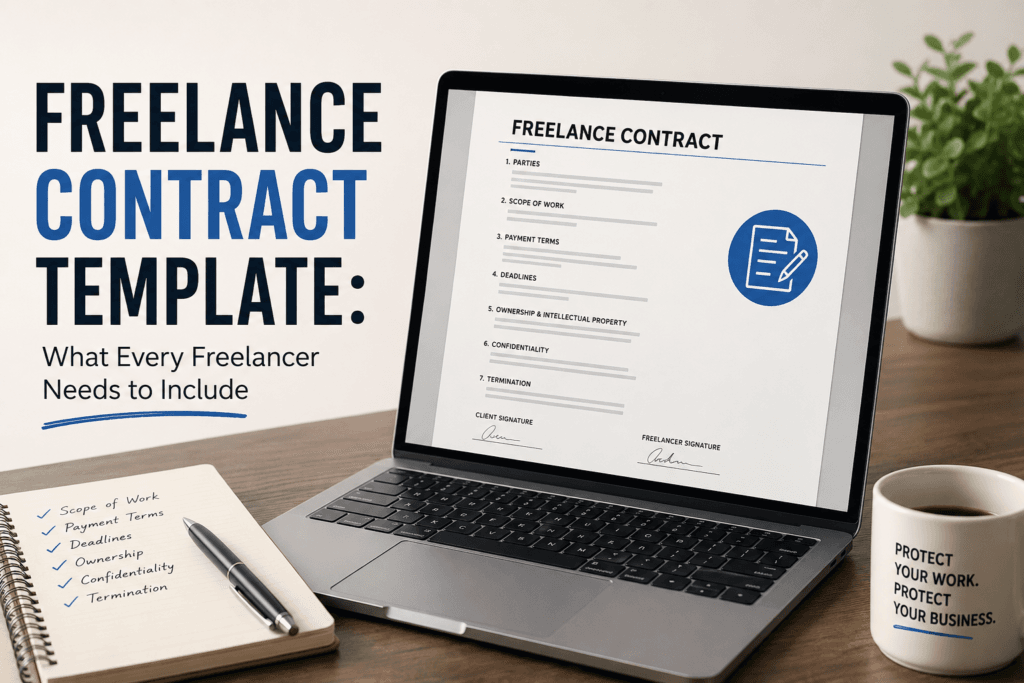
What a Freelance Contract Needs to Include
Every freelance contract should cover eight areas: scope, payment, timeline, revisions, intellectual property, confidentiality, termination, and signatures. Missing any single clause creates a gap that becomes a dispute when expectations do not match reality. Capital on Tap
Each of these elements deserves careful attention, because the devil genuinely lives in the details. Here is what each section needs to cover and why.
Element One: Party Information and Effective Date
Every contract begins by identifying who is entering into the agreement and when it takes effect. This sounds obvious but it is frequently done poorly, with vague or incomplete identification that creates confusion later.
Identify both parties by full legal name and business entity if applicable, and state when the contract takes effect. For example: “This agreement is between Jane Smith, doing business as Smith Design Co., and Acme Corporation, a Delaware corporation, effective as of the project start date.” GoCardless
Include the full legal names of both parties, their business entity type if relevant, their contact information including email addresses, physical addresses, and phone numbers. If the client is a company, include the name of the individual authorized to sign agreements on behalf of that company.
This section protects you in two specific ways. First, it confirms that you know exactly who is responsible for payment and fulfilment. Second, if you ever need to pursue a dispute through legal channels, you need the correct legal identity of the other party. Getting this wrong at the start creates real practical problems later.
Element Two: Scope of Work
The scope of work clause is the most important section in the entire contract, and the one that is most frequently written too vaguely to provide any actual protection.
The scope clause lists every deliverable the client receives, with quantities, formats, and specifications. “Brand identity package” is not a scope clause. “Three logo concepts in AI, EPS, SVG, and PNG formats; color palette document with hex, RGB, and CMYK values; typography guide; brand guidelines PDF of 20 to 30 pages” is a scope clause. Capital on Tap
The specificity here is not bureaucratic obsession. It is the foundation of every other protection the contract provides. If the scope is vague, every other clause is weakened because there is no clear reference point against which to measure whether the work has been done, done correctly, or done within the agreed parameters.
The scope should also state what falls outside the project. Exclusions prevent the single most common source of unpaid freelance labor: scope creep. “Copywriting, stock photography, website implementation, and print production are not included in this contract” is an exclusions clause. Without it, a client can argue that they expected those things to be included. Capital on Tap
Scope creep is the number-one source of unpaid labor for freelancers. A well-written scope of work prevents clients from expanding the project without paying for the additional work. GoCardless
For complex projects, attach a detailed Statement of Work as a separate document referenced in the contract. The main contract covers the legal structure. The Statement of Work covers the operational specifics. Together they create a complete picture that leaves no room for “I thought that was included.”
Also include a change order process in this section. Add a clause stating that any changes to project requirements must be approved in writing and may affect the timeline and cost. A resilient change control process that requires formal approval for scope changes protects you from gradual expansion that erodes your effective hourly rate without either party explicitly agreeing to it. CareerBldr
Element Three: Payment Terms
The payment clause is your primary payment protection. Be specific about every dollar. Specify the total project fee or hourly rate, payment schedule including deposit amount and timing plus milestone payments and final payment, accepted payment methods, invoice frequency, and due dates. GoCardless
Several specific decisions within this section deserve careful thought.
Deposit or upfront payment. Most experienced freelancers require a deposit before work begins. Most freelancers request 25 to 50% upfront. Jobbers The deposit serves two purposes. First, it creates financial commitment from the client, filtering out the casual inquiries from the serious ones. Second, it ensures you are not fully exposed if the client disappears or disputes the project before completion. Never start significant work without a deposit.
Milestone-based payments. For larger projects, breaking payment into milestone-linked installments is significantly safer than billing entirely at the end. Optimizing freelance contract payment terms with milestones and deposits lets you focus on work rather than chasing invoices. GoCardless Structure milestones around concrete deliverables, not just time periods. “Payment upon delivery of first draft” is a milestone. “Payment on March 15th” is a deadline that the client may or may not respect regardless of where the work stands.
Late payment penalties. Specify that invoices unpaid after the due date will accrue a late fee, typically 1.5 to 2% per month. Include your right to suspend work until overdue balances are paid. This clause motivates on-time payment and gives you leverage if you need to enforce collection. 10x Management
Right to pause work. Include explicit language stating that if payment is not received by the agreed date, you reserve the right to pause work on the project until the outstanding balance is settled. This is not aggressive or adversarial. It is a standard business protection that ensures you are not continuing to invest time in a project for a client who has not honored their financial obligations.
Element Four: Timeline and Delivery
The timeline section defines when work will be delivered and what happens when things change. It needs to address the project from both directions: your obligations to the client and the client’s obligations to you.
Define when deliverables are due and how delays will be handled. For example: “The freelancer agrees to submit the first draft by the agreed date and final files by the agreed completion date. Any delay due to late client feedback will extend the deadline proportionally.” This clarifies expectations and prevents you from being penalized for client delays. 10x Management
This reciprocal language is important and often overlooked. Many freelancers include their own delivery timeline but forget to document the client’s turnaround obligations. If a client takes three weeks to review and provide feedback on a draft, the project timeline extends by three weeks. That extension should be automatic per the contract, not something you have to argue for each time.
Define the start date clearly. “Upon receipt of deposit and signed contract” is a better trigger than a specific calendar date, because it makes the start of the project dependent on the client’s actions rather than exposing you to breach of contract claims if they delay their own side of the initiation.
Element Five: Revision Limits
Unlimited revisions is one of the most damaging phrases a freelancer can include in a proposal or contract. It sounds client-friendly at the point of sale and creates a financial black hole once the project is underway.
Revisions are part of creative work, but unlimited revisions can drain your time and profit. Specify the number of revision rounds included in the project fee. A clause might read: “This contract includes two rounds of revisions. Additional revision requests beyond those included will be billed at the hourly rate specified in this agreement.” 10x Management
Define clearly what constitutes a revision round versus a new direction. A revision is a modification of the existing deliverable based on specific feedback. A new direction, such as changing the entire concept or requesting something fundamentally different from what was briefed, is a separate project or a significant scope addition that warrants additional payment. Making this distinction explicit in the contract prevents the situation where a client cycles through conceptual changes indefinitely under the assumption that each round is still covered.
Element Six: Intellectual Property Rights
Intellectual property is the most frequently misunderstood and most consequential area of freelance contract law, and getting it wrong can have expensive long-term consequences for both parties.
Intellectual property ownership is the most frequently litigated issue in freelancer disputes. Many business owners assume they own the work product simply because they paid for it. That assumption is legally wrong. Under federal copyright law, the freelancer owns the copyright to original work unless a written agreement explicitly transfers ownership to the client. This principle applies even if the full fee was paid and the work was created specifically for the business. Without a clear assignment clause, the freelancer retains the right to reuse, license, or sell the same work to competitors. FreeUp
Your contract needs to address this explicitly. The standard approach is a transfer of intellectual property rights upon receipt of full payment. A clause might read: “All intellectual property rights transfer to the client only after full payment has been received.” This protects you from losing control or credit for unpaid work. 10x Management
The timing condition is important. By tying the transfer to full payment, you retain legal ownership of the work as leverage if a payment dispute arises. A client who has not paid in full does not own the deliverable, which is a meaningful legal and practical protection.
Also specify whether you retain the right to include the work in your professional portfolio. Many clients agree to this without hesitation, but if the work involves confidential information or the client has specific competitive concerns, they may want to restrict portfolio use. Having this conversation upfront and including the outcome in the contract prevents awkwardness later.
If the project involves any third-party materials like licensed fonts, stock images, or software libraries, specify who is responsible for obtaining and paying for those licenses. Leaving this vague creates exposure if a licensing issue arises after delivery.
Element Seven: Confidentiality
Many freelance projects involve access to sensitive business information. Client strategies, financial data, customer lists, unreleased products, and internal processes all fall into this category. A confidentiality clause, often called a non-disclosure agreement or NDA, establishes your obligations around how you handle that information.
If you access sensitive business information, include a basic NDA clause. Keep it reasonable. You should not be bound by confidentiality forever, and it should not prevent you from doing similar work for other clients. iHire
A balanced confidentiality clause specifies what information is considered confidential, how long the confidentiality obligation lasts, what exceptions apply such as information that is publicly available or that you knew independently before the project, and crucially, that the clause does not prevent you from working with other clients in the same industry.
Watch out for confidentiality clauses in client-provided contracts that are excessively broad, covering information you cannot realistically identify as confidential or restricting you in ways that would prevent normal professional activity. These clauses are sometimes used intentionally to create leverage over freelancers rather than to protect legitimate business interests.
Element Eight: Termination and Kill Fee
Projects do not always run to completion. Clients change priorities, budgets are cut, businesses pivot, or the working relationship simply does not work out. Your contract needs to address what happens in all of these scenarios before they arise.
Include how much notice is required, typically 14 or 30 days, how that notice should be given, usually in writing, and what happens to any unfinished work or payments. Enterprise Nation
The kill fee is perhaps the most important element of the termination clause and the one that most beginner freelancers leave out entirely. A kill fee is a payment the client owes you if they cancel the project after work has begun, regardless of whether the final deliverable is complete.
A kill fee for early termination is typically 25 to 50% of the remaining project value. This compensates you for the time you have invested, the opportunity cost of turning away other work to accommodate this project, and the disruption to your schedule that the cancellation creates. iHire
Without a kill fee clause, a client can wait until you are three-quarters of the way through a project, receive everything useful from what you have produced so far, and then cancel without paying anything beyond the deposit. The kill fee is what prevents that situation.
Also specify what happens to deliverables in the event of termination. Does the client receive and own what has been completed up to the point of cancellation? Or does intellectual property only transfer upon payment of the full contracted amount? Define this clearly so there is no ambiguity about what the client receives and what they have paid for.
Element Nine: Dispute Resolution
Even with the most comprehensive contract, disputes can arise. The dispute resolution clause establishes the process for handling them without immediately escalating to expensive litigation.
Your freelance contract should have a dispute resolution clause that spells out specific steps for disagreements. Mediation works as a great first formal step. Freelancers who use structured protocols solve disputes 90% more effectively. Courts now expect you to try mediation before litigation, which gives both practical and legal advantages. CareerBldr
A well-structured dispute resolution clause typically requires both parties to first attempt to resolve the issue through direct negotiation within a defined timeframe, typically five to ten business days. If that fails, the clause escalates to formal mediation with a neutral third party. Only if mediation fails does the clause permit either party to pursue legal action.
Specify which state’s law governs the contract and how disputes will be resolved, whether through informal negotiation first, then arbitration, or small claims court. GoCardless
The governing law clause is particularly important for international freelance work. When you are working with a client in a different country, which country’s legal system governs the contract? This needs to be specified rather than left to assumption. In practice, many international freelance contracts specify binding arbitration as the dispute resolution mechanism precisely because arbitration is more enforceable across borders than court judgments from a specific jurisdiction.
Element Ten: Liability Limitation
Freelancers can be exposed to significant liability claims if something goes wrong with a deliverable after delivery. A liability limitation clause caps what the client can claim from you in the event of a problem.
Limit your liability to the total project fee. You should not be on the hook for indirect damages, lost revenue, or problems caused by the client’s misuse of your deliverables. iHire
This is a standard and widely accepted clause. You are agreeing to make the client whole up to the value of what they paid you, but not beyond that. Without this clause, a dissatisfied client could theoretically argue that your work caused them significant consequential damages and pursue claims many times the value of the project fee.
Include a clause stating that you make no warranties about specific results. A copywriter cannot guarantee that a piece of content will achieve a particular search ranking. A designer cannot guarantee that a logo will resonate with every customer segment. State that your obligation is to deliver the agreed work to a professional standard, not to guarantee specific business outcomes.
The Signature Block
Every contract needs to be signed by both parties before work begins, and the signature needs to be collected in a way that is legally enforceable.
Electronic signatures are legally valid in most jurisdictions and significantly more practical than physical signatures for remote freelance work. Tools like DocuSign, HelloSign, and PandaDoc allow contracts to be sent, reviewed, and signed digitally with a complete audit trail of who signed, when, and from which device. That audit trail is valuable evidence in a dispute.
Always send the contract before starting any paid work. This ensures you are protected from day one. Use e-signature tools to get quick signatures. Physical signatures work too, but they are slower. Hireinsouth
Never start work based on a verbal agreement to sign the contract later. “The contract is on its way, just get started so we don’t lose time” is one of the most common ways clients, intentionally or unintentionally, end up working without a signed agreement in place. The signed contract is the starting gun. Nothing begins before it crosses the finish line.
Red Flags in Client Provided Contracts
Sometimes clients send you their own contract rather than accepting yours. This is common with larger businesses that have standard vendor agreements. Review these carefully before signing, because they are written to protect the client’s interests, not yours.
Watch out for “work for hire” language, which means you have zero rights to anything you create including reuse of your own methods and tools. Watch for non-compete clauses that restrict you from working with others in your industry. Watch for unlimited revisions language, which always caps revision rounds in your favor. Watch for payment on “acceptance” without defining what acceptance means, which creates an indefinite approval loop. And watch for the absence of a termination clause, which means you have no exit strategy. Escrow
Dispute resolution clauses often specify which state’s law governs the contract and where disputes must be filed. If a client insists on a jurisdiction that would create substantial travel costs and inconvenience if you ever needed to enforce your contract, push for your own jurisdiction or agree on binding arbitration in a neutral location. Escrow
You are not obligated to sign a client’s contract as presented. Negotiating contract terms is a normal part of professional engagement, and most clients respect a freelancer who knows what they need and asks for it clearly. If a client refuses to negotiate genuinely one-sided contract terms, that itself is a meaningful signal about how the working relationship is likely to go.
Tools for Creating and Managing Freelance Contracts
Writing a contract from scratch for every new project is neither necessary nor efficient. A well-crafted template that you customize for each engagement is a far better approach.
Bonsai is one of the most complete freelance business platforms available, offering contract templates designed specifically for independent workers, proposal creation, time tracking, invoicing, and client management in one integrated system. The contracts are built around the clauses that matter most for freelancers and are recognized as legally sound in most major jurisdictions.
AND.CO by Fiverr provides similar functionality with a focus on simplicity, offering clean contract templates, e-signature integration, and invoice management that connects directly to the contract terms.
Hellosign is worth knowing as a standalone e-signature tool for freelancers who prefer to manage their own contract documents but want a reliable, legally recognized way to collect signatures.
For freelancers who work across borders and need contracts that are enforceable in multiple jurisdictions, consulting a lawyer to review your standard template at least once is a worthwhile investment. Not to draft the entire contract from scratch, but to ensure that the terms you are using hold up in the legal contexts where you most frequently work.
Pairing Your Contract With Payment Protection
A strong contract is the first layer of financial protection for a freelance engagement. The second layer, particularly important for cross-border work and new client relationships, is secure payment handling.
Blockchain and escrow systems have reduced payment disputes by 35% on leading freelance platforms, offering a reliable mechanism for improved payment security. GoCardless
Even with a perfectly written contract, chasing a client in another country for an unpaid invoice through legal channels is time-consuming, expensive, and uncertain. The contract tells you what you are owed. It does not always make collection easy. Escrow-based payment protection addresses this by ensuring that client funds are secured before work begins and released to you upon confirmed delivery, regardless of where either party is located.
Xcrow is built specifically for this purpose, providing escrow-based protection for digital and freelance transactions. The client deposits the project fee into escrow before you start. The funds are held securely by a neutral third party throughout the project. When you deliver the work and the client confirms receipt, the payment is released to you. Neither party has to take a financial leap of faith, which makes the working relationship significantly less stressful from the first conversation.
For a deeper understanding of how escrow-based payment protection works and why it has become the standard for professional online transactions, read our article on what escrow is and how it protects buyers and sellers online.
The combination of a clear, well-structured contract and an escrow-backed payment process gives you comprehensive protection for both the scope and the financial side of every project. The contract defines what is agreed. The escrow ensures that the money is there. Together they create the professional foundation that turns freelancing from a precarious hustle into a genuinely secure business.
The Mindset Shift That Makes Contracts Work
Beyond the legal mechanics, there is a mindset dimension to contracts that experienced freelancers come to understand over time. A contract is not a sign of distrust. It is a sign of professionalism. It is a document that says: I take my work seriously, I take your project seriously, and I want both of us to have complete clarity about what we have agreed to so that nothing gets in the way of a great outcome.
Clients who respond negatively to being asked to sign a contract before work begins are telling you something important about how they approach business relationships. That information is valuable to have before you have invested time and energy in the project, not after.
The freelancers who have the smoothest client relationships are almost always the ones who invest most consistently in clear agreements. Not because the agreements resolve every possible problem, but because the process of working through a contract forces both parties to get specific about expectations before any misalignment has a chance to develop into a dispute.
A good contract takes thirty minutes to write and can save you thousands of dollars and weeks of wasted time. That is one of the most favorable time investments available in the entire freelance business. Make it a non-negotiable part of every engagement you take on.
What to Do When a Client Pushes Back on the Contract
Some clients, particularly individuals and small businesses that are new to working with freelancers, find the formality of a written contract surprising or even off-putting. How you handle this reaction matters.
Do not apologize for having a contract. Instead, frame it as being in both parties’ interests. Something like: “I use a contract for every project I work on because it makes sure we both have complete clarity on what is being delivered, when, and for how much. It protects both of us and means we can focus on the work rather than on any ambiguity about expectations.”
That framing is entirely honest. A contract does protect both parties. A client who understands that tends to become comfortable with it quickly. A client who remains resistant after a genuine explanation of the mutual benefit is someone whose resistance deserves careful thought.
If a client is unwilling to sign anything because the project is very small, consider a simple one-page letter of agreement rather than a comprehensive contract. Even a short document that covers the deliverables, the price, and the timeline provides more protection than a verbal agreement and is less intimidating for clients who are unaccustomed to formal agreements.
Final Thoughts
A freelance contract is not a legal formality or a sign of a contentious relationship. It is the professional infrastructure that makes every freelance engagement safer, clearer, and more likely to end well for everyone involved.
The clauses covered in this guide are not arbitrary. Each one was forged from the real-world experience of freelancers who discovered, often at significant personal cost, that leaving it out was a mistake. The scope clause prevents the project from expanding without compensation. The payment terms prevent delays and non-payment. The intellectual property clause ensures you know who owns what and when. The termination and kill fee clause protects you if the client walks away mid-project. Together they create a document that does exactly what a good agreement should: it removes ambiguity and replaces it with clarity.
Build your template. Customize it thoughtfully for each new project. Send it before you do a single hour of work. And pair it with secure payment tools from the very start.
If you want to understand how to use escrow-based payment protection alongside your contracts to fully protect your freelance income, read more on how Xcrow works for digital transactions.
Related reads you might find useful:
How to Write a Freelance Proposal That Actually Wins Projects
How to Get Your First Client on a Freelance Marketplace: Step by Step

Israel Otoijamun is the founder of Xcrow, an AI-powered freelance marketplace connecting businesses with remote professionals. He has over 15 years experience in digital business, freelancing, technology, and online platforms. He writes about freelancing, remote work, hiring, digital payments, and the future of online work.