
Client says, “Deliver first, I pay later.” If you are a junior freelancer, that sentence can sound normal, especially when the client is friendly, confident, or comes through a referral. But do not rush to say yes. You are not being difficult by asking for payment protection. You are protecting your time, your skill, and the income you need to keep your business running.
Quick answer: Do not deliver the complete project before payment is secured. Use a written agreement, clear milestones, defined revisions, and an escrow or deposit arrangement that protects both sides.
1. Client says “deliver first, I pay later” — Why you should be cautious about delivering before payment is secured.
Let us be real: when you deliver the full work before payment, you carry almost all the risk. The client gets the website, logo, copy, design, video, strategy, or other deliverable in their hands. You are left hoping they will pay when they promised.
Sometimes they will pay. Sometimes they will delay with stories like, “My accountant is processing it,” “The person who approves payments is away,” or “Please give me two more days.” And sometimes they disappear completely. By then, the work is already done, your negotiating power is low, and getting your money may take more time and energy than the original project.
There is another problem: “Pay after delivery” often quietly changes into “Pay after we are fully satisfied.” That can mean endless revisions, new requests, extra pages, additional features, or a completely different idea from what you agreed at the beginning. If no money is secured and the scope is not written down, the client can keep moving the goalpost while you keep working for free.
This does not mean every client is dishonest. It means the arrangement is weak. Good business systems do not depend on guessing whether someone is trustworthy. They reduce the risk for both people before the work starts.
Think of it this way: your client would not normally ask a shop to hand over a phone and promise to pay whenever they feel ready. Your work is also something valuable. Treat it like a real business transaction.
2. Why clients say that — they have been scammed too
Before you get angry, understand where the client may be coming from. Some clients have paid freelancers upfront and received poor work, late delivery, copied work, or nothing at all. They may have been ignored after sending money. They may have had to chase someone for weeks just to get a refund or an explanation.
So when a client says, “I will pay after delivery,” they may not be trying to cheat you. They may be trying to avoid being cheated again. From their side, sending money before seeing progress feels risky. Their fear is real, even if their proposed solution creates too much risk for you.
This is where many junior freelancers make a mistake. They hear the request as an insult: “The client does not trust me.” Then they become defensive, start arguing, or send a long emotional message. That usually makes the conversation worse.
A better approach is to acknowledge the concern and offer a safer process. You can say, in simple terms: “I understand you want protection because you have had a bad experience before. I also need protection so I am not working without payment. Let us use a process that protects both of us.”
That process can include a clear brief, milestones, a small upfront payment, limited revisions, written approval, and escrow. You do not need to make the client feel bad for being careful. You just need to make sure their caution does not turn into unpaid work for you.
3. What is escrow?
Think of escrow as a neutral payment arrangement where the agreed funds are held until the conditions for releasing them are met.
In a normal escrow arrangement, the client places the agreed project funds with a trusted escrow service before you begin. The money is held there instead of being sent straight to you or left entirely with the client. You complete the agreed work and submit it for review. Once the client approves it, the funds are released to you according to the service rules.
The key point is that neither side has to rely only on promises. The client knows the money has been set aside for the project. You know the money is already committed and is not dependent on the client suddenly changing their mind after delivery.
Escrow is not magic, and you still need a written agreement. Before starting, confirm the exact deliverables, deadline, payment amount, number of revisions, approval process, and what happens if there is a dispute. Also check the escrow service’s fees, release rules, identity checks, withdrawal options, and dispute process. Never assume every service works the same way.
For more details, read how Xcrow escrow, milestones, and disputes work.
4. Three copy-paste WhatsApp scripts
Script 1: Short and polite
Copy and send:
“I understand you prefer to pay after delivery. To protect both of us, can we use escrow? You fund the project first, I deliver the agreed work, and the money is released after you approve it. That way, you are protected from poor delivery and I am protected from doing the work without payment.”
This is a good first response when the client seems reasonable and the project is small or mid-sized. It is calm, short, and does not accuse the client of anything. The phrase “protect both of us” matters because it shows that escrow is not only for your benefit.
Script 2: Firm but respectful
Copy and send:
“I do not start full projects on a deliver-first, pay-later basis. My process is to have the agreed amount secured through escrow before work begins. I will deliver according to the brief, include the agreed number of revisions, and submit the final work for your approval. If that process works for you, I am happy to proceed.”
Use this when the client keeps pushing after you have already explained your position. Notice that the message does not sound rude. It simply states your process.
Script 3: For bigger clients or larger projects
Copy and send:
“For a project of this size, I suggest we use a milestone-based escrow arrangement. We will document the scope, timeline, deliverables, revision limit, approval window, and release conditions. The first milestone is funded before work starts. I submit each milestone for review, and funds are released after approval. This gives your team visibility and control while keeping payment tied to completed work. If there is a disagreement, we can use the escrow service’s dispute process instead of relying on informal promises.”
This version works better for companies, agencies, and larger jobs because bigger clients often need a process they can explain internally. For a large project, break it into clear stages such as discovery, first draft, revisions, testing, and final delivery.
5. How the escrow process works
| Stage | What happens |
|---|---|
| 1. Client funds escrow | The client places the agreed project amount with the escrow service. |
| 2. Freelancer delivers | You complete and submit the work described in the agreement. |
| 3. Client approves | The client checks the delivery against the brief and confirms that the milestone is complete. |
| 4. Money releases | The escrow service releases the funds according to its rules. |
Simple diagram:
Client funds escrow → Freelancer delivers → Client approves → Money releases
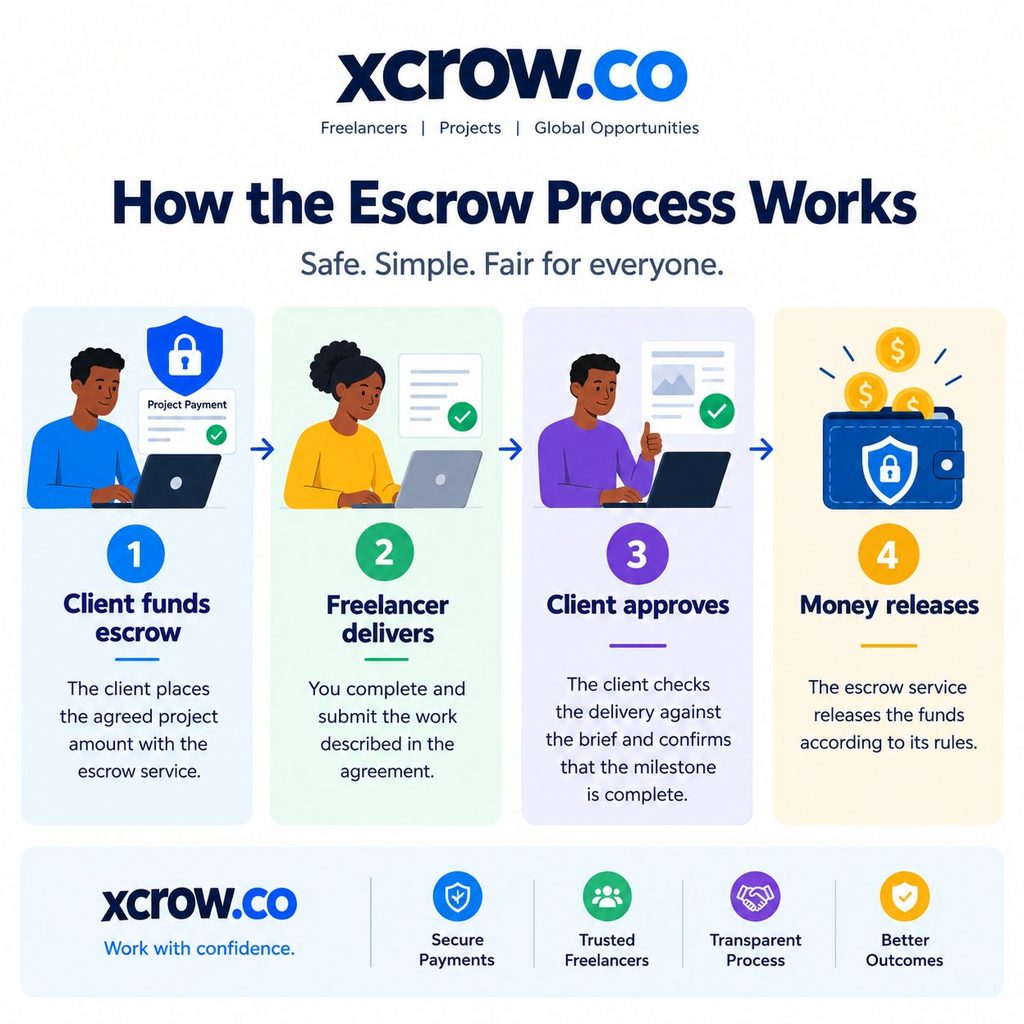
For milestones, the same process repeats in smaller sections. Each stage should have a clear definition of “done.” Label your delivery clearly and request one consolidated list of changes to keep the review process organised.
6. What to do if the client still refuses
If the client refuses escrow, refuses a deposit, refuses milestones, and still insists that you deliver everything first, the cleanest move may be to walk away. You do not need to fight or prove that they are a scammer. You only need to recognise that the payment arrangement does not work for your business.
You can send this message:
“Thanks for explaining your preferred process. I understand it, but I cannot take on the project without payment protection. Since escrow or a secured milestone arrangement will not work here, I will have to decline this project. I wish you the best with it.”
Some clients will come back after seeing that you are serious. Others will move on. Either result is better than spending two weeks on a project while worrying about whether you will be paid.
For broader freelancing advice, see the complete guide to freelancing in Nigeria.
7. FAQ
Is escrow safe?
Escrow can reduce payment risk because the money is secured before you deliver, but the safety depends on the service and the terms. Check that it is legitimate, understand its fees, confirm how disputes are handled, and verify when funds can be released or withdrawn. Escrow does not replace a contract or a clear brief.
How long does it take to get the money?
It depends on the escrow service, release conditions, client approval, dispute rules, identity checks, and withdrawal method. Check the exact timeline and fees before accepting the project instead of promising an arrival time you cannot control.
Should I ask for a deposit instead of escrow?
A deposit is often practical for smaller projects. You might agree on a percentage before starting, another payment at a milestone, and the balance before final handover. Choose the arrangement that matches the project size, client relationship, and amount of risk.
Should I send the final files before the payment is released?
Agree on this before work begins. You can often send a review version, preview link, watermarked file, or limited-access version while the client checks the work. Handle editable source files and final transfer according to the written payment and delivery terms.
What if the client keeps asking for changes?
Go back to the brief and revision limit. If the requested change is included, handle it professionally. If it is new work, explain that it is outside the agreed scope and quote it separately. Escrow protects payment, but scope control protects your time.
Final advice
You do not need to sound like a lawyer to protect yourself. Speak plainly, show empathy, and offer a process that is fair to both sides. The client should not have to pay for work they never receive, and you should not have to deliver valuable work while hoping payment appears later.
For transparency, review the site’s Editorial Policy, Fact-Checking Policy, and Advertising & Affiliate Disclosure. These links improve reader trust and support a quality-focused publishing site.
If they refuse every reasonable payment safeguard, walk away politely. A project is not a good opportunity if the payment risk can wipe out all the value of the work.
Recommended Articles
Why We Built Escrow Into Xcrow: A Guide to Safer Freelance Payments
How Xcrow Escrow, Milestones, and Disputes Work: A Practical Guide
What Is Escrow? How It Protects Online Buyers and Sellers

Israel Otoijamun is the founder of Xcrow, an AI-powered freelance marketplace connecting businesses with remote professionals. He has over 15 years experience in digital business, freelancing, technology, and online platforms. He writes about freelancing, remote work, hiring, digital payments, and the future of online work.