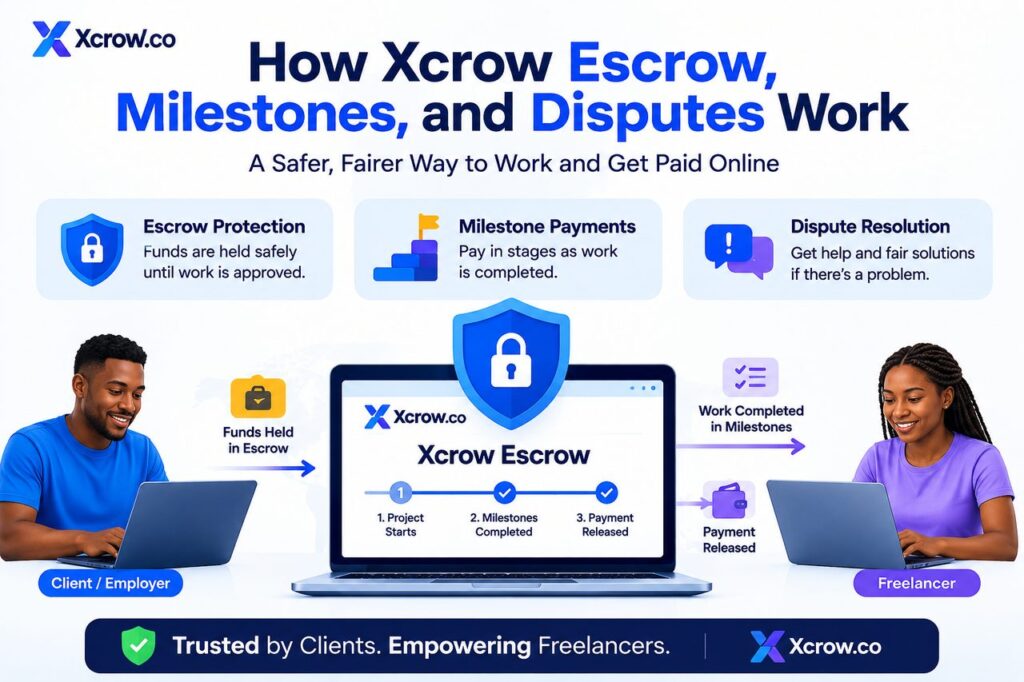
Online freelance projects rarely fail because one person is automatically dishonest. More often, problems begin with a vague brief, an unrealistic deadline, unclear revisions, delayed feedback, or payment expectations that were never written down. Xcrow is designed to make these working relationships more structured through project records, milestones and escrow-based payment processes.
This guide explains how escrow, milestones and disputes should work in practice on Xcrow, while also being realistic about what the platform can and cannot do. Escrow can reduce payment risk, but it does not guarantee perfect work, instant refunds, a successful outcome or a particular dispute decision. The strongest protection still comes from a clear agreement, honest communication and evidence of what both sides accepted.
How Escrow Works on Freelance Marketplaces
Escrow is a payment arrangement designed to create a layer of separation between a buyer and a seller during a transaction. Instead of the client paying the freelancer directly and immediately, the agreed funds are placed with a third party or payment service under specified conditions. The funds are then released according to the terms of the transaction.
The basic idea is simple: the client commits the money, the freelancer completes the agreed work, and the payment is released when the conditions for release are met.
Escrow arrangements are used in different types of transactions, and the exact rules vary depending on the service, contract, jurisdiction, and type of transaction. For example, the Consumer Financial Protection Bureau explains escrow accounts as arrangements in which money is held and managed for a specific purpose.
In freelance marketplaces, this concept can be adapted to the relationship between a client and a freelancer.
A Typical Freelance Escrow Process
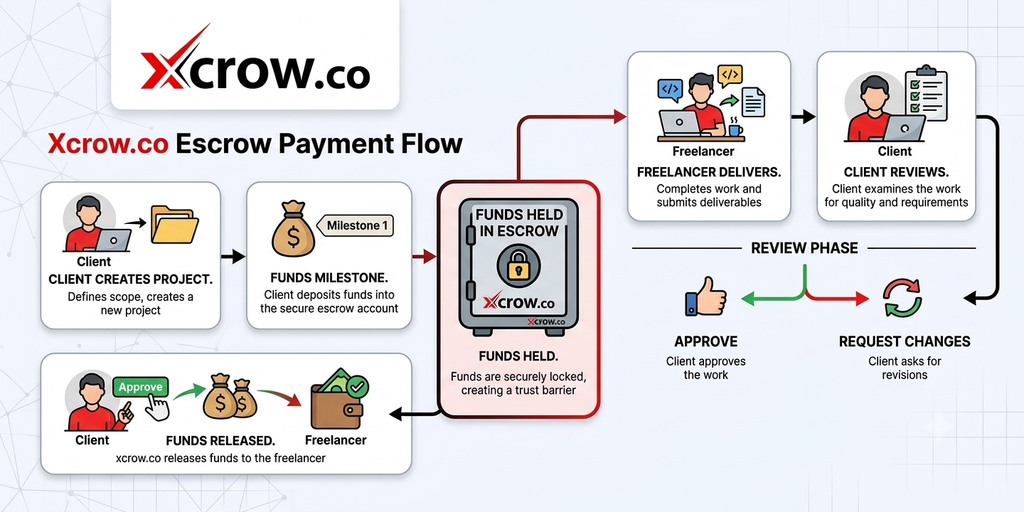
A freelance escrow arrangement generally follows a process similar to this:
1. The client and freelancer agree on the work
Before any money is committed, both parties should agree on what will be delivered, the price, the deadline, and any other important project requirements.
2. The client funds the agreed amount
The client provides the funds required for the project or for a particular milestone. Depending on the marketplace, those funds may be held according to the platform’s payment and escrow terms rather than being immediately transferred to the freelancer.
3. The freelancer works on the project
Once the project or milestone is properly funded, the freelancer begins working on the agreed deliverables.
4. The freelancer submits the work
The completed deliverables are submitted through the agreed process. The client can then review the work against the requirements that were originally agreed upon.
5. The client approves the deliverables
If the work meets the agreed requirements, the client approves the milestone or deliverable and the funds can be released according to the applicable terms.
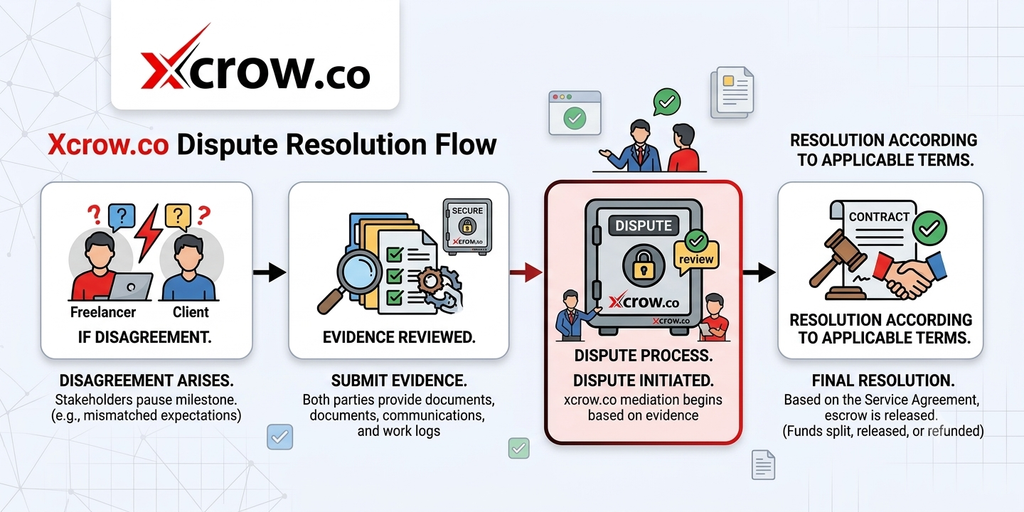
6. A disagreement can trigger a dispute process
If the parties disagree about whether the requirements have been met, the transaction may enter a dispute or review process, depending on the marketplace’s rules. Documentation such as the original project requirements, messages, submitted files, revisions, and other relevant evidence can help establish what was agreed and what was delivered.
For example, Upwork’s guidance on fixed-price milestones explains that milestones can divide a project into phases with individual deliverables, deadlines, and payments. Its dispute guidance also describes how documentation and the original milestone agreement can be relevant when a payment dispute occurs.
Why Escrow Can Be Useful for Freelance Work
Freelance projects can involve uncertainty for both sides.
A client may be concerned about paying for work that is never completed. A freelancer may be concerned about completing work without receiving payment. Escrow is intended to introduce a structured payment process that addresses some of these concerns.
However, escrow does not eliminate every risk.
It does not automatically mean that the freelancer’s work will be perfect, that every dispute will result in a refund, or that either party will always receive the outcome they expect. The protection available depends on the platform’s rules, the agreement between the parties, the evidence available, and the circumstances of the transaction.
This is why clear project requirements and well-defined milestones remain important even when escrow is used.
Escrow and Milestones
For larger freelance projects, breaking the work into milestones can make the payment process easier to manage.
For example, a website development project could be divided into:
- Milestone 1: Website planning and design
- Milestone 2: Homepage and core pages
- Milestone 3: Functionality and integrations
- Milestone 4: Testing and final delivery
Instead of treating the entire project as one transaction, each stage can have its own deliverables, deadline, and payment conditions.
This gives both parties clearer checkpoints throughout the project. The client can evaluate progress at defined stages, while the freelancer has a clearer understanding of what needs to be completed before payment for each milestone is released.
Major freelance marketplaces use similar milestone-based structures. For example, Upwork’s milestone guidance recommends defining a clear deliverable, estimated delivery date, and agreed payment amount for each milestone.
Escrow Does Not Replace a Good Freelance Agreement
One important point is that escrow should not be viewed as a replacement for clear communication or a well-defined project agreement.
Before work begins, clients and freelancers should clearly establish:
- What is being delivered
- What is not included
- The deadline for each milestone
- The amount associated with each milestone
- How revisions will be handled
- What constitutes completion
- What happens if the project changes
- How disagreements will be handled
The clearer these terms are, the easier it can be for both parties to understand their responsibilities.
Keeping project communication and documentation organized can also be valuable if a disagreement occurs. Freelance platforms may use the project agreement, messages, submitted work, and other documentation when reviewing disputes.
How Xcrow Applies This Model
Xcrow uses the same basic principle of creating a structured payment process for freelance transactions, while combining it with projects, milestones, approvals, and dispute handling.
The exact process, payment methods, fees, timelines, and dispute procedures are governed by Xcrow’s current platform terms and policies. Users should review those terms before entering into a transaction.
The next sections explain how escrow, milestones, approvals, and disputes work specifically on Xcrow, including what clients and freelancers should do at each stage of a project.
What Xcrow is trying to solve
Xcrow is an AI-powered freelance marketplace operated by Travla Property Management Ltd, a Nigerian company registered with the Corporate Affairs Commission under registration number 8248515. The platform was founded in 2024 with a focus on connecting African professionals with businesses and supporting freelance work across borders and currencies. You can learn more about the company and its team on the Xcrow About Us page.
In practical terms, Xcrow brings together freelancer discovery, proposals, project communication, milestones and payment information. That structure is useful, but users should still review the current terms shown during a project. Available payment methods, supported currencies, fees, verification requirements and processing times may vary depending on the service and payment provider available at the time of funding.
What escrow means in practice
Escrow is a holding process. A client commits funds for agreed work, but the freelancer does not necessarily receive them immediately. The funds may remain temporarily held until the applicable milestone is reviewed, approved or otherwise handled under the project terms. This can help a client avoid paying the full amount before receiving the work and can help a freelancer avoid completing substantial work without a defined payment process.
Escrow is not a substitute for an agreement. It does not mean that a client can reject work simply because they changed their mind, and it does not mean that a freelancer can ignore missing deliverables or agreed quality requirements. The result depends on the project terms, the evidence available, the actions of both parties and the applicable Xcrow process.
Before funding a project, check the amount, currency, fees, milestones, approval conditions and any relevant refund or dispute terms displayed by Xcrow. For the platform’s current legal and payment information, review the Terms of Service and Refund and Returns Policy.
Why milestones matter
Milestones divide a large project into manageable checkpoints. They allow the client to review progress before the entire assignment is complete and give the freelancer a chance to receive direction before investing more time. Milestones are especially valuable for website development, branding, research, content campaigns and other work where the final result depends on several decisions.
A content project might use topic research, outline, first draft and final revision. A brand project might use discovery, concept direction, selected design and final files. A website project might use sitemap and wireframes, visual design, implementation, testing and handoff. The exact structure should reflect the work rather than copy a generic template.
What makes a good milestone?
A good milestone is observable, reviewable and connected to a specific deliverable. “Research phase” is weaker than “keyword list, source notes and a proposed outline delivered.” “Design work” is weaker than “three homepage concepts presented in the agreed format.” A milestone should explain:
- What files, services or outcomes will be delivered.
- When the delivery is expected.
- How many revisions are included.
- What the client must provide before work can continue.
- What standard or acceptance criteria will be used.
- How approval or requested changes will be communicated.
Specific criteria help both parties. They give the client something practical to review and give the freelancer a fair target to meet. They also create useful evidence if the project later becomes difficult.
Client responsibilities
Escrow does not allow a client to become passive. Clients should provide the brief, brand assets, access, reference materials and decisions needed for the freelancer to work. If the client delays feedback or fails to supply essential information, the project timeline may be affected. That delay should be documented clearly rather than treated as an unexplained freelancer failure.
Clients should review deliveries promptly and give specific feedback. “Make it better” is difficult to act on. “Use the approved product description, increase the headline contrast and keep the existing call-to-action” is actionable. If the client requests a new page, extra feature or additional revision, the request may be a scope change rather than part of the original milestone.
Clients should also avoid approving work before checking it properly. Approval can affect the next stage of a project, so it is better to review the agreed criteria carefully and raise a clear issue while the relevant milestone is still open.
Freelancer responsibilities
Freelancers should define what is included and excluded before work begins. They should clarify deliverables, file formats, revision limits, dependencies, availability and response times. If the brief is incomplete, asking questions is safer than silently guessing what the client wants.
Freelancers should provide visible progress and organised handoffs. A short update, preview or explanation can prevent a small misunderstanding from becoming a major rework request. If a deadline, technical dependency or scope issue creates a problem, it should be reported early with a realistic proposed solution.
Freelancers should not claim credentials, experience, results or ownership of work that they cannot support. A credible profile explains the person’s actual role and presents portfolio work honestly. Clients can also review these seven red flags to watch for in freelancer profiles on Xcrow before hiring.
How disputes should be handled
Not every disagreement is a formal dispute. A clarification, small correction or reasonable deadline adjustment can often be resolved through a calm conversation. A dispute becomes more serious when the parties cannot agree on whether the delivered work meets the written terms or when payment, cancellation or scope cannot be settled.
The first step is to return to the project record. Compare the original brief, milestone definition, delivery, approval messages, revision requests and any documented changes. Ask five factual questions:
- What was promised?
- What was delivered?
- What was approved or rejected?
- Did the requirements change after work began?
- What evidence supports each position?
Keep communication factual and focused on a proposed next step. A useful message identifies the current status, the unresolved issue, the relevant evidence and a reasonable response deadline. Avoid personal attacks, threats or unsupported accusations. If the matter needs to enter Xcrow’s dispute process, follow the instructions and deadlines shown in the relevant project or terms.
What evidence is useful?
Useful evidence can include the original scope, milestone descriptions, files delivered, dated messages, approval notices, revision requests, invoices or payment records and notes about client-provided materials. Keep the information organised and avoid editing old messages to make the timeline look different.
Evidence is strongest when it was created during the project, not assembled only after a disagreement. This is one reason to keep important decisions in the platform’s approved communication and project workflow where possible. Do not share passwords or unnecessary personal information in project messages.
Xcrow.co Escrow Payment Flow
Xcrow.co Dispute Resolution Flow
The realities of using Xcrow
Xcrow can provide structure, but it cannot remove every risk from freelance work. A match is only a starting point: users remain responsible for checking suitability, scope and terms. Escrow may help organise payment protection, but payment processing can involve verification, provider rules, bank or card policies, currency conversion and delays. A payment option is available only when it is displayed in the relevant Xcrow funding or checkout process.
Users should also expect that good outcomes require active participation. A client who gives late feedback can delay a project. A freelancer who accepts work outside their skill level can create quality problems. AI-assisted matching or project tools may support discovery and organisation, but they do not replace human judgment, portfolio review, a clear brief or careful testing.
For freelancers starting on the platform, the beginner’s guide to making your first $100 on Xcrow explains why focused services, honest profiles, sustainable pricing and clear deliverables matter. There is no guaranteed income, fixed timeline or promise that every proposal will receive a response.
A practical project example
Imagine a client hiring a freelancer to build a three-page website. The first milestone covers the sitemap and wireframes. The second covers approved visual design. The third covers responsive implementation, testing and handoff.
The client funds the agreed milestone, the freelancer delivers the defined work and the client reviews it against the brief. If the client asks for two additional pages after approving the sitemap, that request should be recorded as a scope change with its own price and timeline. If a disagreement arises about a layout, both parties can refer to the approved wireframe and written change requests instead of relying on memory.
How to prevent disputes
- Write the scope in plain language.
- Define acceptance criteria for every milestone.
- State the included revision rounds and the cost of extra work.
- Record changes before the freelancer continues.
- Keep important decisions in one clear project record.
- Provide feedback and approvals promptly.
- Keep evidence of deliveries, approvals and handoffs.
- Review the current Xcrow payment, refund and dispute terms before funding.
FAQs
Is escrow the same as instant payment?
No. Escrow is a holding process connected to agreed conditions. Funds may remain held until a milestone is reviewed, approved or handled under the applicable project terms.
Does escrow guarantee perfect work?
No. Escrow supports a more structured payment process, but it does not guarantee quality, a refund or a particular dispute outcome. Quality still depends on the brief, the freelancer’s work and the client’s review.
Do all Xcrow projects need milestones?
Not every small assignment needs several stages, but multi-step or higher-risk projects usually benefit from milestones. The number of milestones should match the work’s complexity.
What should I check before approving a milestone?
Compare the delivery with the written scope, acceptance criteria, file requirements, deadline and included revisions. Raise specific issues before approving if the work does not match the agreement.
What usually causes freelance disputes?
Common causes include unclear scope, changing expectations, undocumented revisions, missed communication, late feedback and payment arrangements that were not understood before work started.
Can Xcrow guarantee that a freelancer or client is trustworthy?
No platform can remove the need for judgment. Review profiles, ask relevant questions, confirm the scope, use the available project workflow and keep important records.
What happens if a project stalls?
Identify whether the cause is missing client information, delayed feedback, missed freelancer delivery or a changed requirement. Document the facts, propose a specific next step and use the applicable Xcrow process if the issue cannot be resolved directly.
Conclusion
Xcrow’s escrow and milestone workflow is most useful when both sides treat it as a project management system, not only a payment feature. Clear deliverables, realistic deadlines, written changes, steady communication and timely reviews make disputes less likely and make difficult conversations easier to assess.
The realistic promise is not that every project will be problem-free. It is that a structured process can make expectations, payments and evidence clearer when people work across borders, currencies and time zones. Review the current Xcrow terms before committing funds, communicate honestly and take responsibility for the decisions your side of the project requires.

Israel Otoijamun is the founder of Xcrow, an AI-powered freelance marketplace connecting businesses with remote professionals. He has over 15 years experience in digital business, freelancing, technology, and online platforms. He writes about freelancing, remote work, hiring, digital payments, and the future of online work.