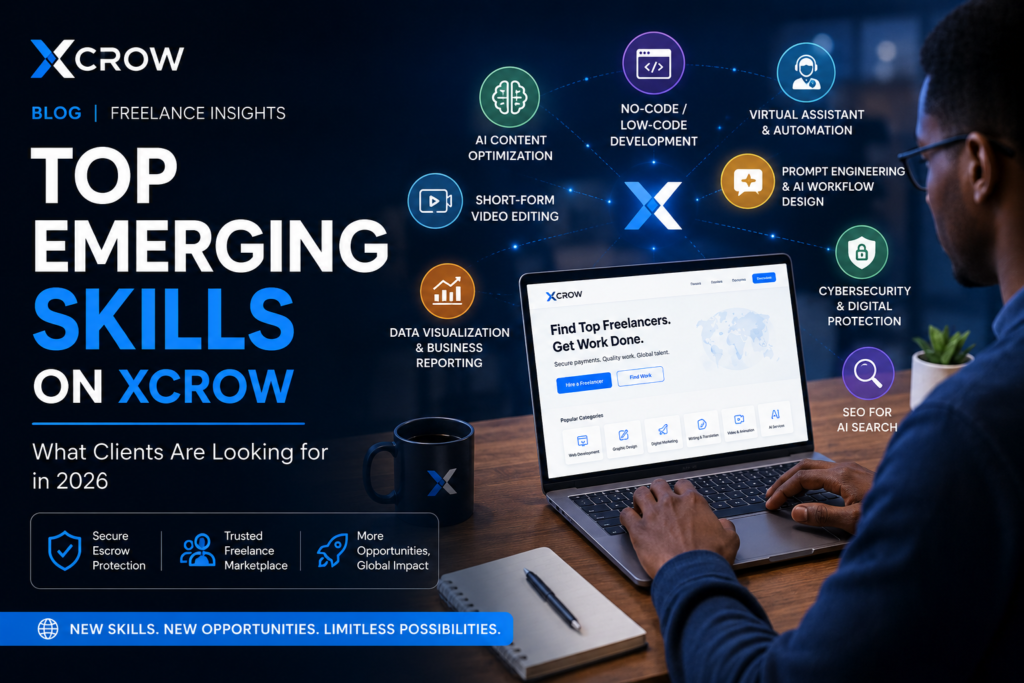
Freelance clients are looking for more than people who can complete isolated tasks. They want professionals who understand the problem, choose appropriate tools, communicate clearly, protect information, and deliver work that supports a measurable business goal.
Emerging skills are not always brand-new tools. They are often established abilities combined with newer workflows or clearer business applications. Demand varies by industry, location, budget, and project, so no skill guarantees work or income.
What makes a freelance skill valuable?
A valuable skill helps a client save time, improve quality, reduce risk, understand information, or create a better customer experience. The strongest freelancers explain the problem they solve, what they deliver, how quality is checked, and where their service has limits.
How to align your skills with client needs
Start with the desired outcome
Identify what the client wants to improve: a website, an internal process, content, customer communication, repetitive work, or performance reporting. A clear outcome makes the project easier to define and evaluate.
Connect the skill to the outcome
Replace broad labels with specific service statements. For example, describe research-based website copy for service businesses or accessible landing-page design rather than simply listing “copywriting” or “graphic design.”
Use tools as part of a workflow
Tools should support judgment, not replace it. Learn how to check outputs, protect confidential data, maintain quality, and explain the process to a client.
Show credible evidence
Create portfolio examples that explain the brief, your role, the process, and the result. Label practice or self-initiated work honestly, and never invent clients, qualifications, testimonials, or performance figures.
Emerging skills clients may value
AI-assisted content and editorial workflows
Businesses may need help with research, outlines, content briefs, editing, repurposing, and brand consistency. The valuable work includes fact-checking, removing unsupported claims, protecting private information, and improving the final content.
Explain where AI tools may be used, what human review involves, and how client information is protected. Follow the client’s requirements for disclosure, originality, copyright, and approved tools.
No-code and low-code automation
Automation specialists map processes, identify repetitive steps, connect approved services, test workflows, and document maintenance. Good work also includes error handling, permissions, privacy considerations, and a way to review or undo automated actions.
Before launch, the client should understand what data is transferred, which accounts are connected, what happens when a step fails, and how the workflow can be paused.
User-focused web and product design
UX and UI professionals help make digital products easier to understand and use. Useful evidence can cover user needs, information architecture, responsive layouts, accessibility, testing, and the reasoning behind design decisions.
A polished visual style should support clear navigation, readable content, usable forms, and an understandable user journey.
Data-informed digital marketing
Marketing freelancers may support audience research, content planning, campaign reporting, analytics interpretation, and testing. Good reporting separates observed data from assumptions and explains what the available data can and cannot show.
Avoid promising guaranteed rankings, revenue, or lead volumes when those outcomes depend on factors outside your control. Define activities, reporting periods, and reasonable indicators instead.
Cybersecurity awareness
Secure access, multi-factor authentication, careful file sharing, and strong password practices can reduce avoidable risk in freelance projects. Security testing must be authorized in writing and performed within a defined scope.
Security awareness is not the same as being qualified to conduct an audit. Describe your training accurately and refer specialized work to appropriately qualified professionals when necessary.
Remote collaboration and asynchronous communication
Distributed teams value freelancers who work independently, document decisions, provide concise updates, manage deadlines, and ask focused questions. Clear status reports, searchable decisions, logical file names, realistic response times, and early notice of blockers are practical skills.
Accessibility and inclusive content
Freelancers may support readable layouts, meaningful headings, keyboard-friendly interfaces, alternative text, captions, color contrast, and plain-language content. Requirements vary, so do not claim full compliance without appropriate testing and a defined standard.
How clients can evaluate an emerging skill
- Ask what business problem the skill solves.
- Request examples relevant to the project.
- Confirm what the freelancer personally contributed.
- Discuss tools, privacy, data handling, and security.
- Define deliverables, deadlines, revisions, and approval criteria.
- Consider a small paid assignment for unfamiliar work.
- Ask the freelancer to explain limitations and risks.
- Evaluate the process, not tool names alone.
Common mistakes when learning new skills
- Learning many unrelated skills without building depth.
- Following a trend without understanding the client problem.
- Listing tools instead of outcomes and deliverables.
- Using unsupported claims or invented case studies.
- Ignoring contracts, privacy, accessibility, licensing, and communication.
- Accepting work that requires qualifications or permissions you do not have.
- Failing to update your profile and portfolio.
How to build a credible skill profile
- Choose one core service and one complementary skill.
- Study the fundamentals and practise on realistic projects.
- Create three useful, clearly labelled portfolio samples.
- Explain your process, deliverables, and limitations.
- Write proposals around the client’s problem and desired outcome.
- Collect specific testimonials only with permission.
- Review your positioning as your experience and market change.
Final thoughts
The strongest freelancers do not chase every trend. They choose a useful problem, build dependable expertise, use tools responsibly, and show credible evidence. Clear scope, honest claims, secure practices, accessibility, and reliable communication help turn an emerging skill into a trustworthy professional service.

Israel Otoijamun is the founder of Xcrow, an AI-powered freelance marketplace connecting businesses with remote professionals. He has over 15 years experience in digital business, freelancing, technology, and online platforms. He writes about freelancing, remote work, hiring, digital payments, and the future of online work.