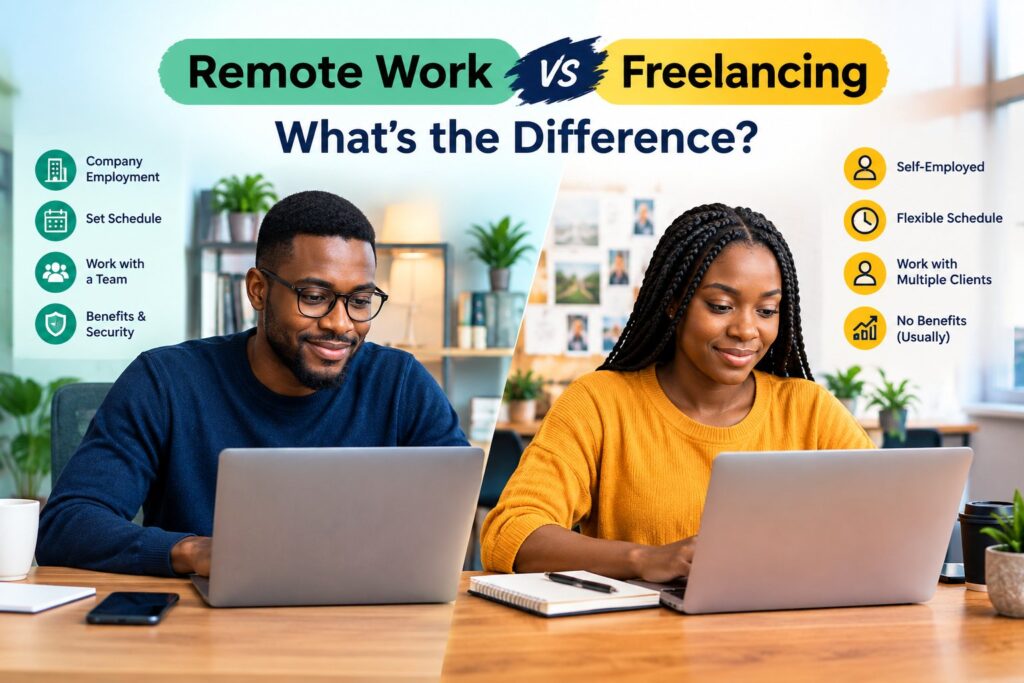
Remote work and freelancing are often discussed as if they mean the same thing. They do not. Remote work describes where work is performed: outside a traditional office. Freelancing usually describes how someone works: independently, by providing services to clients under agreed terms.
A person can be a remote employee, a freelancer, a remote contractor, or a business owner who works from home. These arrangements can overlap, but they involve different responsibilities, income patterns, risks, and expectations. Understanding the difference helps Nigerian professionals choose opportunities more deliberately instead of judging every online job by the same standard.
Remote Work vs Freelancing: The Short Answer
Remote work is a work location or work arrangement. A remote employee may work for one organisation, follow a defined role, attend team meetings, and receive a regular salary while working from home or another approved location.
Freelancing is an independent service arrangement. A freelancer normally finds clients, agrees on a scope of work, sets or negotiates fees, delivers projects, sends invoices, and manages business administration. Freelancers can work remotely, but remote work itself does not automatically make someone a freelancer.
Key Differences at a Glance
| Factor | Remote employment | Freelancing |
|---|---|---|
| Basic meaning | A job performed away from the employer’s office | Independent services delivered to clients |
| Relationship | Usually one employer | Often multiple clients, although one main client is possible |
| Work structure | Defined role, manager, team, and internal processes | Projects, retainers, or services agreed with clients |
| Income | Often a regular salary or wage | Variable invoices, milestones, retainers, or project payments |
| Control | The employer sets many processes and priorities | The freelancer manages business development and delivery |
| Benefits | May include leave, insurance, pension, or other benefits depending on the contract | Usually arranged and paid for independently |
| Equipment | May be supplied or reimbursed by the employer | Usually provided and maintained by the freelancer |
| Client acquisition | Handled mainly by the employer | Handled by the freelancer or a freelance marketplace |
| Payment risk | Usually lower if the employment relationship is stable | Higher because payment depends on contracts, invoices, and client reliability |
What Is Remote Work?
Remote work allows a person to perform their duties outside a conventional office. The employee may work from home, a coworking space, or another approved location. The employer still defines the position, assigns responsibilities, evaluates performance, and decides how the team collaborates.
Remote work can be fully remote, hybrid, or occasionally remote. A fully remote employee may rarely visit an office. A hybrid employee divides time between home and an office. An occasionally remote employee may work from home only on specific days or when circumstances require it.
The important point is that remote work does not remove the employment relationship. A remote employee may still have fixed working hours, reporting requirements, performance targets, paid leave rules, confidentiality obligations, and restrictions on outside work. The office has changed location, but the organisation’s structure remains.
What Is Freelancing?
Freelancing is a form of independent work in which a professional offers skills or services to clients. Common examples include writing, graphic design, web development, software testing, virtual assistance, video editing, social media management, bookkeeping, marketing, and consulting.
A freelancer may accept one-off projects, monthly retainers, short contracts, or long-term client engagements. The work may be performed online or in person. The freelancer is generally responsible for finding opportunities, explaining the service, agreeing on the scope, setting deadlines, delivering the work, requesting payment, and keeping business records.
Independence brings flexibility, but it also transfers more responsibility to the worker. A freelancer must plan for quiet periods, late payments, taxes, software subscriptions, internet costs, equipment repairs, professional development, and client communication. A high project fee is not the same as a predictable salary because business expenses and unpaid administrative time reduce the amount available as personal income.
Independent contractors generally operate under a different working relationship from employees, although the specific classification depends on the facts and applicable law.
Remote Employment: Main Advantages
- More predictable income: A regular salary can make budgeting easier than relying entirely on project payments.
- Team support: Employees can usually ask colleagues or managers for guidance and share responsibility for larger deliverables.
- Clearer role boundaries: A job description and reporting structure can reduce the need to sell a new service for every assignment.
- Potential benefits: Depending on the employer and agreement, remote employees may receive leave, insurance, pension contributions, training, or equipment support.
- Less sales administration: The company normally handles marketing, client acquisition, invoicing, and collections.
Remote Employment: Potential Disadvantages
- Less control over priorities: Managers and company goals determine much of the work.
- Fixed availability: A remote job can still require specific hours, meetings, response times, and time-zone coverage.
- Employment dependency: Losing one job can remove most or all of the worker’s main income.
- Isolation: Remote employees may miss informal office interaction and need deliberate communication habits.
- Outside-work restrictions: Some agreements limit freelance work, competing services, or the use of company equipment.
Freelancing: Main Advantages
- Greater flexibility: Freelancers can often choose when and where to work, subject to deadlines and client agreements.
- Client choice: An established freelancer can focus on industries, project types, and clients that fit their skills.
- Multiple income sources: Working with several clients can reduce dependence on one employer, although it also increases management work.
- Business growth: A freelancer can turn a personal service into an agency, product, course, or specialised consultancy.
- Control over positioning: The freelancer can decide which skills to develop and how to present their offer.
Freelancing: Potential Disadvantages
- Irregular income: Projects may end, clients may pause work, and some months may be stronger than others.
- Unpaid business time: Proposals, marketing, meetings, revisions, invoicing, and follow-ups may not be billable.
- Payment risk: A client may pay late or dispute work, so written agreements and sensible payment terms matter.
- Self-funded benefits and equipment: The freelancer usually pays for internet, software, equipment, learning, leave, and other operating costs.
- Administrative pressure: Records, taxes, contracts, data protection, and client communication become part of the job.
Can Someone Be Both a Remote Worker and a Freelancer?
Yes. These terms answer different questions. “Remote worker” describes the location or working arrangement, while “freelancer” describes the independent relationship with a client.
For example, a person may work remotely as a full-time customer-support employee. Another person may freelance as a web designer from a home office. A third person may have a remote job during the day and accept freelance projects in the evening, if the employment agreement permits it and the additional work does not create a conflict of interest.
Anyone combining both arrangements should check working hours, confidentiality, intellectual-property ownership, non-compete language, client conflicts, and the use of employer equipment. They should also protect their health by setting realistic limits rather than accepting more projects than they can deliver well.
Which Option Is Better for You?
Neither option is automatically better. The right choice depends on your financial needs, experience, risk tolerance, working style, and long-term goals.
Remote employment may be a stronger fit if you value regular income, a team environment, defined responsibilities, structured learning, and fewer sales or administrative tasks. It can also be a useful way to build experience before offering services independently.
Freelancing may be a stronger fit if you already have a marketable skill, want more control over clients and schedule, and are prepared to manage sales, delivery, records, and uncertain income. Freelancing becomes more sustainable when it is treated as a business rather than as a series of disconnected online gigs.
A Practical Decision Checklist
Before choosing an arrangement, ask yourself:
- Do I need predictable monthly income immediately?
- Do I prefer a manager and team, or direct control over my work?
- Do I have a skill that clients already pay for?
- Can I find clients consistently, or do I need time to build a portfolio?
- Can I cover several months of essential expenses if income falls?
- Am I comfortable negotiating scope, deadlines, fees, and revisions?
- Can I manage taxes, records, contracts, and payment follow-ups?
- Do I have reliable internet, suitable equipment, and a professional workspace?
- Does my current employment agreement allow outside work?
Important Contract Questions
Whether you accept a remote job or freelance project, read the agreement before starting. Clarify the duties, working hours, location requirements, payment dates, currency, expenses, ownership of work, confidentiality, data handling, revision limits, notice period, termination terms, and dispute process.
Freelancers should pay particular attention to the scope of work. A clear scope explains what is included, what is excluded, how many revisions are allowed, what the client must provide, and what happens when requirements change. A deposit or milestone arrangement can reduce the risk of completing a large project without payment.
Remote employees should review policies on working hours, monitoring, leave, equipment, security, secondary employment, and the countries or locations from which they may work. A job advertised as remote may still have location, tax, or time-zone limitations.
How to Make Either Arrangement Sustainable
Good work habits matter in both models. Use a reliable calendar, keep written records of commitments, protect account access with strong passwords and multifactor authentication, and maintain backups of important work. Separate personal and professional files where possible, and avoid storing confidential client or employer information on devices that other people can access.
Set communication expectations early. Agree on the best channel, normal response times, meeting windows, and the process for urgent issues. Clear communication reduces unnecessary revisions and helps prevent a flexible arrangement from becoming an always-available arrangement.
Finally, review your arrangement periodically. A remote employee may discover that freelancing is a useful future direction. A freelancer may decide that a stable remote role better supports family, health, or financial goals. Changing direction is not failure; it is a practical response to changing priorities and market conditions.
Frequently Asked Questions
Is every remote worker a freelancer?
No. A remote worker may be a regular employee of one organisation. Remote work describes where or how the work is performed, not necessarily the worker’s legal or commercial relationship.
Is every freelancer a remote worker?
No. Freelancers can work remotely, at a client’s premises, or in a combination of locations. Freelancing describes independent service delivery, while remote work describes the location or arrangement.
Which one pays more?
There is no universal answer. Remote employment may provide more predictable income, while freelancing may offer a higher ceiling for someone with strong skills, pricing, and a reliable client pipeline. Compare net income after expenses, unpaid time, taxes, benefits, and periods without work.
Can I freelance while working remotely for a company?
Sometimes, but first check the employment agreement and company policies. Avoid conflicts of interest, competing work, misuse of employer resources, and any arrangement that affects your job performance or confidentiality obligations.
Is freelancing the same as contract work?
Not always. Both can involve independent work, but “contract work” is a broad term that may describe a fixed-term role, an agency placement, or a specific service agreement. Read the actual contract to understand the relationship and responsibilities.
What should a beginner choose?
A beginner can start with the option that best matches their current needs. A remote entry-level role may provide structure and experience, while small freelance projects can help build a portfolio. Do not choose freelancing solely because it appears easier; client acquisition and business administration require real effort.
Final Takeaway
Remote work is mainly about the location and structure of work. Freelancing is mainly about independence and the relationship between a service provider and clients. A remote employee may have one employer, regular pay, and defined responsibilities. A freelancer may have several clients, variable income, and responsibility for finding and delivering work.
For Nigerian professionals, the best decision should be based on more than a job title. Compare stability, flexibility, payment reliability, expenses, contract terms, skill development, and personal responsibilities. Choose the arrangement you can manage sustainably, and review the decision as your experience and goals change.
Editorial note: This guide provides general information, not legal, tax, or financial advice. Employment and freelance obligations can vary by contract and jurisdiction, so seek qualified professional advice for a situation-specific decision.
Recommended Articles
Xcrow.co vs Upwork Fees in 2026: How Much Do You Keep From $100?
How to Manage Client Feedback and Revisions in Freelance Projects

Israel Otoijamun is the founder of Xcrow, an AI-powered freelance marketplace connecting businesses with remote professionals. He has over 15 years experience in digital business, freelancing, technology, and online platforms. He writes about freelancing, remote work, hiring, digital payments, and the future of online work.