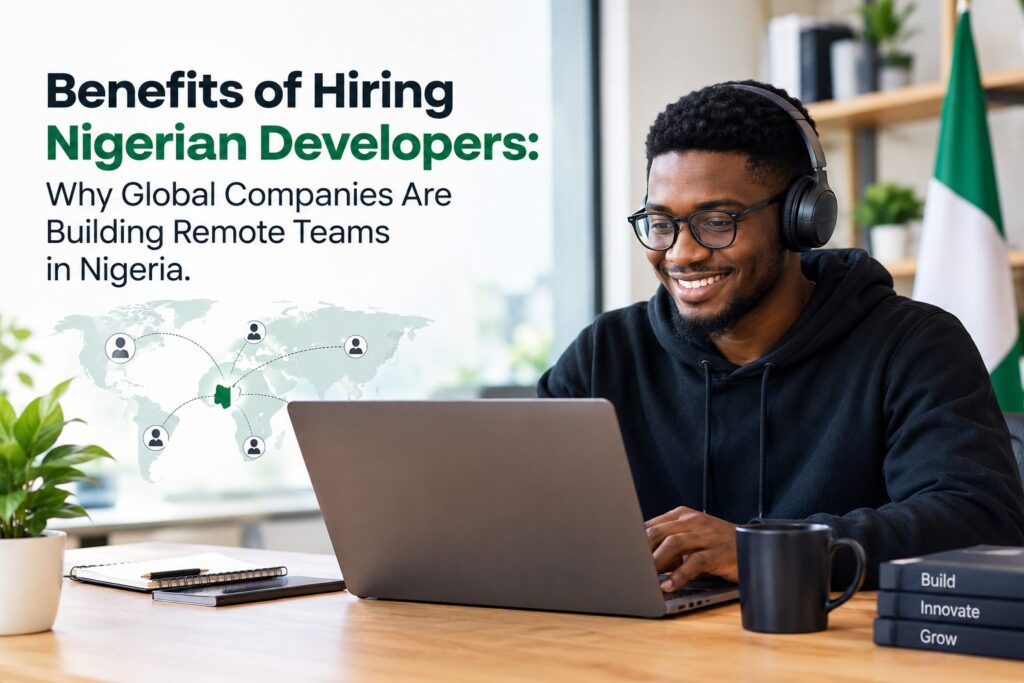
Global companies are no longer limited to hiring software professionals in the cities where they operate. Remote work has made it possible to build strong development teams across borders, and Nigeria has become an increasingly important source of technology talent. Businesses can find skilled professionals, expand efficiently, and bring fresh perspectives to digital projects while working with developers based in Nigeria.
This guide explains why companies hire Nigerian developers, the specializations available, how to evaluate candidates, and what businesses should consider before building a remote team. The goal is not to suggest that one market is right for every company, but to explain the practical benefits of considering Nigerian professionals as part of a distributed team.
11 Benefits of Hiring Nigerian Developers
Access to a Growing Technology Talent Pool
For employers, this creates a wider hiring pool and more opportunities to find candidates with the skills needed for web applications, mobile products, business software, ecommerce systems, and digital services. A wider pool can also improve the chances of finding someone whose experience matches a particular industry or technical challenge.
Competitive Development Costs
Hiring remotely in Nigeria can help companies manage development budgets while accessing qualified professionals. Labour costs are often more competitive than in high-cost markets, particularly when compared with major technology hubs in the United States and the United Kingdom.
Cost savings should not mean lower standards or unfair compensation. Companies get better results when they offer clear contracts, reasonable workloads, timely payments, professional tools, and opportunities for growth. The most effective approach is to compare the total value of a candidate’s skills, reliability, communication, and expected results rather than focusing only on hourly rates.
Strong Experience With Modern Technologies
Nigerian developers work with widely used programming languages, frameworks, content management systems, cloud platforms, databases, collaboration tools, and development workflows. Portfolios may include JavaScript, React, PHP, WordPress, Python, APIs, mobile frameworks, DevOps tools, cloud services, testing systems, and ecommerce platforms.
Technology experience should always be assessed against project requirements. Portfolio reviews, practical tests, technical discussions, and references can help confirm whether a candidate’s skills match the role. Employers should also ask how a developer keeps skills current, handles documentation, tests changes, and works with existing code.
English-Language Communication
English is widely used in Nigerian education, business, and technology. This can make it easier for companies with English-speaking teams to collaborate on requirements, documentation, meetings, customer support, and code reviews.
Employers should still evaluate each candidate’s written and spoken communication. Effective remote work depends on clarity, responsiveness, accurate status updates, and the ability to explain technical decisions to both technical and non-technical colleagues.
Convenient Time-Zone Overlap With Europe and the UK
Nigeria operates on West Africa Time, which creates useful working-hour overlap with the United Kingdom and much of Europe. This can support shared meetings, faster feedback, project handoffs, and convenient collaboration.
Companies can improve this advantage by agreeing on core hours, response times, meeting schedules, holidays, and communication practices from the beginning. Teams in North America can also work effectively with Nigerian developers by using a defined overlap window and asynchronous documentation.
Experience Working With International Clients
Many Nigerian developers have worked with overseas clients, agencies, startups, and distributed teams. This experience can help them understand remote project management, international deadlines, digital communication, version control, and client feedback.
When reviewing a candidate, look for completed projects, repeat clients, measurable results, and evidence that the person can work independently as well as within a team. Ask about a time they handled unclear requirements or adjusted to feedback.
Access to Developers Across Different Specializations
Companies can find Nigerian developers across a wide range of technical disciplines. The right specialization depends on the product, development stage, budget, and long-term goals.
Frontend: Frontend developers build the interfaces users see and interact with. They may work with HTML, CSS, JavaScript, responsive design, accessibility, performance, and modern frontend frameworks.
Backend: Backend developers create server-side logic, databases, APIs, authentication systems, integrations, and business rules that power digital products.
Full-stack: Full-stack developers contribute to both frontend and backend work. They can be useful for startups and smaller teams that need one professional to handle several parts of a product.
Mobile: Mobile developers build applications for Android, iOS, or cross-platform environments. They can support consumer apps, business tools, marketplaces, and service platforms.
DevOps: DevOps professionals help teams manage deployment pipelines, infrastructure, monitoring, security practices, backups, and software reliability.
AI/data: AI and data specialists can help with data analysis, automation, machine learning workflows, reporting systems, and intelligent product features. Companies should define data, privacy, security, and performance requirements clearly before hiring.
Flexibility for Startups and Growing Companies
Remote hiring allows a company to begin with one freelancer, form a project-based team, or develop a longer-term engineering function. This flexibility is useful for startups validating an idea and growing businesses that need additional capacity without immediately creating a large local department.
A company might hire a specialist for a two-week audit, a developer for a product milestone, or a small team for ongoing maintenance. Clear scope and milestones help businesses scale without committing prematurely to a large permanent structure.
Nigeria’s Growing Technology and Startup Ecosystem
Nigeria has a growing technology and startup ecosystem supported by founders, investors, accelerators, developer communities, digital agencies, and technology hubs. This environment gives many professionals exposure to fast-moving products, changing customer needs, payments, logistics, fintech, ecommerce, education, healthcare, and practical business challenges.
The ecosystem encourages continuous learning and collaboration, although every candidate should still be assessed individually on demonstrated skills and results.
Experience Solving Real-World Technology Problems
Developers who work with startups, agencies, small businesses, or international clients often solve practical problems involving limited resources, changing requirements, integrations, performance, security, and user experience. This problem-solving experience can be as valuable as familiarity with a particular programming language.
Ask candidates to explain how they approached a difficult project, what trade-offs they made, what failed, and how they measured the result. Strong answers usually show structured thinking rather than simply listing tools.
Remote Hiring Can Make Team Expansion Easier
A remote hiring model can help companies add skills when they need them. Businesses may hire for a defined project, ongoing maintenance, a product launch, or a permanent remote position.
Clear documentation, secure access, task ownership, regular check-ins, code repositories, issue tracking, and outcome-based expectations make it easier to expand a distributed team without creating unnecessary management complexity. A written onboarding process can help new developers become productive more quickly.
What to Consider Before Hiring a Nigerian Developer
Before making an offer, define the role, required skills, budget, working hours, project duration, communication expectations, and ownership of work. Companies should also consider payment arrangements, confidentiality, intellectual property, data protection, employment classification, and applicable tax or legal obligations.
Reliable equipment, internet access, backup procedures, and secure account management should be discussed where relevant. Use least-privilege access, separate personal and business accounts, and remove access when a project ends. These steps protect both the company and the developer.
How to Find and Vet Nigerian Developers
Start with a clear job description focused on outcomes rather than an unnecessarily long list of requirements. Review portfolios, code samples, references, previous client feedback, and relevant professional experience.
- Use a structured interview to assess technical knowledge and communication.
- Give candidates a short, relevant, and fairly compensated practical assessment when appropriate.
- Discuss availability, time-zone overlap, tools, milestones, and preferred working methods.
- Begin with a clearly defined trial project or contract when the arrangement requires it.
- Use written agreements explaining payment, deliverables, confidentiality, and intellectual property.
- Ask for examples of testing, documentation, debugging, and collaboration.
- Set a review point after the first milestone and adjust the process using evidence.
A good hiring process should be consistent and respectful. Avoid making assumptions based on location, and evaluate candidates using the same role-related criteria.
Nigerian Developers vs. Hiring Locally in the US or UK
Hiring Nigerian developers can give companies access to a broader talent pool, competitive development costs, and useful time-zone overlap with Europe and the UK. Local hiring in the US or UK may offer easier proximity for in-person work, but it can also involve higher salary expectations and greater competition for technical talent.
| Factor | Hiring Nigerian Developers | Hiring in US/UK |
|---|---|---|
| Talent access | Growing technology talent pool | Large established talent pools |
| Development costs | Often competitive | Generally higher |
| English communication | Strong | Strong |
| Remote work | Increasingly common | Common |
| Time-zone overlap | Strong with UK/Europe | Depends on location |
| Team scalability | Can be flexible | Depends on hiring market |
| Specializations | Web, mobile, cloud, AI, fintech and more | Broad range |
The best choice depends on the project, budget, security requirements, communication needs, and desired working relationship. Remote hiring should be evaluated on skills, reliability, results, and fit—not nationality alone.
How Xcrow.co Helps Businesses Hire Nigerian Freelancers
Xcrow.co can help businesses approach Nigerian freelance hiring with a clearer process for discovering professionals, reviewing relevant skills, and connecting project requirements with available talent. Companies can communicate expectations, compare suitable freelancers, and agree on deliverables before work begins.
Whether a business needs frontend development, backend engineering, WordPress support, mobile development, DevOps, or AI/data expertise, a structured hiring process can make remote collaboration easier. Businesses should still perform their own due diligence and establish clear agreements with each freelancer.
Frequently Asked Questions
Why do companies hire Nigerian developers?
Companies hire Nigerian developers to access a growing talent pool, competitive development costs, modern technical skills, English-language communication, and useful working-hour overlap with Europe and the UK. The right candidate should still be selected based on skills and evidence of results.
Are Nigerian developers experienced with modern technologies?
Many work with current languages, frameworks, cloud services, databases, APIs, mobile tools, WordPress, DevOps systems, and data technologies. Employers should verify the specific technology experience needed for their project through portfolios, interviews, and practical discussions.
How should I vet a Nigerian developer?
Review relevant work, conduct a structured interview, check references where available, discuss communication habits, and use a short practical assessment when appropriate. A small paid trial project can also show how the developer handles real requirements.
Can Nigerian developers work with US or UK teams?
Yes. Many remote arrangements use written documentation, project management tools, scheduled meetings, and agreed core hours. Nigeria’s time zone provides particularly useful overlap with the UK and much of Europe.
What roles can I hire for?
Common roles include frontend, backend, full-stack, mobile, DevOps, cloud, WordPress, QA, AI, data, and ecommerce development. Availability and suitability should be checked for each individual role.
How can I manage a remote Nigerian developer?
Define outcomes, deadlines, communication channels, access permissions, review points, and payment terms. Regular feedback and concise documentation are usually more effective than excessive meetings or constant monitoring.
Is hiring a Nigerian developer cheaper than hiring in the US or UK?
Development costs can be competitive compared with high-cost US and UK markets, but actual rates vary by specialization, experience, complexity, and contract terms. Compare total value and expected results rather than choosing solely on price.
What legal issues should I consider?
Consider contracts, intellectual property, confidentiality, data protection, payment procedures, worker classification, and tax obligations. Obtain appropriate professional advice for your specific jurisdictions and arrangement.
Should I hire a freelancer or a full-time developer?
A freelancer may suit a defined project or temporary capacity need, while a full-time remote hire may suit ongoing product development. Choose based on workload, continuity, management capacity, and long-term requirements.
Conclusion
Nigerian developers can offer global companies access to a growing technology talent pool, modern technical skills, competitive development costs, English-language communication, and convenient collaboration with Europe and the UK. With careful vetting, fair agreements, secure workflows, and clear expectations, companies can build remote teams that support short-term projects and long-term growth.
Recommended Articles:
Remote Work vs Freelancing: What’s the Difference?
How to Start an Online Service Business in Nigeria: A Practical Step-by-Step Guide
The Complete Guide to Selling Digital Services Internationally From Africa

Israel Otoijamun is the founder of Xcrow, an AI-powered freelance marketplace connecting businesses with remote professionals. He has over 15 years experience in digital business, freelancing, technology, and online platforms. He writes about freelancing, remote work, hiring, digital payments, and the future of online work.