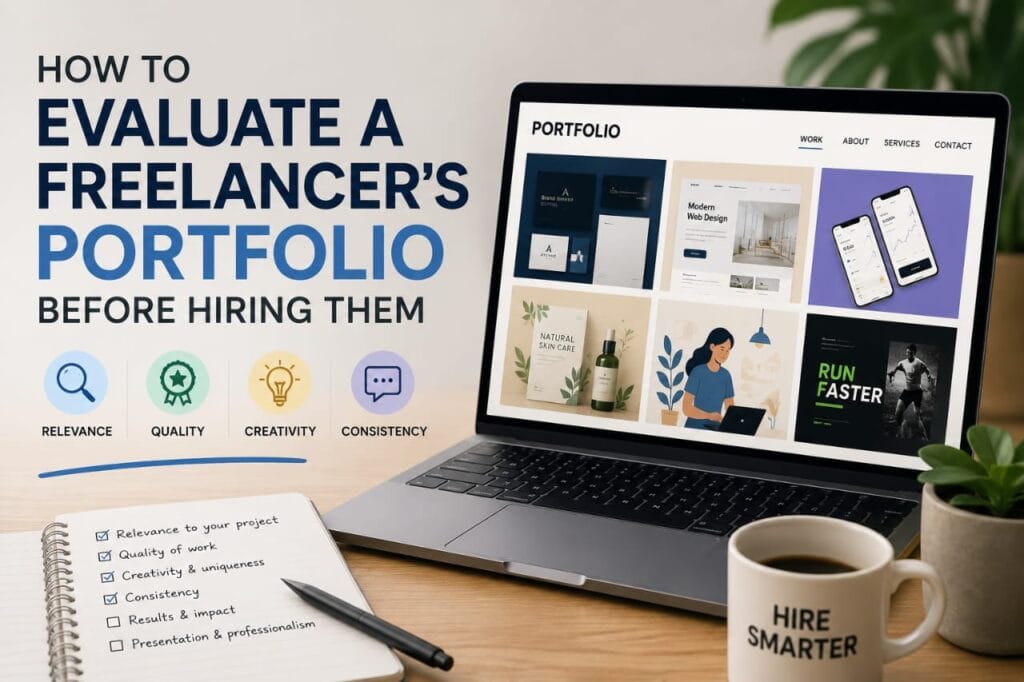
Hiring a freelancer is not simply a matter of choosing the portfolio with the most attractive images. A portfolio is a curated presentation of past work, and good hiring decisions depend on understanding the work behind the presentation. Clients should look for relevant experience, clear thinking, honest ownership, strong communication, and evidence that the freelancer can work within real business constraints.
A polished portfolio can still be incomplete. It may show only the final result, leave out the freelancer’s exact contribution, or focus on projects that are unrelated to the client’s needs. The best review process therefore combines portfolio analysis with thoughtful questions, references, a defined trial project, and a written agreement. You may also find it useful to compare portfolio evidence with broader hiring signals in How to Evaluate Freelancers Beyond Star Ratings.
Start with relevance, not popularity
A famous client name or visually impressive project can attract attention, but it does not prove that the freelancer is right for your assignment. Begin by identifying the skills your project actually requires. A website redesign, product illustration, email campaign, mobile application, and brand identity project all require different kinds of experience.
Look for examples that match the project’s format, audience, industry, technical requirements, and level of complexity. Related work is useful, but adjacent work should not be treated as identical. Ask the freelancer to explain which parts of their previous experience transfer directly to your project and which parts they would need to learn.
Look for process as well as results
Finished work shows what was delivered, but the process shows how the freelancer thinks. A useful case study should explain the original brief, the target audience, the constraints, the options considered, the feedback received, and the reason the final direction was selected.
Process does not need to be lengthy or confidential. A designer may show sketches or wireframes, a writer may explain how research shaped an article, and a developer may describe technical decisions without exposing private code. The purpose is to understand how the freelancer moves from an unclear problem to a dependable result.
Be careful with portfolios that contain many unrelated services but no project in meaningful depth. Breadth can be valuable, especially for a generalist, but surface-level work across ten disciplines may provide less evidence than two detailed projects in the skill you need most.
Confirm the freelancer’s exact role
Team projects create an important verification question: what exactly did this person do? A freelancer may have worked for an agency, contributed to a larger product, or supported a project managed by another professional. There is nothing wrong with collaboration, but the portfolio should make individual responsibility clear.
Ask whether the freelancer led the project, completed a particular stage, supplied specialist work, or assisted another team member. Honest answers help you estimate what support the freelancer may need. They also prevent you from assuming that one person can reproduce an entire team’s output alone.
Ask questions that reveal judgment
A portfolio walkthrough is more useful than passive scrolling. Select one or two relevant examples and ask: What was the original goal? What was the hardest constraint? Which option did not work? How did feedback change the work? What would you improve if you started again?
These questions reveal judgment, adaptability, and self-awareness. Strong freelancers can usually explain why decisions changed and what they learned. They do not need to claim that every project was perfect. An honest discussion of failed approaches often provides more useful information than a collection of flawless final images.
Do not confuse unpaid tests with proper evaluation
Clients understandably want confidence before committing to a large project. However, asking several candidates to complete substantial unpaid assignments is unfair and often produces a poor signal. It rewards availability rather than capability and may encourage people to give away valuable work.
If the portfolio and interview do not answer a specific question, use a small paid test with a clear scope. Explain how the test will be evaluated, limit the time required, and pay for the result. A paid trial also shows how both sides communicate and manage feedback without requiring either party to make a large commitment.
Check communication and working habits
A strong portfolio cannot compensate for unreliable communication. During the review process, notice whether the freelancer reads the brief, asks relevant questions, identifies missing information, and explains their availability. A freelancer does not need to answer immediately at every hour, but they should set realistic response expectations.
Ask how they organize files, track revisions, report progress, and handle delays. The answers do not need to match your preferred software. What matters is whether the freelancer has a repeatable way to keep work visible and prevent small misunderstandings from becoming expensive problems.
Review technical and business fit
Some portfolio gaps are industry-specific. A general web designer may not have experience with accessibility, subscription billing, multilingual content, or complex user permissions. A writer may produce excellent articles but have no experience with regulated subjects. A developer may show attractive interfaces without demonstrating testing, security, maintenance, or documentation.
Ask for examples that demonstrate the most important requirements. If private work cannot be shared, request a verbal walkthrough or anonymized explanation. A professional freelancer should be able to discuss relevant constraints without revealing confidential client information.
Verify references and expectations
References are most useful when you ask focused questions. Did the freelancer meet deadlines? How did they respond to feedback? Was the final work close to the agreed scope? Would the client hire them again? A short, specific reference is more informative than a long list of anonymous praise.
Before hiring, write down the deliverables, deadline, revision limit, payment schedule, ownership terms, confidentiality requirements, and approval process. This document protects the relationship even when both parties have good intentions. For additional payment-safety considerations, read How to Safely Pay Freelancers Internationally Without Getting Scammed.
Make the decision using evidence
The right freelancer is not necessarily the person with the largest portfolio or the lowest quote. It is the person whose relevant work, process, communication, availability, and commercial terms fit the actual project. Compare candidates against the same criteria and avoid changing the standard simply because one portfolio is visually exciting.
A careful portfolio review takes longer than choosing the first impressive profile, but it reduces the chance of hiring based on assumptions. Look beyond presentation, ask how the work was created, and give the freelancer a fair opportunity to explain their contribution. For general guidance on avoiding deceptive online practices, consult the U.S. Federal Trade Commission’s small-business scam guidance.
Frequently asked questions
What should I look for first in a freelancer’s portfolio?
Start with work that is relevant to your project’s format, audience, industry, technical requirements, and complexity. A smaller number of closely related examples is usually more useful than a large collection of unrelated work.
How can I verify that a freelancer actually created the portfolio work?
Ask the freelancer to explain their role, process, decisions, challenges, and revisions for selected samples. You can also request references or use a small paid trial. Do not ask them to disclose confidential client information.
Should I request an unpaid test project?
Substantial unpaid tests should be avoided because they ask candidates to provide valuable work without fair compensation. If a trial is necessary, keep it short, clearly scoped, and paid.
How many portfolio examples should I review?
There is no universal number, but reviewing two or three relevant projects in depth can be more useful than quickly viewing dozens. Focus on the freelancer’s contribution, reasoning, results, and ability to meet comparable requirements.
What questions should I ask during a portfolio review?
Ask about the original goal, the freelancer’s exact contribution, the hardest constraint, the feedback process, what changed during revisions, how quality was checked, and what they would improve now.
Can a portfolio guarantee that a freelancer will deliver good work?
No. A portfolio provides evidence, but it cannot guarantee future results. Combine it with communication checks, references, a written scope, clear milestones, and—when appropriate—a small paid trial.
Final checklist before hiring
- Confirm that the work is relevant to your project.
- Understand the freelancer’s exact contribution to each sample.
- Ask about process, constraints, feedback, and measurable outcomes.
- Check communication, availability, and working habits.
- Verify references for important or high-value projects.
- Use a fair paid trial instead of a substantial unpaid test.
- Put deliverables, deadlines, revisions, payment, ownership, and confidentiality in writing.
- Use a reputable payment method and keep project records together.
The best hiring decision is based on evidence rather than presentation alone. A thoughtful portfolio review protects the client, respects the freelancer’s work, and creates clearer expectations for the project from the beginning.
Learn more about Xcrow: Visit the Xcrow About Us page to understand the platform and its approach to freelance collaboration.

Israel Otoijamun is the founder of Xcrow, an AI-powered freelance marketplace connecting businesses with remote professionals. He has over 15 years experience in digital business, freelancing, technology, and online platforms. He writes about freelancing, remote work, hiring, digital payments, and the future of online work.