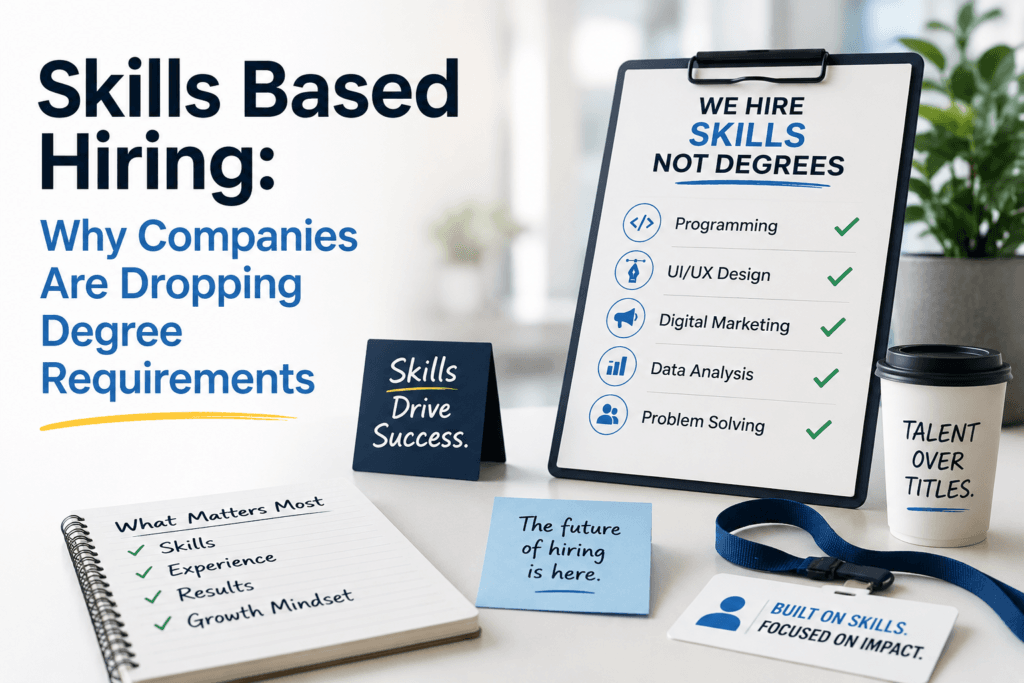
Skills-based hiring focuses on what a person can do rather than treating a degree as the automatic measure of suitability. It does not mean lowering standards or ignoring education. It means defining the work clearly and giving candidates a fair opportunity to demonstrate the abilities the role actually requires.
For employers, this approach can widen the talent pool and improve job fit. For candidates, it can create opportunities for people who built expertise through work, training, certifications, independent projects, caregiving, or nontraditional career paths. The process works best when employers replace vague preferences with consistent, job-related evidence.
Why degree requirements are changing
A degree can demonstrate persistence, subject knowledge, and the ability to complete a structured program. In some professions, it remains essential because licensing, safety, or regulation demands it. But a degree does not always show whether someone can perform the daily tasks of a particular job.
Technology also changes faster than many formal programs. A candidate may have current practical skills gained through recent projects, while another applicant with an older credential may need significant retraining. Removing an unnecessary requirement allows employers to assess current ability instead of relying on an imperfect shortcut.
What skills-based hiring looks like
The process begins with a realistic description of the role. Employers identify the outcomes expected during the first months and separate essential capabilities from preferences. A marketing role might require campaign planning, clear writing, data interpretation, and collaboration. A developer role might require problem-solving, testing, documentation, and familiarity with particular technologies.
Assessment can include a relevant work sample, structured interview questions, portfolio review, certifications, references, or a practical discussion of previous projects. The strongest assessment resembles the real work without asking candidates to complete a large amount of unpaid labor.
Benefits for employers
A clear process can improve access to capable applicants who would have been screened out by an unrelated credential. It may help employers identify transferable skills, practical judgment, and people who learned through experience. It can also improve job descriptions because the company must explain what success actually looks like.
Better clarity can reduce mismatched expectations after hiring. Candidates understand the work more accurately, and managers have a stronger basis for setting goals during onboarding and performance reviews. The result is not guaranteed, but the decision is based on evidence that is closer to the job itself.
Benefits for candidates
Candidates can present portfolios, certifications, volunteer work, freelance assignments, personal projects, and quantified achievements. This is particularly useful for people changing careers or returning to work after a gap. Practical evidence gives them a way to explain what they can contribute rather than asking an employer to infer ability from job titles alone.
Risks to avoid
Removing a degree requirement does not automatically remove bias. Interviewers may still favor candidates who attended familiar schools, speak in a particular style, or share their background. Unstructured interviews can reward confidence rather than competence, and take-home tasks can disadvantage people with limited free time or accessibility needs.
Employers should publish clear instructions, use the same core questions, set reasonable time limits, provide accommodations, and score evidence against agreed criteria. Interviewers should document decisions and avoid changing the standard from one candidate to another.
How to implement the approach responsibly
- Identify the outcomes and competencies required for the role.
- Separate legal, safety, or licensing requirements from preferences.
- Write a plain-language job description based on actual work.
- Choose a short assessment that reflects realistic tasks.
- Use structured questions and a consistent scoring guide.
- Explain the process and offer reasonable accommodations.
- Train interviewers to recognize evidence rather than assumptions.
- Review hiring, performance, retention, and promotion outcomes.
What candidates can do
Candidates should build a focused portfolio and describe their personal contribution to each project. Quantify results only when the figures can be supported. Explain decisions, constraints, tools, and lessons learned. A small number of relevant examples is usually more persuasive than a long list of unrelated abilities.
Candidates can also ask how the assessment works, how it is scored, and which capabilities matter most during the first months. These questions help determine whether the employer has created a fair process and whether the role is genuinely suitable.
A balanced conclusion
Skills-based hiring is not a universal replacement for degrees, licenses, or experience. It is most useful when practical ability can be measured directly. The fairest approach combines necessary credentials with relevant evidence of performance, uses consistent evaluation, and remains open to different ways people develop expertise.
For employers, the goal should not be to remove every credential. It should be to stop using credentials as a substitute for thinking carefully about the work. When the selection process measures what the job requires, companies can make more informed decisions and candidates receive a fairer opportunity to show what they can do.

Israel Otoijamun is the founder of Xcrow, an AI-powered freelance marketplace connecting businesses with remote professionals. He has over 15 years experience in digital business, freelancing, technology, and online platforms. He writes about freelancing, remote work, hiring, digital payments, and the future of online work.