
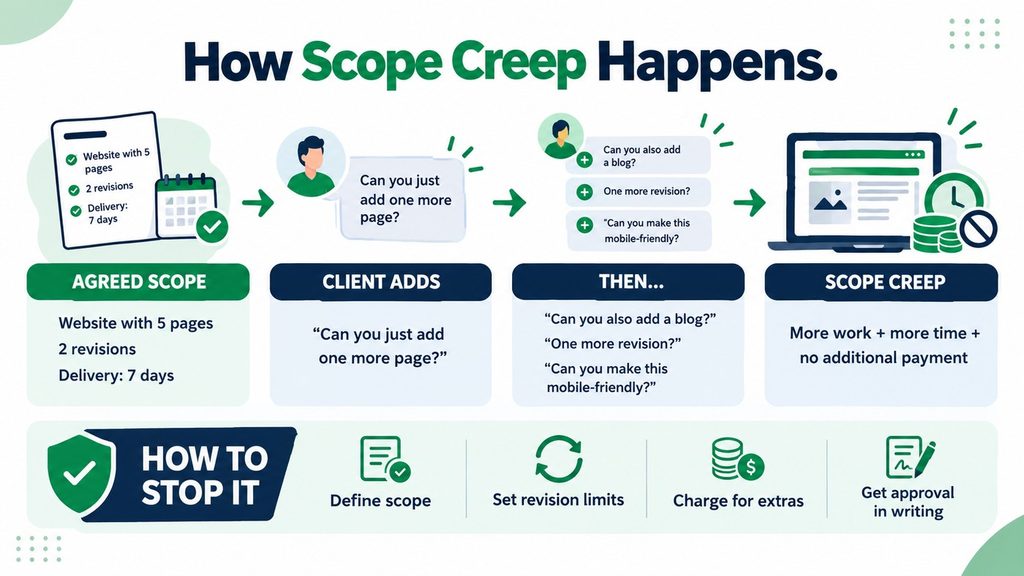
Scope creep happens when a freelance project grows beyond the agreed work without a clear adjustment to the deadline, budget, or deliverables.
It can begin with a seemingly minor request, such as “one small change,” but repeated additions can consume unpaid hours, delay delivery, and create tension. Freelancers can prevent it by defining the scope clearly, setting revision limits, documenting change requests, pricing additional work, and communicating early and professionally.
Editorial note: This guide provides practical project-management information. Contract terms, payment rules, tax obligations, and legal requirements vary by location and project type, so obtain qualified advice when you need a binding legal interpretation.
What Is Scope Creep?
Scope is the agreed boundary of a freelance project. It describes what the freelancer will do, what will be delivered, how many revisions are included, when the work is due, and what the client will provide. Scope creep is the gradual expansion of that boundary after the project has started, especially when the extra work is requested without a corresponding change to the price or timeline.
Scope creep is not always caused by bad intentions. A client may learn something new during the project, remember an omitted requirement, receive feedback from another stakeholder, or decide that a related improvement would be useful. The problem is not that a client asks for a change. The problem is treating a change as if it were already included when it alters the agreed work.
What Counts as Scope Creep?
- A new deliverable is added after the project begins.
- The quantity increases, such as five pages becoming eight.
- A different audience, platform, language, or format is introduced.
- A new decision-maker adds requirements that were not in the brief.
- The client changes the approved direction and asks for a new approach.
- Extra revisions continue after the included revision limit.
- The freelancer is asked to perform a related task that was never priced.
- The deadline stays the same even though the workload expands.
- “Final” files now require additional versions, source files, or documentation.
A correction to an error made by the freelancer is generally different from a new client preference. If the agreed requirement was misunderstood or the delivered work does not match the brief, the freelancer should address that issue. If the client changes the requirement or requests a new direction, it should be treated as a change request.
Examples of Scope Creep in Freelancing
Writing and content
A client hires a freelancer to write four 1,000-word blog posts. During the project, the client asks for two additional articles, social media captions, image research, and uploading to the website. Each item may seem connected to writing, but the quantity and responsibilities have changed.
Design
A logo project includes three concepts, one selected direction, and two revision rounds. After approval, the client requests a complete alternate identity, animated versions, packaging mockups, and a new slogan. These are additional deliverables, not ordinary corrections to the agreed logo.
Development
A freelancer is hired to build a five-page website with a contact form. The client later requests membership accounts, an online store, multilingual support, analytics dashboards, and a custom booking system. These features may be valuable, but they require new estimates and possibly a different technical plan.
Marketing
A monthly content package includes a calendar and eight posts. The client begins requesting competitor research, daily community management, paid-ad setup, and weekly reporting. The new responsibilities affect both time and expertise, even if they are described as “just part of marketing.”
Why Scope Creep Causes Problems
Uncontrolled additions affect more than a freelancer’s workload. They can reduce quality because the original time is spread across extra tasks. They can also create missed deadlines, rushed reviews, unclear accountability, and disagreements about what the client is paying for.
For freelancers, repeated unpaid work can make a project unprofitable and limit availability for other clients. For clients, unclear scope can make the final result cost more than expected and make it difficult to know whether a delay is reasonable. A documented change process protects both sides by turning an informal request into a visible decision.
| Original agreement | New request | Potential impact |
|---|---|---|
| Four web pages | Add three pages and mobile redesign | More production time and review cycles |
| Two revision rounds | Keep revising until everyone approves | Unclear effort and no fixed endpoint |
| Final design files | Add animation, templates, and source variations | New formats and specialist work |
| Contact form | Add accounts, payments, and automation | New technical risks and testing needs |
How to Respond to “One Small Change”
Do not respond emotionally or agree automatically. First, acknowledge the request and assess whether it fits the existing brief. If it is included, confirm that clearly. If it is not included, explain what would need to change.
A useful response is:
“Thanks for the suggestion. I can add this, but it is outside the current scope because the agreement covers [existing deliverable]. I can quote it as an additional item, or we can replace [existing item] with this request so the budget and deadline stay unchanged. Which option works better for you?”
This wording is direct without being confrontational. It gives the client a choice and makes the trade-off visible. Avoid saying “yes” and hoping the extra task will be quick. The request may involve research, testing, meetings, revisions, or dependencies that are not obvious at first.
Set Revision Limits Before Work Begins
Revision limits prevent an open-ended review process. A revision round should be defined in practical terms: one consolidated set of feedback on a submitted version, covering changes within the approved direction. It should not mean that every stakeholder can request a new concept indefinitely.
When writing the agreement, state:
- How many revision rounds are included.
- When a revision round begins and ends.
- How feedback should be submitted.
- How long the client has to review a draft.
- Whether new concepts or changed requirements are outside scope.
- What happens when feedback is late or contradictory.
- How additional rounds will be priced.
For example: “The project includes two revision rounds. Each round consists of one consolidated list of changes to the approved direction. New deliverables, new concepts, or changes to the approved brief are handled as change requests.” This is clearer than simply writing “revisions included.”
Use a Simple Change-Request Process
A change request is a written record of work that falls outside the current agreement. It does not need to be complicated. For each request, record the requested change, reason, additional deliverables, price, effect on the timeline, assumptions, and approval status.
| Question | If yes | If no |
|---|---|---|
| Does it match the agreed deliverables? | Handle it within scope. | Continue the review. |
| Does it replace existing work? | Confirm the replacement and its effect. | Continue the review. |
| Does it add time, quantity, or complexity? | Price and schedule it as a change. | Confirm that it is truly minor. |
| Has the client approved the adjustment? | Schedule the work. | Do not begin the additional work yet. |
Keep the original scope and the change request together. This creates a reliable project record and prevents later confusion about which price and deadline apply to which work.
How to Price Additional Work
Additional work should be priced according to the effort and risk it introduces, not according to how casually it was requested. Estimate the time for planning, execution, communication, review, testing, and handover. If the request affects other deliverables, include the rework it creates.
You can price a change in several ways:
- Fixed additional fee: useful when the new deliverable is clearly defined.
- Hourly estimate: useful when discovery is needed or the request may evolve.
- Replacement trade-off: remove one agreed item and add another of comparable value.
- New milestone: add the work as a separately approved stage with its own deadline.
Explain what the price includes. A quote for an extra page might include research, writing, one revision round, formatting, and delivery. If it does not include stock assets, development, translation, or publishing, say so. Transparent assumptions are better than a low quote that causes another dispute later.
Contract Wording That Helps Prevent Scope Creep
A contract should describe the project in enough detail that both parties can identify a change. Useful clauses cover scope, deliverables, revisions, client responsibilities, approvals, delays, change requests, fees, and ownership.
Sample wording to adapt with appropriate professional advice:
“The services are limited to the deliverables listed in the project description. Requests that add deliverables, increase quantities, change an approved direction, require additional revision rounds, or introduce new platforms or formats are outside the agreed scope. The freelancer will provide an estimate of any additional fee and schedule impact. Additional work will begin only after the client approves the change in writing.”
Also state that client delays can affect the delivery date, and identify what the client must provide, such as access, copy, brand assets, product information, approvals, or technical credentials. A contract cannot remove every disagreement, but precise wording gives the conversation a shared reference point.
Client Communication: Be Early, Specific, and Calm
Good communication is one of the strongest protections against scope creep. Raise the issue as soon as you notice it rather than waiting until the final invoice. Use neutral language focused on the work, not the client’s character.
Instead of writing, “You keep adding work,” write: “The latest request adds two deliverables that are not in the current project list. I have outlined the options below so we can protect the agreed deadline.” This keeps the conversation constructive and makes the next decision easy.
Useful habits include:
- Summarize decisions after calls.
- Ask one person to consolidate client feedback.
- Use a shared list of approved deliverables.
- Confirm ambiguous requests before acting on them.
- State the effect of a change on price and timing.
- Do not hide a change inside a casual message.
- Pause extra work until approval is recorded.
What If the Client Says the Extra Work Is Included?
Return to the brief and ask which existing deliverable the new request belongs to. Sometimes the request is genuinely included and the clarification resolves the issue. If it is not included, show the specific difference in quantity, format, audience, functionality, or revision level.
Offer a practical choice: keep the original scope and deadline, replace an existing item, extend the deadline and add the fee, or create a separate follow-up project. Do not argue over whether the request feels small. Discuss the measurable effect on the work.
Prevent Scope Creep Before the Project Starts
Prevention begins during discovery. Ask questions that expose hidden work:
- Who will approve the work?
- How many people will provide feedback?
- What materials and access will be available?
- What platforms and formats are required?
- Are translations, accessibility, testing, or compliance included?
- What does the client mean by “final”?
- What happens if the brief changes after approval?
- Which tasks are explicitly excluded?
Write a short project summary before sending the final quote. If the client cannot confirm the summary, the project is not ready to price confidently. A short discovery phase can be paid work when the requirements are too uncertain for a reliable fixed estimate.
Scope-Creep Prevention Checklist
| Project stage | Action | Evidence to keep |
|---|---|---|
| Before quoting | Clarify outcome, audience, exclusions, and dependencies. | Approved brief |
| Before starting | Confirm deliverables, fee, deadline, and revision limits. | Signed agreement or written approval |
| During production | Track requests and distinguish corrections from changes. | Change log |
| During review | Collect consolidated feedback within the review window. | Versioned feedback |
| Before extra work | Send the price and schedule impact for approval. | Approved change request |
| At handover | Check delivery against the agreed acceptance criteria. | Final delivery checklist |
Frequently Asked Questions
Is every client request scope creep?
No. A request is usually within scope when it corrects an error, fits the agreed deliverable, or uses one of the included revision rounds without changing the approved direction. Compare it with the written brief rather than judging it by how small it sounds.
Should I charge for every small change?
Not necessarily. A genuinely minor adjustment that fits the agreed work may be included as a professional courtesy. Decide consistently, and remember that repeated exceptions can create an expectation that all extra work is free.
How many revision rounds should a project include?
There is no universal number. Choose a limit based on the project type, the quality of the brief, the number of stakeholders, and the likelihood of subjective feedback. State what a round includes so the number has practical meaning.
Can I refuse additional work?
Yes, you can explain that the request is outside the current agreement and offer options. You may accept it for an additional fee, exchange it for an existing item, schedule it later, or decline it if it does not fit your availability or expertise.
What if the client will not approve the change request?
Do not begin the additional work on the assumption that payment will follow. Restate the original deliverables, offer to complete the agreed scope, and keep records of the discussion. If the disagreement affects a contract or payment dispute, consider qualified legal or professional advice.
Does a detailed contract prevent scope creep completely?
No. A contract improves clarity, but projects still change. The goal is not to prevent every new idea; it is to make changes visible, priced, scheduled, and approved before they consume unplanned effort.
Final Takeaway
Scope creep in freelancing is best managed through clarity rather than confrontation. Define what is included, limit revisions, document new requests, explain the effect on price and timing, and wait for written approval before starting additional work. When freelancers and clients treat scope changes as normal project decisions instead of personal disagreements, they can protect the relationship while keeping the work profitable and predictable.
Recommended Articles
Remote Work vs Freelancing: What’s the Difference?
How to Explain Escrow to a Client Who Wants to Pay After Delivery
How to Manage Client Feedback and Revisions in Freelance Projects

Israel Otoijamun is the founder of Xcrow, an AI-powered freelance marketplace connecting businesses with remote professionals. He has over 15 years experience in digital business, freelancing, technology, and online platforms. He writes about freelancing, remote work, hiring, digital payments, and the future of online work.