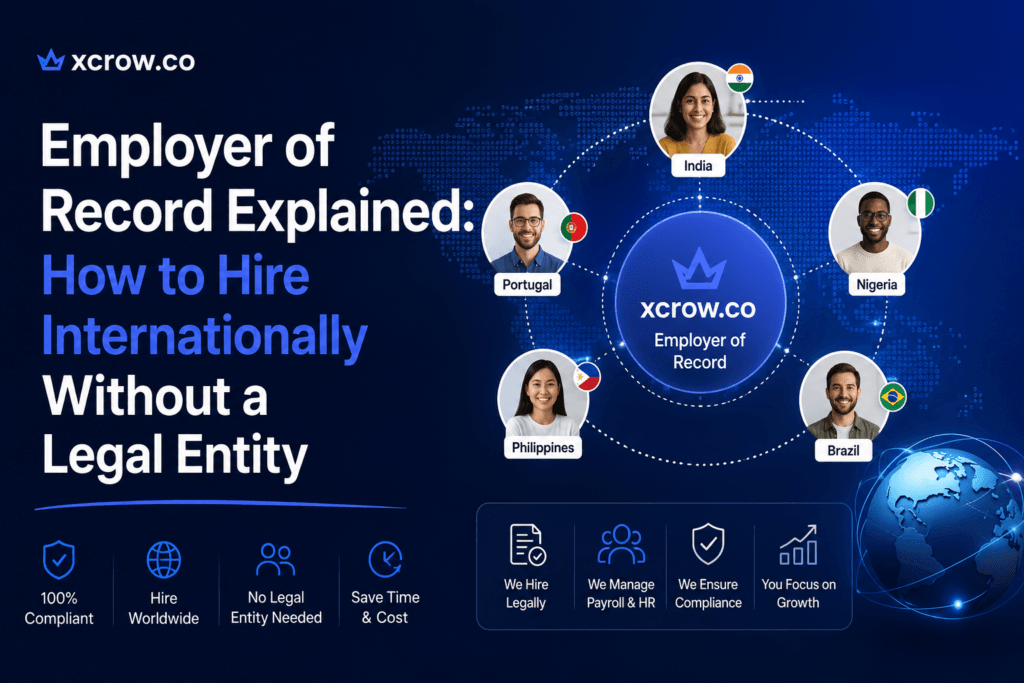
Hiring internationally can help a growing company reach skilled professionals in new markets without immediately creating a separate legal entity in every country. It can also create responsibilities involving employment contracts, payroll, taxes, benefits, privacy, worker classification, and termination. The safest approach is to choose a structure based on the actual working relationship and obtain qualified local advice before hiring.
What does it mean to hire without a local entity?
A company may hire internationally through an Employer of Record (EOR), engage a genuinely independent contractor, or use another compliant local employment arrangement. These options are not interchangeable. The correct choice depends on whether the person will function as an employee, how long the relationship will last, where the work is performed, and what local law requires.
How an Employer of Record works
An EOR is a third-party organization that employs a worker on behalf of another company. The EOR generally prepares a locally compliant employment contract, processes payroll, withholds taxes, administers statutory benefits, and handles required employment filings. The client company normally selects the person, defines the role, assigns daily work, sets goals, and reviews performance.
This creates a clear division of responsibilities. The EOR is the legal employer for specified employment matters, while the client company directs the worker’s day-to-day activities. The arrangement should be explained openly to the worker, including who handles payroll, leave, benefits, workplace concerns, and formal employment documentation.
Why companies consider an EOR
Creating a foreign subsidiary can involve registration, banking, accounting, payroll, reporting, tax, and ongoing administration. An EOR may allow a company to hire one or several employees while testing a market, supporting an international customer, or building a distributed team.
An EOR can simplify administration, but it does not eliminate management duties or legal risk. The company still needs clear responsibilities, secure systems, appropriate equipment, respectful supervision, and a process for handling performance, leave, workplace concerns, and access to confidential information.
Employee or contractor?
Independent contractor arrangements may be suitable when a person operates an independent business, controls how the work is performed, serves multiple clients, invoices for services, and accepts project-based responsibility. A written contract should describe the services, deliverables, payment terms, confidentiality, intellectual property, and termination process.
Classification becomes risky when a person works exclusively for one company, follows fixed employee-like hours, performs an ongoing core role, uses the company’s systems, and is closely supervised. Calling someone a contractor does not determine their legal status. Classification tests vary by country, so review the facts with qualified local counsel before choosing this route.
A practical international hiring process
- Define the role, location, working arrangement, compensation, and expected start date.
- Decide whether the relationship is genuinely employment or independent contracting.
- Compare compliant options, including an EOR or local entity.
- Request a country-specific estimate of payroll, taxes, benefits, fees, and currency costs.
- Review the proposed contract and confirm ownership of work, confidentiality, and data handling.
- Give the worker a clear explanation of the employer, manager, payroll schedule, and benefits.
- Complete onboarding, security training, equipment setup, and access controls.
- Maintain records and review the arrangement when the role, location, or working pattern changes.
Costs to examine carefully
EOR pricing may include a recurring administration fee, statutory employer contributions, payroll processing, benefits, currency conversion, onboarding, insurance, and termination-related charges. Ask for a written breakdown of recurring and one-time costs. Check whether benefits are included, optional, or billed separately.
Do not compare providers only by their advertised monthly fee. Review local coverage, support quality, payroll timing, data security, contract flexibility, payment methods, and the provider’s use of its own legal entity or a local partner.
Questions to ask before choosing a provider
- Who is the legal employer in the worker’s country?
- Which payroll, tax, leave, benefits, and filing services are included?
- What additional costs may arise during onboarding, relocation, leave, or termination?
- How are employee records stored and protected?
- What support is available to the worker and the client company?
- How are complaints, performance issues, and workplace investigations handled?
- What happens if the worker changes location?
- How can either party end the arrangement?
Privacy, security, and intellectual property
International hiring often involves transferring identity, payroll, contact, and performance information across borders. Limit access to people who need it, use secure systems, document retention practices, and confirm how the provider handles privacy obligations. Contracts should also address ownership of work product, confidential information, inventions, and the return or deletion of company data.
When an EOR may not be ideal
An EOR may become less economical when a company has a large, stable workforce in one country and can justify establishing its own entity. It is also unsuitable for a relationship that is genuinely independent contracting if the provider’s employment model does not match the work. The best arrangement is the one that reflects the facts and can be managed consistently.
Final checklist
Before hiring, identify the worker’s location, classify the relationship carefully, compare total costs, review local benefits and termination rules, confirm privacy and intellectual property terms, and document who is responsible for each employment task. Do not rely on a convenient label or a generic agreement copied from another country.
Hiring internationally without a legal entity can be practical, but it should not be treated as a shortcut around local requirements. An EOR may simplify employment administration, while a properly structured contractor relationship may suit independent project work. In both cases, accurate classification, transparent communication, secure data handling, and qualified local advice provide the strongest foundation for a responsible international team.

Israel Otoijamun is the founder of Xcrow, an AI-powered freelance marketplace connecting businesses with remote professionals. He has over 15 years experience in digital business, freelancing, technology, and online platforms. He writes about freelancing, remote work, hiring, digital payments, and the future of online work.