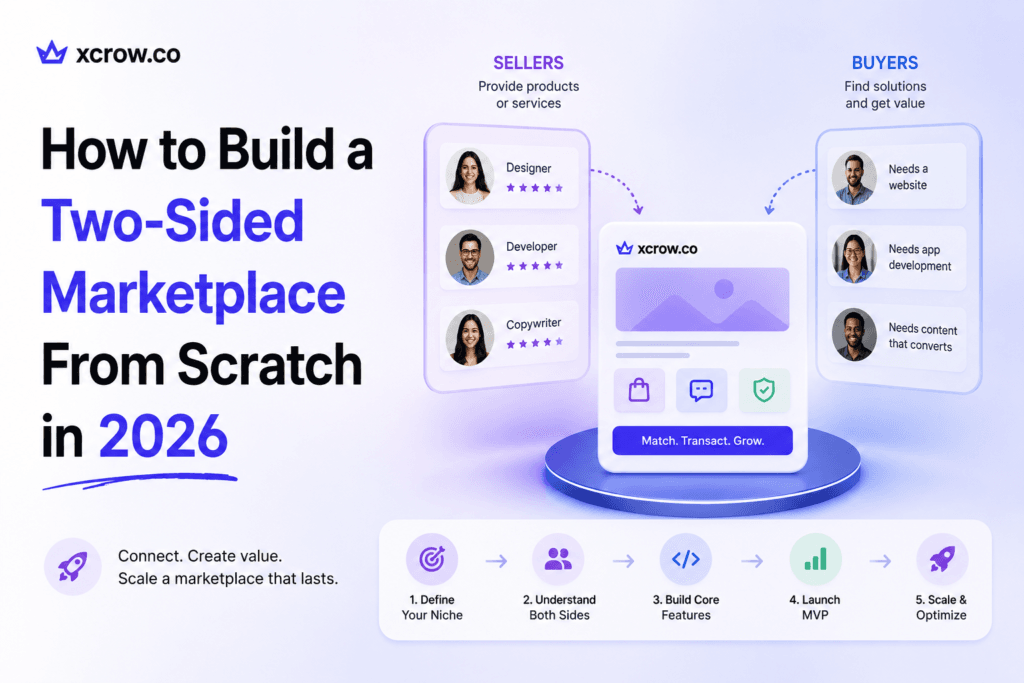
Building a two-sided marketplace is different from building a website with listings. A marketplace must help two groups find each other, trust each other, complete transactions, and return. Buyers need useful choices, while sellers need a realistic opportunity to reach customers. This guide explains how to test the idea, launch a focused first version, and improve it responsibly.
Understand the marketplace model
A two-sided marketplace connects buyers with sellers, customers with service providers, or organizations with independent professionals. The platform may earn revenue through a transaction commission, subscription, listing fee, lead fee, promoted placement, or a combination of models.
The central challenge is that each side depends on the other. Buyers do not want to visit an empty platform, and sellers do not want to invest time where there is no demand. This is often called the chicken-and-egg problem. The solution is not to launch everywhere at once. It is to create enough activity in a narrow segment that users can complete valuable transactions.
Choose a narrow starting niche
Start with a defined customer, category, location, or use case. “A marketplace for everyone” is difficult to explain and expensive to operate. A focused platform for a particular service, professional group, neighborhood, or business problem gives you a clearer audience and makes supply and demand easier to concentrate.
Choose a niche where the problem is frequent, existing alternatives are frustrating, and both sides are reachable. Consider whether buyers currently struggle to compare providers, whether sellers need better access to customers, and whether the transaction is valuable enough to support your business model.
Validate before building
Interview potential buyers and sellers before paying for complex development. Ask how they solve the problem today, what the current process costs, what creates the most frustration, and what would make them change. Avoid relying only on questions such as “Would you use this?” because people can express interest without taking action.
Look for evidence of behavior. Can you recruit providers who agree to create profiles? Will potential buyers make a request, schedule a conversation, or pay for a small pilot? A simple spreadsheet, landing page, form, or manual matching service can reveal more than a polished prototype that nobody uses.
Launch with a concierge MVP
A concierge MVP is a small version of the marketplace where important tasks are performed manually. You may recruit the first providers yourself, review listings, match buyers with suitable sellers, answer questions, and coordinate payment or delivery. This approach helps you learn what users actually need before automating the process.
Manual work is valuable when it produces real transactions and useful information. Record common questions, reasons for rejection, delays, cancellations, disputes, and repeat requests. These observations should guide the features you build later.
Build supply and demand deliberately
Supply means the products, services, or professionals available on the platform. Demand means qualified buyers who have a genuine reason to use them. Recruit enough high-quality supply for a buyer to find relevant choices, then invite buyers who match that supply.
Do not measure success only by registrations. Track meaningful activity: completed profiles, searches, inquiries, matches, completed transactions, repeat usage, cancellations, and response times. A smaller group that completes transactions is more valuable than a large audience that never returns.
Decide what to build first
The first product should support the core transaction. Depending on the marketplace, that may include profiles, listings, search, filters, messaging, requests, scheduling, payments, notifications, reviews, and basic administration. Avoid adding complex social features or broad customization before the main exchange works reliably.
Existing marketplace software or a no-code tool may be appropriate for early testing. Custom development becomes more sensible after you have validated demand and identified requirements that existing tools cannot meet. Choose technology based on the transaction, security needs, budget, maintenance capacity, and ability to export or protect your data.
Create trust and safety systems
People are more willing to transact with strangers when the platform makes expectations clear. Use appropriate identity or business verification, accurate profiles, transparent pricing, clear terms, reviews tied to completed transactions, and a way to report problems.
For higher-risk transactions, consider payment protection, staged payments, moderation, insurance, or additional verification. Explain when money is collected, held, released, refunded, or disputed. Do not promise protection that your platform cannot actually provide.
Choose a sustainable revenue model
A transaction commission is often easy to understand because the platform earns when users receive value. Other options include subscriptions for professional sellers, listing fees, paid leads, or promoted placements. Test pricing carefully. Charging providers before you have demonstrated demand can prevent you from building enough supply.
Be transparent about fees, taxes, refunds, payment processing, and currency conversion. Users should be able to understand what they pay and what the platform provides in return.
Reduce off-platform leakage ethically
Once buyers and sellers meet, they may try to transact elsewhere. The best response is to create continuing value rather than relying only on restrictions. Reliable payments, records, dispute support, reviews, scheduling, repeat-order tools, and useful communication can make staying on the platform worthwhile.
Use clear terms, but avoid unfair restrictions that prevent users from making informed choices. Privacy and competition rules may apply, so obtain professional advice when designing platform policies.
Measure marketplace health
Track the percentage of inquiries that become transactions, time to first response, successful match rate, repeat purchase rate, provider retention, buyer retention, cancellations, disputes, and revenue per transaction. Review these measures by segment and location rather than hiding weak results inside a total.
Liquidity is a practical measure of whether users can find a suitable match quickly. If a category has many providers but few buyers, improve demand generation or narrow the supply. If buyers arrive and cannot find suitable providers, recruit better-matched supply before spending more on advertising.
Plan for responsible growth
Expand only after the first segment produces reliable transactions and support processes are manageable. New locations and categories may introduce different payment methods, tax rules, consumer protections, language needs, and safety risks. Update terms, privacy notices, moderation procedures, and support capacity before expanding.
A successful marketplace is built through repeated learning, not a single launch campaign. Start with a specific problem, validate behavior, facilitate early transactions manually, build trust into the experience, and measure completed value. When buyers and sellers consistently benefit from participating, technology and marketing can help the marketplace grow on a stronger foundation.
Recommended Article
How to Safely Pay Freelancers Internationally Without Getting Scammed
Freelancing Mistakes That Make Clients Stop Hiring You — and How to Fix Them

Israel Otoijamun is the founder of Xcrow, an AI-powered freelance marketplace connecting businesses with remote professionals. He has over 15 years experience in digital business, freelancing, technology, and online platforms. He writes about freelancing, remote work, hiring, digital payments, and the future of online work.