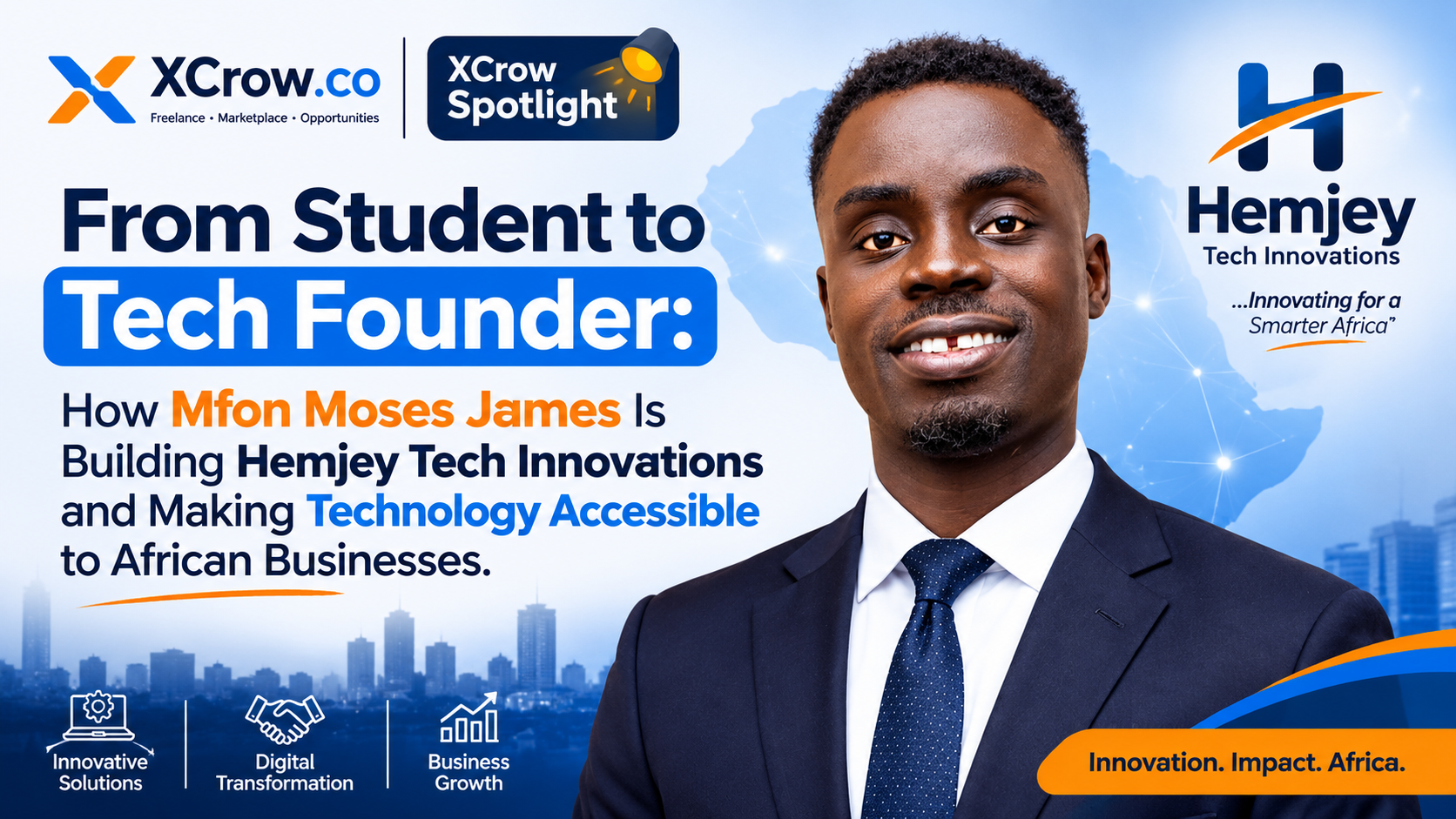
Good day, everyone, and welcome to another exciting edition of Xcrow Spotlight, where we bring you closer to the people, stories, experiences and ideas shaping the future of technology, entrepreneurship and innovation.
Xcrow Spotlight is a platform dedicated to celebrating visionary individuals, exploring entrepreneurial journeys, sharing practical insights and creating conversations that inspire the next generation of innovators, professionals and business leaders.
Today, we are delighted to have with us a young entrepreneur and technology enthusiast who is making his mark in Nigeria’s digital and technology ecosystem.
Our guest is Mfon Moses James, the Founder and CEO of Hemjey Tech Innovations Limited, a Nigerian technology company helping startups, small businesses and growing organisations establish and strengthen their digital presence.
His entrepreneurial journey began in 2024, and since then, he has continued to develop the company across areas including web development, mobile applications, UI/UX design, branding, digital marketing, business automation and digital skills training.
Beyond entrepreneurship, Mfon is currently pursuing Computer Science at the University of Ibadan. He is also passionate about making technology more accessible, empowering young Africans with practical digital skills and helping businesses leverage technology to grow.
Today, we will explore his personal journey, the challenges of building a technology company, the opportunities emerging from artificial intelligence, the future of digital entrepreneurship in Africa and the lessons he has gathered along the way.
Mfon, welcome to Xcrow Spotlight. It’s a pleasure to have you with us.
Let’s get started!
SECTION ONE: PERSONAL BACKGROUND & ENTREPRENEURIAL JOURNEY
1. Let’s start with your personal story. Who is Mfon Moses James beyond being the Founder and CEO of Hemjey Tech Innovations?
Beyond the title of Founder and CEO, I would describe myself as a learner, builder, problem-solver and someone who genuinely enjoys seeing an idea become something real.
My journey has not been one of having everything figured out from the beginning. I have had to learn through experience, mistakes, experimentation and taking responsibility for the decisions I make. My upbringing taught me the importance of resilience, humility, discipline and being willing to start small.
Academically, my background is in Computer Science, and I am currently pursuing my degree at the University of
Ibadan. Technology has always interested me because of its ability to solve problems beyond physical boundaries. A simple website, application or digital system can help a small business reach customers it could never physically reach.
Outside technology and business, I am interested in learning, personal development, leadership, digital entrepreneurship and understanding how technology can be used to create opportunities for other people.
What has shaped me most is probably the realization that you don’t always need to have everything before you begin. Sometimes you begin with what you have, learn along the way, improve your capacity and gradually build something bigger.
That philosophy has influenced both my career and the way I approach Hemjey Tech Innovations.
2. You are currently pursuing Computer Science at the University of Ibadan while leading a technology company. How have you managed both?
It has not always been easy.
There are periods when academic responsibilities, business responsibilities and personal development compete for the same time. I have had to become much more intentional about prioritisation.
One thing entrepreneurship has taught me is that being busy is not necessarily the same thing as being productive. I have learned to distinguish between activities that require my direct attention and those that can be delegated, systemised or scheduled.
My academic experience has also influenced how I approach technology. Computer Science has strengthened my understanding of logic, systems, algorithms and structured problem-solving. At the same time, running a company has taught me that technology does not exist in isolation.
You can build technically impressive software and still fail if it doesn’t solve the customer’s actual problem.
So I try to combine both perspectives: technical thinking and business thinking.
University gives me theoretical foundations, while entrepreneurship constantly challenges me to apply what I know to real-world problems.
3. What initially inspired your interest in technology, web development and digital innovation?
My interest developed from seeing how much a digital presence could change the perception and reach of a business.
I became particularly interested in websites because I realised that a website is more than a collection of pages. For many businesses, it is their digital office, storefront, credibility platform and a place where potential customers can learn about them at any time.
That idea fascinated me.
I started exploring web development and WordPress, experimenting with websites and learning how different digital tools could be combined to solve business problems.
Over time, my curiosity expanded from simply building websites to understanding digital marketing, automation, UI/UX, applications and business systems.
The more I learned, the more I realised that technology was not just about writing code. It was about understanding a problem and using technology to create a practical solution.
That became the foundation of how I think about technology today.
4. At what point did you decide to establish your own technology company?
There was a point where I realised I didn’t just want to build digital solutions for individual projects. I wanted to create an organisation that could consistently help businesses use technology to grow.
That was the thinking behind Hemjey Tech Innovations.
The company began operations in 2024. At the beginning, the vision was relatively simple: provide practical and affordable digital solutions to businesses that might otherwise struggle to access professional technology services.
As we worked with more businesses, I began to see a much larger problem.
Many small businesses in Nigeria have good products and services but lack the digital infrastructure to present themselves professionally. Some rely entirely on social media, while others have no website, no structured digital marketing system and very limited automation.
I saw an opportunity to build a company that could help close that gap.
Hemjey therefore grew from an idea around web and digital services into a broader technology company focused on helping businesses establish and improve their digital presence.
SECTION TWO: BUILDING HEMJEY TECH INNOVATIONS
5. Can you walk us through the journey from 2024 to becoming a limited liability company in 2026?
The journey has been gradual.
We began operations in 2024, when the focus was primarily on delivering digital solutions and gaining practical experience in the market.
In January 2025, Hemjey was registered as a business name. That was an important step because it moved the company from simply operating as an emerging venture toward having a more formal business structure.
By February 2026, we took another major step and incorporated Hemjey Tech Innovations Limited.
Each stage represented a different level of maturity.
The early stage was about learning and proving that the idea could work.
The business registration stage was about formalisation and credibility.
The limited liability company stage represented our intention to build something more structured and sustainable.
One of the biggest lessons from that journey is that business growth doesn’t happen overnight. You build credibility one client, one project, one relationship and one improvement at a time.
6. Hemjey operates across websites, applications, UI/UX, branding, digital marketing, automation and training. How did this broad offering develop?
It developed primarily from listening to our clients.
A client may initially come to us because they need a website. During the conversation, we may discover that they also need branding, digital marketing, automation, a customer management system or training for their staff.
So instead of looking at technology as isolated services, we began looking at the bigger digital ecosystem surrounding a business.
I would describe Hemjey as a combination of a technology development company and a digital transformation partner.
Our goal is not simply to deliver a website or application and walk away. We want to understand what the business is trying to achieve and determine where technology can help.
7. Your vision is to help 500 startups and growing businesses establish a strong digital presence.
Why 500?
The number 500 represents something bigger than a numerical target.
I have seen many businesses with good ideas struggle because they don’t have the right digital infrastructure or because they assume professional technology is only available to companies with large budgets.
I want to challenge that perception.
Our vision is to help at least 500 startups and growing businesses establish a stronger digital presence through websites, digital tools, automation, branding and other technology solutions.
For me, success would not simply mean saying, “We served 500 businesses.”
It would mean being able to look back and say that hundreds of businesses became more visible, more credible, more organised and better positioned to compete because of the technology we provided.
We intend to achieve this through affordable packages, partnerships, referrals, digital education, strategic marketing and continuously improving our service delivery.
8. How do you make quality technology accessible to businesses with limited budgets?
We focus heavily on value.
Affordability should not mean giving clients an inferior product. At the same time, a small business doesn’t necessarily need the same technology stack as a large corporation.
The key is understanding what the business actually needs.
For example, a startup may not need a highly complicated custom application on day one. It may need a professional website, a proper business profile, good customer communication systems and an effective way of generating leads.
We therefore try to build solutions that are appropriate for the client’s current stage while leaving room for future growth.
We also package services strategically and use technologies such as WordPress, automation platforms and AI-assisted tools where appropriate to reduce development costs and delivery time.
The objective is to balance four things: Value. Quality. Sustainability. Affordability.
If we cannot maintain that balance, the business model itself will eventually become unsustainable.
SECTION THREE: BUSINESS OPERATIONS, PROJECTS & INDUSTRY EXPERIENCE
9. Which project or client engagement has been particularly memorable?
One thing I have learned is that every project teaches you something different.
Projects such as Moove Travels & Logistics, Sula Hope Foundation, Queen & Sons Autos and Shalom Healing
Ministries have been particularly meaningful because they represent different industries and different digital needs.
What makes a project memorable to me is not necessarily its technical complexity. It is seeing the moment when a client begins to understand what their digital presence can actually do for their organisation.
A client may initially say, “I just need a website.”
But during the process, they begin to see possibilities around customer acquisition, credibility, communication, automation and growth.
That transformation in the client’s thinking is one of the most rewarding parts of the work.
10. How do you translate a client’s business needs into functional digital products?
We begin with questions before we begin with design.
We need to understand: • What does the business do? • Who are its customers? • What problem does it solve? • What makes it different? • How currently do customers find it? • What happens after someone makes an enquiry? • What does the business want technology to improve?
Only after understanding those things do we start thinking about the technology.
A beautiful website that does not generate enquiries, communicate value or support the business objective is not necessarily a successful project.
So we try to connect design with functionality and business objectives.
For us, the question isn’t simply “Does it look good?”
The bigger question is: “Does it work for the business?”
11. What aspects of running the company have been most challenging?
One of the biggest lessons has been that technical ability alone does not build a successful company.
You can know how to build websites and applications and still struggle with sales, pricing, customer management, project management and cash flow.
Client acquisition has been particularly important because you cannot build a sustainable company without a consistent way of attracting the right customers.
I have also had to learn how to manage expectations.
Sometimes entrepreneurs want everything immediately, but quality work requires proper planning.
Over time, I have become more focused on processes: defining project requirements, setting expectations, documenting work, creating clearer packages and improving communication.
I’m still learning, but I now understand that systems allow a business to grow beyond the capacity of the founder.
12. What differentiates Hemjey Tech Innovations?
I think our biggest differentiator is our approach to accessibility and practical problem-solving.
We don’t want technology to feel intimidating to small businesses.
We try to communicate in a language that business owners understand rather than overwhelming them with technical terminology.
We also take a long-term view of client relationships.
Our goal isn’t simply to complete a project and disappear. We want to help clients understand what they have, how to use it and how they can improve it as their business grows.
Trust is also extremely important.
In technology, clients are often giving you access to sensitive business information, websites, systems and sometimes customer data. That requires responsibility.
So we are continuously working to build trust through transparency, communication, quality delivery and accountability.
SECTION FOUR: TECHNOLOGY, AI & THE FUTURE OF WORK
13. How is AI influencing your work at Hemjey?
AI is already changing the way we work.
We use AI-assisted tools for areas such as brainstorming, research, content development, troubleshooting, workflow automation and speeding up certain parts of development.
But I don’t see AI as a replacement for thinking.
AI can generate something quickly, but someone still needs to understand the business requirement, verify the output, identify mistakes and make appropriate decisions.
We are also interested in helping our clients use AI practically.
For example, AI can support customer communication, content creation, internal workflows, lead management and business automation.
The opportunity is much bigger than simply asking AI to write something.
It is about asking: “Where can intelligence and automation reduce repetitive work and improve the way this business operates?”
14. Will AI disrupt traditional developers and technology professionals?
Absolutely, it will disrupt parts of the industry.
But disruption does not necessarily mean elimination.
Technology has always changed the way technical professionals work. Developers who refused to adopt new tools were eventually left behind.
I think the future belongs to professionals who combine technical knowledge with problem-solving, communication, creativity, business understanding and the ability to work with AI.
Aspiring developers should not focus only on learning syntax.
They should learn: problem-solving, software fundamentals, system thinking, communication, product thinking, cybersecurity awareness, AI literacy and business understanding.
The question is no longer simply: “Can you code?”
It is increasingly: “Can you use technology intelligently to solve valuable problems?”
15. Why did Hemjey move into digital skills training?
Because technology is only powerful when people know how to use it.
There are many young Africans who have access to smartphones and the internet but don’t know how to convert that access into economic opportunity.
Our training initiatives in areas such as virtual assistance, Excel, social media and AI for business are part of our broader belief that digital literacy should be practical.
I don’t want training to be purely theoretical.
Someone should be able to learn a skill and understand how that skill can help them work remotely, support a business, start a service, improve their productivity or compete internationally.
Digital education can play a significant role in reducing the skills gap and preparing young Africans for the changing nature of work.
16. What prevents many talented Nigerians from accessing international opportunities?
Talent is only one part of the equation.
A person can be technically excellent but still struggle internationally because they don’t know how to position themselves.
Some of the challenges include poor portfolios, weak communication, lack of professional online presence, inconsistent delivery, limited knowledge of international client expectations and difficulty demonstrating credibility. Young professionals need to think beyond simply saying, “I can do this.”
They need to demonstrate it.
Build a strong portfolio. Develop a professional LinkedIn profile. Document your work. Learn how to communicate with clients. Understand contracts and scope. Deliver on time. Build relationships. Keep learning.
In a global marketplace, your reputation can travel further than your physical location.
SECTION FIVE: ENTREPRENEURSHIP, AFRICA’S DIGITAL ECONOMY & OPPORTUNITY CREATION
17. What advice would you give someone moving from freelancing to building a technology company?
First, understand that freelancing and running a company are not exactly the same thing.
As a freelancer, you may be selling your personal skill.
As a company, you are building a system that can deliver value beyond your personal capacity.
The first thing I would advise is to identify a clear problem and a clear market.
Then formalise the business when appropriate, separate personal and business finances, create proper pricing, document processes and learn sales.
Don’t rush to build a large team simply because you want to look like a big company.
Build the right systems first.
Also, don’t confuse revenue with profit.
A business can generate money and still be financially unhealthy.
Entrepreneurs need to understand their numbers, manage cash flow and reinvest intelligently.
Most importantly, don’t build a company simply because having a company sounds impressive.
Build because there is a problem you genuinely want to solve and a market willing to pay for that solution.
18. What are the biggest barriers to technology startup growth in Nigeria and Africa?
I think it is a combination of several factors.
Funding is important, but I don’t believe funding is the only problem.
Infrastructure, reliable electricity and internet access, customer trust, access to skilled talent, regulatory uncertainty, limited digital adoption and sometimes the difficulty of acquiring paying customers all affect technology businesses.
There is also a gap between having technical talent and having commercially viable technology companies.
We need more people who understand both technology and business.
We also need stronger ecosystems where entrepreneurs can access mentorship, markets, funding, infrastructure and networks.
If we can improve those areas simultaneously, Africa has enormous potential.
19. What is your perspective on platforms such as Xcrow?
I think platforms such as Xcrow can play an important role in reducing the distance between talent and opportunity.
One of the biggest advantages of digital work is that geography is becoming less restrictive.
A skilled Nigerian professional should not necessarily have to relocate to another country before accessing international opportunities.
Platforms that connect businesses with professionals can help solve part of that problem by providing discovery, credibility and access to clients.
However, professionals still have a responsibility.
A platform can create the opportunity, but your skill, communication, reliability, portfolio and professionalism determine whether you can retain that opportunity.
I see platforms like Xcrow as part of the larger digital economy that can help African professionals move from simply having skills to actually monetising those skills globally.
SECTION SIX: LEADERSHIP, FUTURE AMBITIONS & PERSONAL INSIGHTS
20. Where do you see Hemjey Tech Innovations in the next five years?
Over the next five years, I want Hemjey to evolve beyond being known primarily as a service company.
I want us to develop proprietary technology products, expand our digital transformation services, create more employment opportunities and serve businesses beyond Nigeria.
Our 500-business vision is an important milestone, but I see it as part of something much bigger.
I would like Hemjey to become a recognised African technology brand that helps businesses adopt technology without feeling that technology is inaccessible or unnecessarily complicated.
I also want us to invest more in training young people and creating opportunities for talented professionals.
Ultimately, I want to build a company that is commercially successful but also creates measurable economic value.
QUICK FIVE: GETTING TO KNOW THE FOUNDER
1. What is one business or technology lesson you wish you had learned earlier in your entrepreneurial journey?
Sales is as important as the product.
You can build something excellent, but if you cannot communicate its value to the right people, the market may never discover it.
I wish I had understood earlier that entrepreneurship requires both creation and distribution.
2. If you had to choose between building a product that generates millions and one that positively impacts millions, which would you choose?
I would choose the one that positively impacts millions, provided it can also become financially sustainable.
I don’t believe impact and profitability should be enemies.
In fact, the strongest businesses often solve meaningful problems at scale while generating enough revenue to continue solving those problems.
For me, the ideal is impact at scale with sustainable economics.
3. What book, individual or experience has influenced your approach to business and leadership?
One of the biggest influences has been my experience itself.
Building Hemjey has taught me lessons that no book could completely teach me—dealing with uncertainty, clients, setbacks, money, responsibility and the pressure of making decisions.
I have also drawn lessons from business thinkers and entrepreneurs who emphasise sales, positioning, customer psychology, leadership and execution.
But ultimately, I believe the most powerful teacher is experience combined with the willingness to learn from it.
- What is one misconception young Nigerians have about becoming successful technology entrepreneurs?
One major misconception is that success in technology means simply learning how to code.
Technical skills are important, but entrepreneurship requires much more.
You need to understand customers, sales, finance, communication, marketing, leadership and execution.
Another misconception is that you need a huge amount of money before you can start.
Sometimes what you need first is a clear problem, a useful skill, a customer and the discipline to start small and improve.
- If you could give your 18-year-old self one piece of advice, what would it be?
Start earlier, learn faster and don’t be afraid of being a beginner.
I would tell myself not to wait until everything is perfect.
Learn valuable skills. Build things. Talk to people. Make mistakes. Take opportunities seriously. And most importantly, be patient with the process.
You don’t have to have your entire life figured out at 18.
You just need to keep becoming more capable.
PROFESSIONAL BIOGRAPHY
Mfon Moses James is the Founder and CEO of Hemjey Tech Innovations Limited, a Nigerian technology company focused on helping startups, SMEs and growing organisations establish and strengthen their digital presence.
With a background in Computer Science and an entrepreneurial journey that began in 2024, Mfon has built his experience around web development, digital transformation, automation, branding, digital marketing and technology-driven business solutions.
Under his leadership, Hemjey Tech Innovations has evolved from an emerging digital venture into a formally incorporated limited liability company, serving businesses and organisations across different sectors.
His vision is to help at least 500 startups and growing businesses gain access to professional and practical digital solutions without assuming that quality technology must be unaffordable.
Beyond technology development, Mfon is passionate about digital skills development and believes that practical technology education can help young Africans participate more effectively in the global digital economy.
He is currently pursuing Computer Science at the University of Ibadan while continuing to lead and develop Hemjey Tech Innovations.
His broader ambition is to build an African technology company that combines commercial sustainability with meaningful impact—helping businesses grow, creating opportunities for young professionals and making digital technology more accessible to emerging businesses.
ADDITIONAL CONTRIBUTOR INFORMATION
Official Company: Hemjey Tech Innovations Limited
Official Website: Hemjey Tech Innovations.
Company LinkedIn: https://www.linkedin.com/company/hemjey-tech-innovations/
Company Instagram: @hemjey_tech_innovations
Company X: @hemjeytechinno
Company TikTok: @hemjeytechinnovations
Company YouTube: @hemjeytechinnovations
CLOSING MESSAGE
Thank you for taking the time to participate in Xcrow Spotlight. We believe your experiences, insights, and entrepreneurial journey will provide valuable lessons for aspiring technology professionals, young entrepreneurs, freelancers, and business owners across Africa and beyond. We look forward to sharing your story with the Xcrow community.

Israel Otoijamun is a digital business strategist, technology entrepreneur, and the founder of Xcrow, a platform connecting businesses with top remote talent.
With more than 15 years of experience across online platforms, technology, and digital payments, Israel regularly publishes insights on freelancing, tech job opportunities, remote workforce strategies, and modern hiring ecosystems.
Read more about Israel Otoijamun.
Leave your comment
You must be logged in to post a comment.