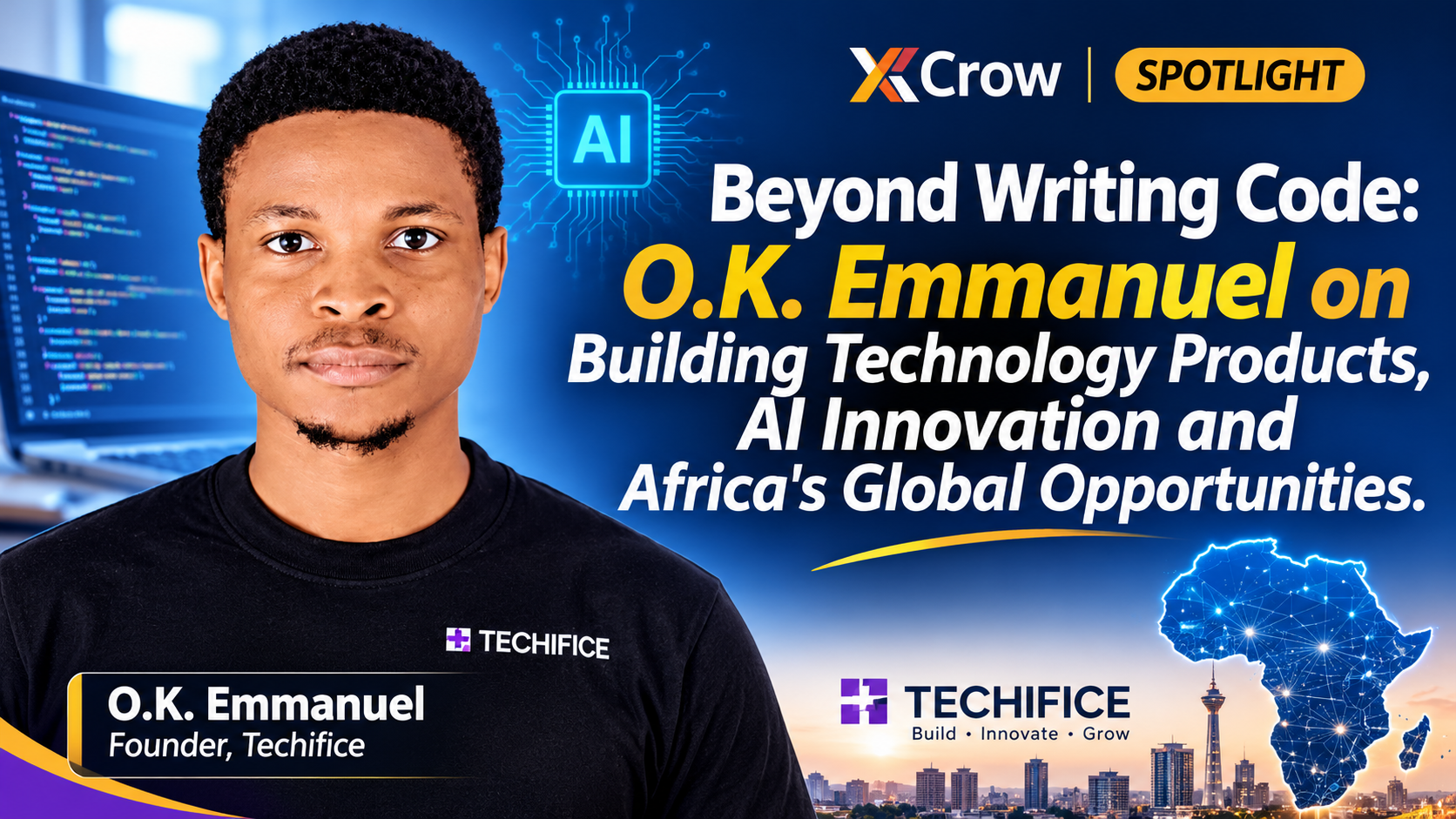
The technology industry is evolving rapidly, and the opportunities available to African professionals are no longer limited to providing technical services or working on projects for clients. From artificial intelligence and software engineering to digital product development and business automation, a new generation of technology professionals is exploring how to build solutions, create sustainable businesses and compete in the global digital economy.
One of the professionals contributing to this evolving landscape is O.K. Emmanuel, a software engineer, technology entrepreneur, digital strategist and educator, and the Founder of Techifice, a digital innovation and technology company focused on helping businesses turn ideas and operational challenges into functional digital solutions.
His journey into technology began with an early curiosity about how things work, progressing from mechanical typewriters and basic computer skills to software engineering, product development and entrepreneurship. Through continuous learning, professional experience and a strong interest in the relationship between technology and business, Emmanuel has developed a perspective that goes beyond writing code or building applications.
In this edition of XCrow Spotlight, we speak with O.K. Emmanuel about the thinking behind Techifice, the realities of building a technology company, and why successful digital products must begin with solving genuine problems rather than simply adopting popular technologies.
He also shares his perspective on artificial intelligence and its impact on software developers and other digital professionals, the skills African freelancers need to compete internationally, and the opportunities available to entrepreneurs looking to build technology businesses from Africa.
From identifying worthwhile business problems before investing in software development to understanding the importance of professional credibility, product ownership and continuous learning, this conversation offers practical insights for aspiring developers, freelancers, founders and anyone interested in the future of technology in Africa.
PART ONE: THE PERSON BEHIND THE BUSINESS
1. Before we get into Techifice, we’d love to know the person behind the company. Could you tell us a little about yourself, your background and how your journey into technology began?
My name is Olawuni Emmanuel Kayode, professionally known as O.K. Emmanuel. I am a builder of people, platforms and ventures that elevate livelihoods. I work at the intersection of technology, business, innovation and human development as a software engineer, technology entrepreneur, digital strategist and educator.
My journey into technology began at a relatively young age, driven largely by curiosity and a desire to understand how things work. From the days of working with mechanical typewriters, I was fascinated by the possibilities technology presented, particularly its ability to turn ideas into practical solutions.
I was also interested in understanding how organisations operated. I gradually moved beyond typewriting into basic computer skills, including desktop publishing and graphic design in 2014. I leveraged these digital skills to assist my school during examination periods by typesetting documents and facilitating practical sessions in the school’s computer laboratory.
What started with creative and digital work gradually evolved into a deeper interest in computing, software engineering, product development and business systems.
Mine has been largely a self-directed learning journey. I have had to learn, experiment, build, unlearn and rebuild, often finding opportunities to develop my capabilities outside conventional academic pathways.
I trained at KS Academy, where I also worked as a Programming Instructor for three years. I later completed the intensive 18-month ALX Software Engineering programme in November 2024, which further strengthened my engineering foundation and helped me appreciate collaborative development.
Over the years, I have also become increasingly interested in the business and human dimensions of technology. I am not limited to building software; I explore the purpose behind building, the problems it should solve, the businesses it can create and the people it can empower.
That combination of interests has significantly shaped my work and the vision behind Techifice.
2. What first sparked your interest in technology and software development? Was there a particular experience or moment that made you realise this was the path you wanted to pursue?
I would say curiosity was the initial spark, but the real attraction was discovering that technology gives you the ability to create things that exist in your imagination. It is also a form of leverage for stability.
I have always been drawn to the process of taking an idea, understanding what it requires and figuring out how to bring it to life. My early experiences with digital creativity introduced me to the possibilities of technology, but software development opened an entirely different dimension.
While there wasn’t a single defining moment when I decided to go all-in on technology, my interest expanded through exposure to different possibilities and the influence of people I admired, such as Taiwo Adedotun and Jude Labeh Terungwa. They became sources of motivation during periods when my enthusiasm was low.
I also believe in evolution. Every new thing I learned revealed another possibility, and every project made me more interested in what could be built next.
Eventually, I stopped seeing engineering as just an interest or a career. It became a medium through which I could express my ideas, solve problems and create opportunities for other people.
Technology is a tool for me, not my destination.
3. Take us back to the early days of Techifice. What inspired you to start the company, and what gap or problem did you see in the market that you wanted to address?
First, let’s unravel how the name was coined. “Tech” represents technology, while “Edifice” means a large, impressive building.
Techifice started as an idea to build the next generation of African technology leaders and changemakers while developing sustainable systems across industries. Although our methods are subject to revolutionary change, the core mission remains unchanged. Building people and systems is at the heart of our assignment.
Personally, I had experienced different aspects of the digital industry, from creative communication and marketing to digital solutions, software development and business support.
One thing became increasingly clear to me: many businesses had ambitions to grow but lacked the right technological infrastructure, expertise and strategic guidance to make that growth sustainable.
I wanted to build a company that could bridge that gap.
The original vision has continued to evolve. Today, I see Techifice as a technology and digital innovation company that helps businesses move from ideas and operational challenges to functional products, intelligent systems and scalable digital infrastructure.
For me, the opportunity has never been limited to building websites or applications. It is about helping businesses become more capable through technology.
One of the biggest challenges has been building a business while simultaneously developing the capacity required to run it.
There is a significant difference between being technically competent and building an organisation that consistently delivers value.
As a founder, I discovered through experience that my responsibilities extend beyond my strongest professional skills. I had to understand business development, operations, finance, client relationships, project management, people and long-term strategy. Not because I had to do everything, but because my role demanded more than technical expertise.
There is also the challenge of building with limited resources. You often have to make strategic decisions about what to prioritise, what to build internally, what to outsource and when to invest in capacity. Most founders can relate to the challenges associated with hiring competent and reputable individuals.
I have navigated these challenges through continuous learning, experimentation, strategic partnerships and a willingness to refine the business model as we grow.
One thing entrepreneurship has taught me is that vision is important, but vision without operational discipline can become an expensive ambition.
Building a company requires both.
PART TWO: BUILDING TECHIFICE
5. For someone discovering Techifice for the first time, how would you describe what the company does, the problems it solves and the kinds of businesses it helps?
Techifice is a digital innovation and technology company focused on helping businesses build, adopt and leverage technology for growth.
We work across software and product engineering, custom digital solutions, AI-powered automation, SaaS development and strategic digital systems.
Our work addresses a fundamental problem: businesses often have growth ambitions but lack the technological capabilities, infrastructure or expertise to execute them effectively.
For some clients, that means building a website or developing a custom application. For others, it means transforming manual processes through automation, creating a digital product, integrating business systems or developing a software solution that addresses a specific market need.
We primarily serve startups, SMEs, institutions and entrepreneurs who recognise that technology must become an integral part of how they operate and compete.
Beyond delivering individual projects, our broader ambition is to build scalable technology products and solutions that can serve markets beyond our immediate operating environment.
I would describe Techifice as a company that helps businesses turn technological possibilities into practical business capabilities.
6. Techifice focuses on product engineering, software development, AI and SaaS solutions. What does product engineering actually mean, and why should businesses care about it when building digital products?
Product engineering is the discipline of building technology around a real problem, a defined user need and a sustainable business objective.
It goes beyond writing code or designing interfaces. It involves understanding the market, identifying the problem, validating assumptions, defining product requirements, designing the user experience, engineering the solution, testing it and continuously improving it based on actual usage and feedback.
For example, two businesses can have the same idea for a mobile application, but the quality of their outcomes will depend significantly on how well they understand their users, structure the product and make decisions throughout development.
This is why businesses should care.
A technically functional product is not necessarily a successful product. It can be beautifully designed and still fail because it solves the wrong problem, has poor user adoption, lacks a viable business model or cannot scale effectively.
Product engineering connects technology with business reality.
At Techifice, this is an important distinction in how we approach development. We want to build solutions that are not only functional but also useful, maintainable, commercially relevant and capable of evolving with the needs of the business.
We also dedicate quality time to understanding the product market, adoption strategy and feasibility before committing to development.
We mostly operate under white-label arrangements, where we develop and maintain technology solutions under our clients’ brands while respecting confidentiality agreements. This means there are projects whose details we cannot publicly disclose.
However, one particularly interesting project within our product engineering work was the development of an end-to-end restaurant management ecosystem.
The problem we sought to address was operational fragmentation within restaurant businesses.
Restaurant operations involve several interconnected activities, including order management, kitchen operations, sales, inventory control and business reporting. Yet, these functions are often handled through disconnected tools, manual processes or systems that do not communicate effectively.
This creates inefficiencies, makes it difficult to maintain accurate operational records, complicates inventory and sales reconciliation, and limits management’s ability to make informed decisions in real time.
Our approach was to develop an integrated platform that brought these operational functions into one ecosystem.
The solution covered order management, food and inventory management, a point-of-sale (POS) system and AI-powered recommendations, with the broader objective of improving operational coordination and business visibility.
From an engineering perspective, the project required us to think beyond individual features and consider how the different components would interact as one functional system.
We adopted an agile development approach, breaking the work into manageable sprints, developing and testing features progressively, gathering user feedback and refining the system throughout the process.
One of the key lessons from this experience was the importance of understanding the entire business operation before engineering individual solutions.
Building an integrated product requires more than getting separate modules to work; it requires ensuring that they communicate effectively and collectively address the underlying business problem.
8. Many aspiring entrepreneurs have great ideas for websites, mobile applications or digital platforms but don’t know where to begin. What should someone consider before investing money in developing a technology product?
My first advice is simple: don’t start with the website, app or technology. Start with the problem.
Before investing in development, you should be able to explain exactly what problem you are solving, who experiences that problem, how they currently solve it and why your proposed solution would be better.
There are several important considerations.
First, validate the problem. Talk to potential users and establish that the problem exists beyond your personal assumptions.
Second, understand the market. Identify your target audience, competitors, existing alternatives and what would make your product meaningfully different.
Third, establish the business model. How will the product create value, and how will that value translate into revenue or sustainability?
Fourth, discuss the minimum viable product (MVP) with your technology team. You do not need to build every feature you have imagined. Identify the smallest functional version that can test your core assumptions and deliver meaningful value.
Fifth, think about the long-term implications: maintenance, security, infrastructure, scalability, integrations, compliance and the cost of supporting the product after launch.
Finally, choose the right technical partner. Someone who can challenge your assumptions, understand your business and translate your objectives into a realistic product roadmap is often more valuable than someone who simply agrees to build everything you request.
The goal should not be to spend money developing software. The goal should be to invest in building a solution that people actually need and are willing to use.
9. What has been your biggest lesson so far from building and managing a technology company, particularly when it comes to working with clients, managing projects and building the right team?
My biggest lesson is that technical competence alone does not build a successful technology company. Systems, communication, integrity and people do.
With clients, I have learned the importance of expectation management. A project can have excellent engineering and still become a poor experience if expectations, timelines, deliverables and responsibilities are not properly established from the beginning.
Clients may have ideas and become engrossed in the possibilities of success. However, our responsibility goes beyond building. We must also validate those ideas and ensure that we contribute to making their projects successful.
I have also learned that not every opportunity is necessarily a good business opportunity. There must be alignment between the client’s needs, the company’s capabilities, the commercial arrangement and the value we can realistically deliver.
We have declined more projects than we have accepted in order to maintain the quality of our clients and uphold our standards and values.
When it comes to teams, I look beyond the ability to execute a technical task. I value ownership, curiosity, communication, accountability and the willingness to learn.
I believe the right people should not simply be able to complete assigned work; they should understand why the work matters and take responsibility for the quality of the outcome.
Ultimately, I want Techifice to become an organisation where integrity and excellence are not just corporate values written on a wall but standards reflected in the way people think, work, communicate and deliver.
PART THREE: ARTIFICIAL INTELLIGENCE AND THE FUTURE OF WORK
10. AI is changing almost every aspect of the technology industry. From your experience, how do you think artificial intelligence will reshape businesses and the way people work over the next five years?
I believe AI is already changing the economics of productivity, decision-making and business operations.
Over the next five years, we will see a shift from businesses simply using digital tools to businesses operating increasingly intelligent systems.
Tasks that previously required significant manual effort, coordination and time will become increasingly automated. Customer support, research, data analysis, content production, software development, administrative operations and even certain aspects of strategic planning will become more efficient.
However, I think the more significant development will be the integration of AI into entire business workflows rather than the use of standalone AI tools.
For instance, imagine a business where customer enquiries are automatically classified, relevant information is retrieved, responses are drafted, transactions are processed and management receives actionable insights without manually coordinating every stage.
That is a different level of operational capability.
We will also see smaller teams achieve what previously required much larger organisations. This will create opportunities for entrepreneurs and emerging businesses to compete more effectively.
However, businesses must understand that AI does not automatically create value. Its effectiveness depends on the quality of the data, processes, infrastructure and decisions surrounding it.
The organisations that benefit most will be those that learn to redesign how they work, not simply those that purchase the most AI subscriptions.
Three years ago, people were sarcastic about AI skills. Over time, however, we have seen obvious improvements in AI capabilities across certain tasks. We have also seen companies such as Microsoft, Canva and Google increasingly integrate AI into their products and workflows.
I believe AI will replace certain tasks, reduce the demand for some forms of routine execution and fundamentally change what clients expect from digital professionals. We should not pretend otherwise.
However, replacing tasks is not the same as replacing the entire value of a professional.
Consider software development. AI can generate code, explain technical concepts, identify errors and accelerate implementation. But understanding the business problem, making architectural decisions, evaluating trade-offs, managing complexity and taking responsibility for a production system still require considerable human judgment.
The same applies to design and writing. Generating an image or producing an article is becoming easier. Understanding the audience, developing a compelling concept, establishing a brand direction and communicating something meaningful are different capabilities.
I believe we are moving from an economy that rewards execution alone to one that increasingly rewards judgment, problem-solving, creativity, strategic thinking and the ability to orchestrate intelligent tools.
The professionals most at risk are those who refuse to evolve their value proposition.
My advice is not to compete with AI at what it does best. Learn to use it, understand its limitations and develop capabilities that allow you to direct it effectively.
The opportunity is enormous for people who can combine domain expertise, human judgment and AI-enabled execution.
12. What AI tools, technical skills or emerging technologies would you encourage African freelancers and young professionals to start learning today if they want to remain relevant and competitive?
I would encourage them to develop a combination of AI literacy, technical competence and business problem-solving skills.
Sometimes, valuable opportunities are hidden in plain sight. Popular AI tools such as ChatGPT, Claude and Gemini have far more capabilities than most professionals currently take advantage of.
Don’t limit yourself to asking questions or generating content. Learn how to use them for research, analysis, coding, documentation, workflow design and productivity.
Explore automation platforms such as n8n and understand how APIs, webhooks and integrations connect different systems.
But there is another skill I consider particularly important: learning how to identify and solve problems.
The global market does not reward someone simply because they know how to use a particular tool. It rewards people who can apply their knowledge to deliver valuable outcomes.
Technology changes. Tools become obsolete. The ability to learn, adapt and solve problems is what sustains a professional over time.
I have also personally enrolled in courses on XCrow Academy, and I would encourage professionals who are serious about continuous development to explore the learning opportunities available there.
13. Many businesses are rushing to integrate AI into their operations. In your opinion, how can entrepreneurs identify where AI genuinely adds value instead of simply adopting it because it is trending?
“Can’t we use AI to build our hosting platform?” That is what a client asked me some time ago. I just smiled because it goes beyond AI integration by force.
I would advise entrepreneurs to conduct a process audit before an AI adoption exercise.
Look at the business and identify where time, money, information or productivity is being lost.
Which activities are repetitive? Where are employees spending too much time on administrative work? Where are decisions delayed because information is scattered? Which processes involve predictable patterns that could be automated?
These are better starting points than asking, “How can we use AI in our business?”
The next step is to determine whether AI is actually the appropriate solution. Some problems require better processes, conventional software, staff training or improved data management rather than artificial intelligence.
Where AI is appropriate, establish a measurable objective.
Is it reducing response time, lowering operational costs, improving customer experience, increasing conversion or helping employees produce better work?
Start with a contained use case, test it, measure the results and improve it before expanding.
I also think businesses must pay attention to data privacy, security, accuracy and human oversight.
Automating a poor process or allowing an unreliable AI system to make consequential decisions can create more problems than it solves.
My philosophy is that technology adoption should be driven by business value, not technological excitement or fantasies.
PART FOUR: FREELANCING, REMOTE WORK AND GLOBAL OPPORTUNITIES
14. Africa has a growing pool of talented developers, designers and digital professionals, yet many struggle to secure international clients. What do you think is responsible for this gap between talent and opportunity?
I think the gap is less about the absence of talent and more about the systems through which talent becomes visible, trusted and commercially accessible.
Africa has exceptional technical and creative talent. However, being good at something and being positioned to compete in a global marketplace are two different things.
A major challenge is positioning.
Many professionals communicate what they can do without clearly communicating the business problems they can solve.
A developer might say they know React or Django, but the client wants to know whether they can build a reliable product that helps the business operate better.
Another challenge is professional credibility.
International clients are not just purchasing technical skills; they are purchasing confidence. They want to know that a professional can communicate effectively, understand requirements, meet deadlines, manage expectations and take responsibility.
There are also structural challenges, including access to international payment systems, professional networks, exposure, reliable infrastructure and the effects of geographical and economic perceptions.
I believe we need to move beyond presenting African talent as affordable labour. We should position African professionals as capable problem-solvers, innovators and business partners.
The conversation should increasingly be about the quality of our thinking, the sophistication of our solutions and the value we can deliver to the global economy.
15. When Techifice works with developers or other independent professionals, what qualities do you look for beyond technical skills? What makes someone a professional you would confidently work with again?
Ownership is probably the first quality I look for.
I want to work with people who understand that delivering a task is not necessarily the same as delivering a good outcome. They should be interested in the quality of the work and willing to take responsibility for their contributions.
Communication is equally important.
Someone can be exceptionally talented, but if they cannot communicate progress, ask the right questions, explain challenges or manage expectations, collaboration becomes unnecessarily difficult.
I also value:
- Integrity: Being honest about capabilities, timelines and limitations.
- Accountability: Taking responsibility rather than constantly shifting blame.
- Problem-solving: Thinking beyond instructions and contributing solutions.
- Adaptability: Being willing to learn new tools and approaches.
- Attention to detail: Understanding that quality is often reflected in the things people overlook.
- Professional maturity: Respecting commitments, people, processes and time.
I would rather work with someone who is willing to learn, takes ownership and consistently improves than someone with an impressive technical profile but little professional discipline.
Skills can be developed. Character and professional attitude determine how effectively those skills translate into value.
16. For freelancers hoping to attract international clients, how important are portfolios, previous projects, communication skills, client reviews and professional credibility? What should they prioritise when positioning themselves for global opportunities?
They are all important, but they do not carry equal weight in every situation.
A portfolio establishes evidence of capability. Previous projects demonstrate experience. Reviews and testimonials reduce the perceived risk of engaging you. Communication demonstrates that you can collaborate effectively, while professional credibility creates confidence in your overall delivery.
My recommendation is to build a portfolio around outcomes rather than merely displaying finished work.
Don’t just show a website you developed. Explain the problem it addressed, your role, the decisions you made, the technologies involved and the value the solution was intended to create.
Also, become deliberate about positioning. Avoid presenting yourself as someone who does everything for everyone. Identify a market, a specific problem or a category of outcomes you can deliver exceptionally well.
Develop a professional online presence, join freelancing platforms, maintain a strong LinkedIn profile, build good relationships with other professionals, document your projects and collect credible testimonials.
If you don’t have enough commercial projects to showcase, work on realistic case studies and document your problem-solving processes. Demonstrating how you think and approach problems can be just as valuable as showcasing completed projects.
Most importantly, learn to communicate in the language of business. Clients want to understand how your work contributes to their objectives.
International opportunities are built on more than visibility. They are built on trust, demonstrated competence and consistent delivery.
17. Imagine a young Nigerian developer with good technical skills but no international clients or freelance experience. What practical steps would you recommend to help that person land their first international project?
First, I would tell that person not to wait until they feel completely ready.
I’ve seen professionals with less technical experience earn significantly more because they understand positioning, communicate their value effectively and know how to access opportunities.
The market does not always reward the most technically competent person; it rewards perceived value, positioning and the ability to deliver.
If you are better skilled but someone else is positioning themselves more effectively, you must also learn to adjust your positioning.
Start by building two or three substantial projects that reflect the type of work you want to be hired for. These should solve realistic problems and be documented properly. A strong case study is often more persuasive than a long list of technologies.
Third, establish a professional presence. Optimise your LinkedIn profile, create a credible portfolio and ensure that your communication reflects the quality of work you want to attract.
Fourth, start engaging with the market. Platforms such as XCrow.co, Upwork, LinkedIn and relevant professional communities can provide access to opportunities, but don’t depend exclusively on job applications.
Identify businesses that could benefit from your expertise and approach them with thoughtful, problem-specific proposals.
Fifth, develop your communication and project management skills. Learn to ask good discovery questions, prepare proposals, define deliverables and communicate professionally across different time zones.
Finally, treat your first international project as an opportunity to establish a reputation, not simply earn money.
Deliver exceptionally well, request honest feedback and build a relationship that could generate referrals and future work.
Your first opportunity may come from a small project, but your approach should reflect the standards of a professional capable of handling much bigger responsibilities.
PART FIVE: ENTREPRENEURSHIP AND AFRICA’S TECHNOLOGY ECOSYSTEM
18. From your perspective, how would you describe the current state of Africa’s technology ecosystem, particularly Nigeria’s software development industry? Where do you see the biggest opportunities emerging?
I would describe the ecosystem as one with tremendous potential, increasing sophistication and significant structural challenges.
Nigeria has a growing community of software engineers, product builders, designers, technology entrepreneurs and digital professionals.
There is also increasing awareness of the role technology can play in solving local problems and creating globally competitive businesses.
However, I think we are still at a stage where much of the ecosystem’s potential remains underdeveloped.
We have talent, but we need better synergy, stronger institutions, better infrastructure, more sustainable technology businesses, deeper research and development capabilities, and more capital flowing into product innovation.
I see significant opportunities in financial technology, health technology, education, agriculture, logistics, enterprise software, AI-powered services and business automation.
I am particularly interested in the opportunity to build software products that address operational problems across industries.
Many businesses still depend on fragmented tools, manual processes and inefficient systems. There is considerable room for locally informed solutions that can also compete internationally.
I also believe the next phase of growth should involve moving beyond being consumers and implementers of global technology towards becoming creators and owners of intellectual property.
Africa’s opportunity is not simply to participate in the global digital economy. It is to create products, companies and technologies that shape it.
19. What do you think African technology companies, startups and entrepreneurs need to do differently to compete more effectively in the global market and create more opportunities for local talent?
I think we need to become more intentional about building businesses rather than simply building projects.
We shouldn’t build businesses just to survive on daily needs. We should build to solve problems and aim to exist for as long as possible. A short-term vision affects the energy and commitment we bring to our work.
There is a difference between being able to deliver software and building a technology company that can consistently innovate, compete, create employment and sustain itself.
First, we need stronger product thinking. We should invest more time in understanding markets, validating problems and developing solutions that can scale beyond individual engagements.
Second, we need to raise our standards around engineering, customer experience, security, documentation and operational excellence. Global competitiveness requires global standards, regardless of where a company is based.
Third, we need to build more intellectual property. African technology companies should not limit themselves to providing implementation services for other people’s products. We should also be creating and owning products, platforms and technologies.
Fourth, we need to invest in people. Talent development should not be treated as an afterthought. Companies must create environments where young professionals can gain practical experience, develop discipline and grow into responsible industry contributors.
Finally, we need to think globally without losing our understanding of local realities.
Geography should describe where we execute, not limit the ambition of what we build.
I believe African technology companies can compete globally, but that will require more than talent. It will require disciplined execution, sustainable business models, stronger collaboration and a commitment to excellence.
PART SIX: LOOKING BACK AND MOVING FORWARD
20. Looking at everything you’ve experienced so far, what advice would you give to a young African who wants to build a successful career in technology, become a freelancer, or eventually establish a technology company? And what exciting things should we look forward to from Techifice in the coming years?
My first advice is to take your development seriously.
Don’t pursue technology merely because it is trending or because someone told you it is a lucrative career. Develop a genuine understanding of the problems you want to solve and the value you want to create.
Learn the fundamentals. Build things. Work with people. Seek feedback. Document your progress and consistently improve your capabilities.
I would also encourage young professionals to understand the business side of their skills. Technical knowledge becomes significantly more valuable when you understand markets, customers, communication, value creation and commercial realities.
Don’t be in a hurry to establish a company simply because entrepreneurship looks attractive. Learn how value is created, understand how businesses operate and develop the discipline required to manage people, resources and responsibilities.
And perhaps most importantly, don’t build your entire identity around a particular tool or technology.
Tools will change. The ability to think, learn, solve problems and adapt will remain valuable.
As for Techifice, we are building towards a much broader vision.
We want to evolve into a global growth technology company, combining product engineering, custom software development, AI-powered automation, strategic digital systems and scalable SaaS solutions.
We are particularly interested in developing products that address real business and human problems, while also creating opportunities for more technology professionals to participate in meaningful work.
Beyond the commercial ambition, I want Techifice to become an organisation known for the quality of its thinking, the integrity of its operations and the excellence of its people.
We are interested in building more than software. We want to build systems, products, capabilities and an ecosystem that can create value beyond the boundaries of the company itself.
There is a lot ahead, and I believe we are only getting started.
THE QUICK FIVE
We asked O.K. Emmanuel five quick questions to discover some of his personal preferences, professional beliefs and thoughts about the future of technology.
1. What is one technology tool or application you simply cannot do without?
ChatGPT. It has become a valuable thinking, research and execution partner across my work, from software engineering and problem-solving to strategy and content development.
2. If you had to choose one, would you rather build a technology product from scratch or scale an existing product?
Build from scratch. I enjoy the process of identifying a problem, imagining a solution and bringing something entirely new to life. Although scaling is where a product’s commercial potential is fully tested.
3. What is one skill you believe every young African should learn in today’s digital economy?
Problem-solving. Technology tools will continue to evolve, but the ability to identify problems, think critically and develop useful solutions will remain valuable across industries.
4. What is one mistake you wish more aspiring entrepreneurs and freelancers would avoid?
Confusing activity with progress. Being busy, acquiring tools, taking courses and chasing opportunities do not automatically translate into building a valuable business or career.
Focus on creating measurable value.
5. Complete this sentence: “The biggest opportunity for African technology professionals in the next five years is __________.”
Moving from providing digital labour to building and owning globally competitive technology products, intellectual property and scalable businesses.
ABOUT O.K. EMMANUEL
O.K. Emmanuel is a technology entrepreneur, software engineer, digital strategist and educator working at the intersection of technology, business innovation and human development.
He is the Founder of Techifice, a digital innovation and technology company helping businesses leverage software engineering, product development, artificial intelligence and strategic digital systems to solve problems and accelerate growth.
With multidisciplinary experience spanning digital creativity, software engineering, business strategy and technology education, Emmanuel approaches technology as more than a technical discipline. He sees it as a tool for creating opportunities, building sustainable enterprises and improving lives.
Beyond developing digital solutions, he is passionate about developing people, empowering emerging professionals and contributing to a technology ecosystem where African innovators build globally competitive products, businesses and institutions.
Professional Designation: Founder, Techifice | Software Engineer | Digital Strategist | Technology Entrepreneur
Company Website: https://www.techifice.com
LinkedIn: https://linkedin.com/in/olawuni-emmanuel-kayode
Personal Website: https://okemmanuel.tech
Instagram: https://instagram.com/theokemmanuel
CONCLUSION
O.K. Emmanuel’s perspective offers an important reminder that building a career or business in technology requires more than mastering programming languages, acquiring certifications or keeping up with emerging tools. It requires the ability to understand problems, recognise opportunities, develop practical solutions and consistently deliver value.
Throughout this conversation, one message stands out: technology should be driven by purpose, not simply by trends. Whether developing software for a business, integrating artificial intelligence into existing operations or building a product from scratch, understanding the people and problems behind the technology remains essential.
His insights also highlight an important opportunity for African technology professionals. Rather than being defined primarily by their ability to provide affordable digital services, they can position themselves as problem-solvers, product builders and creators of intellectual property with the capacity to compete in international markets.
For aspiring freelancers, his emphasis on ownership, professional communication, accountability and demonstrable results provides a useful perspective on what it takes to earn clients’ confidence and build lasting professional relationships.
As Founder of Techifice, Emmanuel is working towards a broader vision that combines software engineering, AI-powered automation, digital innovation and scalable SaaS solutions. His ambition extends beyond delivering technology projects to developing products, systems and opportunities that create value for businesses and people.
His journey and insights reinforce a valuable lesson for the next generation: the future belongs not only to those who understand technology, but also to those who know how to use it to solve meaningful problems.
XCrow Spotlight celebrates the people, ideas and businesses contributing to the growth of Africa’s digital economy. Through conversations like this, we continue to highlight the experiences, lessons and perspectives that can inspire professionals, connect opportunities and encourage the next generation of African innovators.

Israel Otoijamun is a digital business strategist, technology entrepreneur, and the founder of Xcrow, a platform connecting businesses with top remote talent.
With more than 15 years of experience across online platforms, technology, and digital payments, Israel regularly publishes insights on freelancing, tech job opportunities, remote workforce strategies, and modern hiring ecosystems.
Read more about Israel Otoijamun.
Leave your comment
You must be logged in to post a comment.