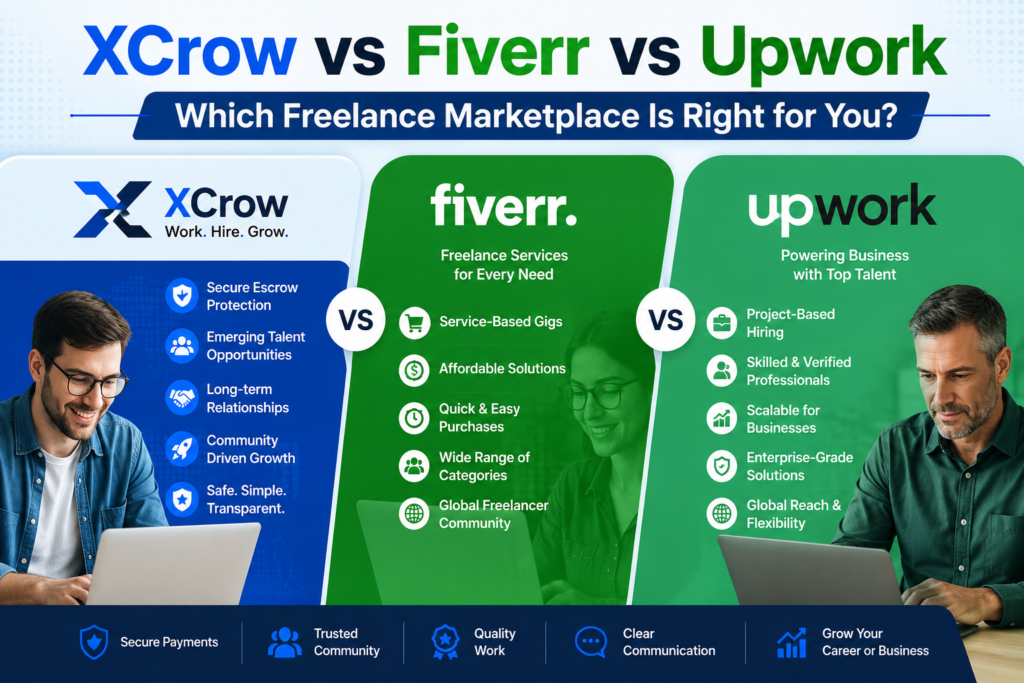
Freelance marketplaces differ in how clients find professionals, define projects, process payments, and resolve disagreements. This guide compares XCrow, Fiverr, and Upwork using publicly available platform information and clearly separates documented features from practical considerations. No marketplace is best for every project, and fees, eligibility rules, payment methods, and protections may change. Check the current terms before committing funds or sharing sensitive information.
Quick comparison
| Category | XCrow | Fiverr | Upwork |
|---|---|---|---|
| Fees | Check the current XCrow fee schedule for client and freelancer charges. | Fiverr applies service fees and freelancer earnings deductions according to its current pricing and terms. | Upwork applies client and freelancer fees that can vary by contract, plan, and service. |
| Payment mechanisms | Project-based payments are arranged through the platform according to the agreed terms. | Clients generally purchase a listed service or use a custom offer; funds are processed through Fiverr. | Clients may use fixed-price milestones or hourly contracts managed through Upwork. |
| Escrow | XCrow presents escrow or protected-payment transactions as part of its marketplace model. Confirm the exact release rules for each project. | Fiverr holds payment during its order process under its current terms; this is not identical to every form of milestone escrow. | Upwork uses funded fixed-price milestones and payment-protection processes subject to eligibility and its user agreement. |
| Dispute process | Review the current XCrow dispute and resolution procedure before starting. | Fiverr provides order-resolution tools and support processes, subject to its terms and deadlines. | Upwork provides dispute processes for eligible contracts, with different rules for hourly and fixed-price work. |
| Project workflow | Clients and freelancers agree on a project scope, payment terms, delivery, and approval process. | Clients commonly select a packaged service, provide requirements, review delivery, and request revisions included in the order. | Clients commonly post a job or search talent, review proposals, interview candidates, and use hourly tracking or fixed-price milestones. |
| Freelancer onboarding | Freelancers create profiles and list their services subject to platform requirements and review. | Freelancers create seller profiles and service listings subject to Fiverr eligibility and quality rules. | Freelancers create profiles, submit proposals or receive invitations, and may be subject to identity, category, and account requirements. |
| Client onboarding | Clients create an account, describe a project, review available professionals, and agree on terms. | Clients can browse listings and place an order or request a custom offer. | Clients create a job post or search talent, then select a contract structure and fund the work. |
| Geographic focus | Confirm current country availability and marketplace coverage directly with XCrow. | Fiverr operates internationally, but available services, sellers, currencies, and payment methods can vary by location. | Upwork operates internationally, but eligibility, tax requirements, currencies, and payment access vary by country. |
| Payment options | Check the current XCrow payment and withdrawal options for your country. | Payment and withdrawal options can include card, bank, and other methods depending on country and account eligibility. | Payment and withdrawal options vary by country and may include cards, bank methods, and supported third-party withdrawal services. |
Table note: This table is a high-level comparison, not a contract or legal advice. “Escrow” and “payment protection” can have different meanings. A funded milestone, an order hold, and a formal escrow arrangement may use different release, refund, and dispute rules.
Fees and total cost
The headline project price is not always the final cost. Compare client fees, freelancer deductions, taxes, currency conversion, withdrawal charges, subscription costs, and any optional services. Fiverr commonly presents packaged prices, while Upwork projects may use hourly rates or fixed-price milestones. XCrow users should review the platform’s current fee schedule and the terms shown before payment.
Payment mechanisms and payment protection
Payment protection depends on the contract type and the platform’s rules. Before work begins, record the deliverables, milestones, deadline, revision limit, approval conditions, ownership terms, and what happens if the scope changes. Do not assume that placing money on a platform guarantees a refund or that a dispute will automatically be decided in your favor.
Disputes and incomplete work
Keep requirements, messages, files, approvals, and delivery records inside the relevant platform where possible. Read the dispute deadlines before starting because some processes require a response within a specific period. If work is late or incomplete, describe the missing requirements clearly and use the platform’s documented resolution process instead of making unsupported public accusations.
Project workflow
Fiverr
Fiverr is commonly associated with packaged services. This can be efficient when the client knows the required deliverable, quantity, deadline, and revision expectations. Custom offers can provide more flexibility, but clients should still define scope in writing.
Upwork
Upwork is commonly associated with job posts, proposals, talent searches, interviews, hourly contracts, and fixed-price milestones. This model can suit detailed projects or ongoing relationships, but it may require more client involvement during selection and management.
XCrow
XCrow’s public positioning emphasizes structured transactions and trust-focused relationships. The practical workflow depends on the current features available to the client and freelancer, so users should verify how proposals, milestones, approvals, payments, and disputes operate before beginning work.
Onboarding and evaluating professionals
Freelancer onboarding does not prove competence. A new profile may belong to an experienced professional, while an older profile may not be the right fit for a particular assignment. Review relevant work, confirm what the person personally contributed, ask practical questions, and consider a small paid stage for an important project.
Clients should provide a useful brief, including the goal, audience, deliverables, examples, deadline, budget range, technical requirements, approval process, and client responsibilities. Better onboarding reduces misunderstandings on every marketplace.
Geographic availability and payment options
International availability does not mean that every feature works in every country. Check whether your country is supported, which currencies are available, how identity and tax checks work, whether local taxes apply, and how long withdrawals take. Also verify payment limits, refunds, currency conversion, and withdrawal fees before accepting a contract.
Which marketplace may fit?
- Fiverr: may fit a clearly defined, packaged service where browsing existing offers is useful.
- Upwork: may fit proposal-based hiring, interviews, hourly work, fixed-price milestones, or longer engagements.
- XCrow: may fit users who prefer a project-focused marketplace with structured agreements and protected-payment features, subject to its current terms and availability.
These descriptions are general tendencies, not guarantees. Service quality depends on the individual professional, the brief, communication, project complexity, and contract terms.
How to choose responsibly
- Compare the complete cost, not only the advertised rate.
- Read the current fee, payment, refund, and dispute policies.
- Define scope, milestones, revisions, ownership, and acceptance criteria.
- Use the platform’s official payment and communication systems.
- Share only the access and information required for the work.
- Keep records of approvals, changes, deliveries, and payments.
- Check country support and withdrawal options before starting.
Sources and verification
For current rules, verify information in the official platform documentation before making a decision: Fiverr Terms of Service, Fiverr Legal Portal, Upwork Legal Center, Upwork Help, and XCrow. These sources may change, and the applicable terms depend on the user’s country, account, service, and contract.
Final thoughts
Fiverr, Upwork, and XCrow use different marketplace models. The most suitable option depends on whether the project is packaged or customized, how much selection and management the client wants to do, which payment protections apply, and whether the platform supports the parties’ countries and payment methods. A neutral comparison should be revisited whenever platform policies change; no marketplace can guarantee a successful outcome for every project.

Israel Otoijamun is a digital business strategist, technology entrepreneur, and the founder of Xcrow, a platform connecting businesses with top remote talent.
With more than 15 years of experience across online platforms, technology, and digital payments, Israel regularly publishes insights on freelancing, tech job opportunities, remote workforce strategies, and modern hiring ecosystems.
Read more about Israel Otoijamun.