Connect with other freelancers and employers on Xcrow.co Whatsapp Community. Use this link to join!

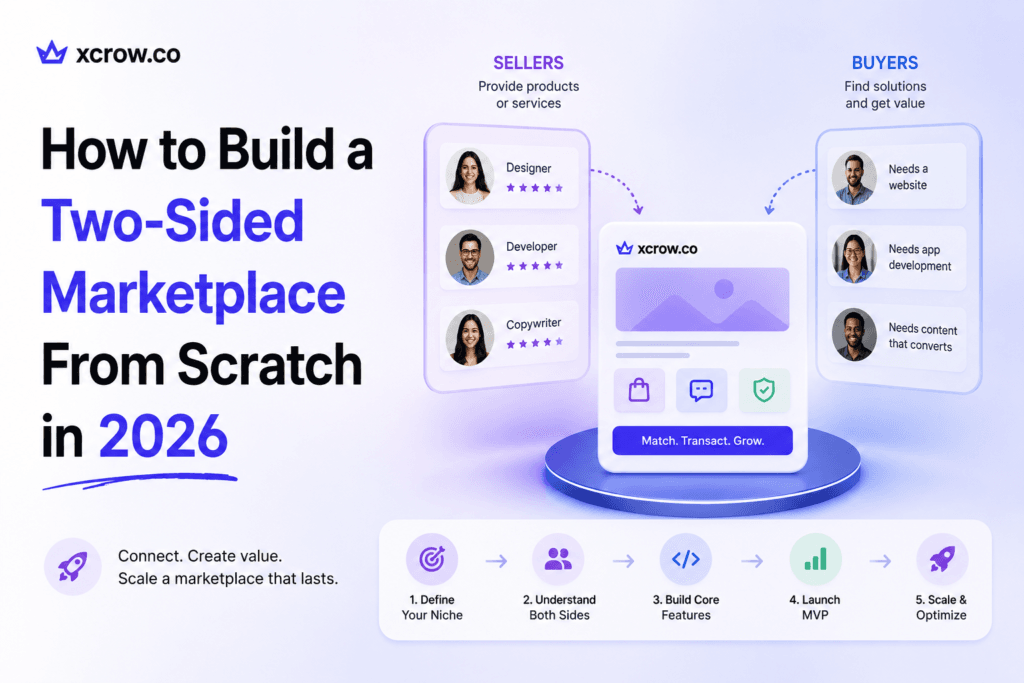
How to Build a Two-Sided Marketplace From Scratch in 2026

I remember the exact conversation that made me appreciate just how hard marketplace building actually is. A founder I know had spent eight months and significant money building what she described as “the Airbnb for creative studio spaces in Lagos.” The platform looked good. The tech worked. But nine months after launch, almost nothing was happening on it. Hosts were listing spaces. Renters were registering. But the two sides were not actually meeting.

She had built a platform. She had not built a marketplace.

The difference between those two things is everything, and most people who set out to build marketplaces discover it the hard way. This guide is an attempt to close that gap before you spend the resources.


What a Two-Sided Marketplace Actually Is

A two-sided marketplace connects buyers and sellers, takes a cut of each transaction, and never holds inventory. Companies like Airbnb, Uber, and Etsy have proven the model at massive scale, and third-party marketplace sales are projected to account for 59% of all global e-commerce by 2027. slideshare

The defining characteristic is interdependence. Neither side has a reason to be there without the other. Sellers need buyers. Buyers need sellers. The platform creates the conditions for them to find each other and transact.

Two-sided marketplaces bring together buyers and sellers, or customers and service providers, and give them a quick, safe, and worthwhile place to exchange value. This kind of platform succeeds when both sides show up together in a way that creates reliable, repeatable transactions. ComeUp

That last sentence is where most marketplace founders underestimate the work involved. Getting both sides to show up simultaneously is genuinely hard. Getting them to transact reliably is harder still.


The Model’s Genuine Appeal and Its Genuine Difficulty

The model offers founders low startup costs, multiple monetization paths, network effects, and cross-side virality. But it also presents real challenges: the chicken-or-egg problem, reaching liquidity, preventing leakage, and building trust between strangers. slideshare

Those challenges are not minor inconveniences. They are the structural problems that have killed more marketplace startups than poor technology or poor design ever have.

Understanding them before you build is the most important preparation you can do.


The Chicken-and-Egg Problem: Every Marketplace Faces It

Buyers have zero reason to join an empty marketplace, while sellers at least have the possibility of a future source of customers. Lendio

This asymmetry is your starting point. Supply is easier to acquire first because providers have a direct incentive: the platform represents potential customers even if none exist yet. Buyers, on the other hand, need to see inventory worth browsing before they commit their time.

Build supply first. Recruit sellers through cold outreach, online communities, or fee holidays. Buyers follow when there is something worth browsing. Breaking AC

The founder I mentioned earlier had made the opposite mistake. She had run a launch campaign targeting both sides simultaneously. The result was a trickle of hosts and a trickle of renters who arrived to find almost nothing on offer. Both sides left quickly and did not return.

By far the most successful marketplaces have started out by focusing on a really, really small niche. Instead of aiming for volume, they built a small but faithful audience who loved using the platform. And when you manage to solve the chicken-and-egg problem once and find liquidity, you have a playbook on which you can start building your expansion strategy. Indeed


The Concierge MVP: How Most Successful Marketplaces Actually Started

Here is something the polished origin stories of marketplace giants usually leave out.

In their earliest days, most of them were doing things manually that the platform was supposed to automate.

Airbnb founders photographed listings themselves. Uber’s first rides were coordinated by hand. TaskRabbit’s founder personally recruited the first taskers.

Successful marketplaces focus on supply-first execution, generate manual traction before automation, deliver single-player mode value, and grow within constrained, high-density segments. Above all, they prioritize trust and liquidity before scale. Gloroots

A concierge MVP means manually recruiting the first suppliers, manually matching the first buyers, and facilitating the first transactions before you automate anything. This is not a workaround. It is the strategy. It lets you learn what the transaction actually needs to work, who your best early users are, and what friction points will kill repeat engagement before you have locked those problems into software.

Manual facilitation is legitimate. Curating matches and facilitating early transactions is a finite, strategic investment that buys time for organic dynamics to develop. Upwork


Choosing Your Niche: The Narrower the Better

One of the most common and most damaging marketplace decisions is choosing too broad a niche at launch.

Every successful marketplace you can name started narrow.

eBay started as the go-to platform for second-hand goods. Depop carved out its space in unique fashion. Zillow established itself as the leader in real estate listings. By focusing on one niche, they created a clear value proposition and attracted the right users. fiverr

Constraint is a feature. Launching in a single city or niche concentrates supply and demand co-presence, which is exactly what early liquidity requires. Upwork

For African marketplace founders specifically, the geographic constraint is powerful. Launching exclusively in one neighborhood, one city, or one professional community lets you achieve the density of transactions that generates early social proof before expanding.

A freelance marketplace that launches for “all Nigerian creatives” is competing with Upwork, Fiverr, and every other general platform. A freelance marketplace that launches specifically for Yoruba-speaking graphic designers in Lagos, with naira-based pricing and local payment support, is offering something those platforms cannot.


Validating Before You Build: The Step That Saves Months

Validate before you build. Interview potential users about their problems, not your idea. A marketplace that does not solve a real pain point has no reason to exist. Breaking AC

This sounds obvious. It is violated constantly.

The validation questions that matter are not “would you use this?” That question produces optimistic answers that do not predict behavior. The questions that reveal real signal are:

How do you currently solve this problem? What does that cost you in time and money? What is the worst part of the current solution? Have you tried anything else and why did it not work?

If you cannot get clear, consistent answers to those questions from both the supply side and the demand side of your intended marketplace, you do not have enough signal to build yet.

Talk to twenty potential suppliers and twenty potential buyers before writing a single line of code or deploying a single dollar of build budget.


Build or Buy: Choosing Your Technical Approach

Coding a marketplace from scratch requires a large upfront investment, a team of developers, and six to twelve months or more before launching. Building with no-code marketplace tools is by far the fastest and easiest option, though also the least customizable. slideshare

For most first-time marketplace founders in 2026, the right answer is almost always to use an existing platform rather than build from scratch.

Sharetribe is the most widely used marketplace-specific SaaS platform. It comes with listings, search, secure payments including escrow, messaging, reviews, and customizable branding built in. It saves time and cost compared to building from scratch, while still giving flexibility to scale and customize. Depending on complexity, you can launch a basic marketplace MVP within days or weeks. Golance

For service marketplaces built on WordPress, the Workreap theme offers native escrow, milestone payments, and dispute resolution features specifically designed for freelance and service marketplace models. It is a faster and more affordable starting point than custom development for founders who want to own their platform rather than pay ongoing SaaS fees.

No-code tools like Sharetribe let you launch in a day and cut development costs by up to 90%, so you can test, learn, and iterate with real users from day one. slideshare

The time to build from scratch is when you have validated your model through an MVP, identified specific technical requirements the existing platforms cannot meet, and have the resources to absorb a six to twelve month build cycle without losing market timing.

Most founders are not at that point when they are tempted to build from scratch.


Monetization: The Models That Actually Work

Most marketplace monetization falls into a small number of proven structures.

The most common models are: commissions, taking a percentage of each transaction between users, which is the most popular because it scales with activity and aligns your success with your users’ success. Subscription fees, charging one or both sides a recurring fee for access. Listing fees, charging sellers to list their offerings. Lead generation fees, charging sellers for introductions to potential buyers. Advertising and promoted listings, allowing sellers to pay for enhanced visibility within the platform. slideshare

Uber charges a 25% commission from drivers on each successful ride. Airbnb charges 3% fees to hosts and 5 to 15% fees from guests. Expert360

For a new marketplace at zero liquidity, commissions are the cleanest model because they create zero friction for early adoption. Nobody pays anything until a transaction completes. This reduces the barrier to getting both sides onto the platform while you are still building density.

The strategic error to avoid: charging listing fees or subscription fees before you have proven value on both sides. Charging suppliers to list on a marketplace with no buyers is asking them to pay for a problem you have not yet solved. It kills early supply acquisition and signals a misalignment of incentives.


Trust Infrastructure: The Part That Determines Survival

The challenges of marketplace building include the chicken-or-egg problem, reaching liquidity, preventing leakage, and building trust between strangers. Breaking AC

Trust is not a feature. It is the foundational condition for transactions between strangers on your platform. Without it, both sides transact once, have a bad experience, and never return.

Trust infrastructure in a marketplace has three components.

The first is identity and verification. Users need reasonable confidence that the person on the other side is who they claim to be. This can range from email verification at the minimal end to government ID verification, portfolio verification, and background checks at the more rigorous end. Your niche determines how much verification is required. A marketplace for high-value professional services needs more rigorous identity infrastructure than one for low-value transactions.

The second is reputation and reviews. Create verified seller badges and highlight early adopters with a trust badge or featured placement. Recognition can be a powerful motivator, especially in reputation-driven verticals. Breaking AC Reviews need to be verified as coming from real transactions rather than self-generated, and the system needs to handle both positive reviews and legitimate negative ones without suppressing either.

The third is payment protection. This is the most mechanically important trust component because it is where financial risk is highest.

Trust and identity systems need to include verification, review, and escrow infrastructure appropriate to your marketplace type from day one. Upwork

Escrow-based payment systems hold buyer funds until the transaction is completed to the agreed standard, then release them to the seller. Neither party has to take a financial risk on the other’s trustworthiness. The platform becomes the neutral guarantor of the transaction.

Xcrow provides exactly this infrastructure for digital and freelance transactions, holding client funds securely until work is delivered and confirmed. For marketplace builders who are either integrating with an escrow-capable platform or building payment protection into their own system, understanding how this mechanism works is essential.

You can read a full breakdown in our article on what escrow is and how it protects buyers and sellers online.


Preventing Leakage: The Problem That Appears After You Build Liquidity

Most marketplace founders worry about getting users onto the platform. They worry less about keeping transactions on it. By the time leakage becomes visible, it has already cost significant revenue.

Leakage is when buyers and sellers who met on your platform take subsequent transactions off it to avoid paying your commission. It is rational behavior from the user’s perspective and an existential threat to your monetization model.

Leakage is the post-launch version of the chicken-and-egg problem. Once both sides are present, off-platform transactions drain the liquidity you built. Design for on-platform completion from the start. Upwork

The defenses against leakage are built into the platform design.

Payment protection that only exists on-platform gives users a strong incentive to keep transactions there. When a buyer knows their payment is only escrowed and protected if it goes through the platform’s payment system, leaving the platform means losing that protection.

Relationship management tools that exist only within the platform, messaging history, project files, review records, and contract documentation, create friction for moving off-platform because both sides would lose access to that operational infrastructure.

Reputation portability is a design choice that affects leakage. If a seller’s reviews and transaction history are only visible and valuable on your platform, leaving the platform means starting from zero elsewhere. That is a meaningful retention mechanism.


The Metrics That Actually Tell You Whether Your Marketplace Is Working

Vanity metrics like registered users and total listings tell you almost nothing about whether a marketplace is healthy.

Metrics such as search-to-booking rate, response time, and listings per search session reveal whether liquidity is really improving. Early signs of imbalance that signal the need to intervene might include longer wait times, declining engagement, or rising acquisition cost per transaction. U.S. Chamber of Commerce

The metric that matters most is liquidity: the probability that a buyer searching the platform finds what they need and completes a transaction, and the probability that a seller listing on the platform makes a sale within a reasonable time window.

Liquidity means the likelihood of a seller making a sale on your marketplace and of a buyer finding what they are looking for. If you take away one thing, it should be this: do not focus on volume when you start a marketplace. Focus on liquidity in a small niche. Breaking AC

A marketplace with 50 users completing transactions is healthier than one with 5,000 registered users who never transact. The former has proven liquidity. The latter has proven that registration does not equal use.

Track your liquidity metrics weekly from the day you launch. The moment they plateau or decline, investigate the cause before adding more users to a broken system.


Scaling: When and How to Expand Beyond Your Initial Niche

The timing of expansion is one of the most consequential decisions a marketplace founder makes.

Expanding before you have proven liquidity in your initial niche spreads your supply and demand too thin and breaks the liquidity you have already built. Expanding too late cedes adjacent market territory to new entrants.

Consider starting small, like with a single location, and scaling from there. You might end up with a mismatch between buyers and sellers if you scale too fast, leading to skewed pricing, weak selection, or a poor vendor experience. Lendio

The right trigger for expansion is consistent, high liquidity in the initial niche: transaction completion rates are stable, both sides are returning for repeat transactions, and your supply-to-demand ratio is balanced without requiring active management to maintain.

At that point, you have a playbook. The expansion is repeating what worked in the initial niche in a new geography or vertical, with the advantage that you now have a track record to use in recruiting early users for the new segment.


The Africa-Specific Opportunity in Marketplace Building

For entrepreneurs building marketplaces specifically for African markets, the opportunity is significant and the competitive dynamics are different from Western markets.

Major global marketplace platforms have underserved African markets structurally. Payment infrastructure limitations, language barriers, and lack of local trust signals mean that global players have not captured the same market share in Africa as elsewhere. This creates genuine room for locally-built, locally-tuned platforms.

The specific advantages a locally-built African marketplace has over global platforms:

Local payment rail integration. Supporting Paystack, Flutterwave, M-Pesa, and local bank transfers removes the payment friction that global platforms create for African users.

Local trust infrastructure. Verification systems that use local identity documents, local business registration databases, and local reputation signals are more meaningful than generic global verification.

Language and cultural fit. Marketplaces that communicate in local languages and understand local transaction norms convert better with local audiences than platforms with generic international UX.

The challenge is building the payment protection layer that global platforms take for granted. Cross-border transactions between African buyers and sellers, or between African freelancers and international clients, require robust payment security that protects both sides.

Xcrow was built specifically for this context, providing escrow-based payment protection for digital transactions in markets where cross-border payment security is a genuine concern. For marketplace builders who want to offer users the kind of payment protection that builds lasting trust, understanding how this infrastructure works is foundational. Read our breakdown of how digital marketplaces are replacing traditional employment for broader context on where the market is heading.


Common Mistakes That Kill Marketplaces Before They Reach Scale

These patterns repeat across failed marketplaces with enough consistency to be worth naming directly.

Building for both sides simultaneously before proving value on either side. The result is a thinly populated platform that satisfies neither.

Building technology before validating the problem. The concierge MVP approach exists precisely because building before validation is expensive and slow to correct.

Charging fees before demonstrating value. Listing fees and subscription fees on an illiquid marketplace kill supply acquisition. Zero-commission periods for early suppliers cost you nothing because there are no transactions yet and buy you the supply density that makes demand worth attracting.

Ignoring leakage until it becomes a revenue crisis. Design for on-platform transaction completion from the start, not as a retrofit when you realize users are taking relationships off the platform.

Treating trust as a feature to add later. Building the verification, review, and escrow infrastructure appropriate to your marketplace type needs to happen from day one, not as a retrofit once you discover that users do not trust each other. Upwork


Final Thoughts

Building a two-sided marketplace is genuinely harder than building most other types of businesses. The interdependence of the two sides creates coordination challenges that do not exist in one-sided products.

The trust infrastructure required for strangers to transact requires investment before any revenue justifies it. And the chicken-and-egg problem is not solved by technology. It is solved by strategy, manual effort, and patient niche focus.

The founders who succeed are the ones who treat the early phase as an intelligence-gathering operation, not a growth operation. They start in the smallest viable niche, manually facilitate the first transactions, build trust infrastructure before worrying about growth, and expand only after they have proven liquidity in their initial market.

That path is slower than it looks from the outside. It is also far more reliable than trying to build Airbnb from a standing start.

If you are building a marketplace in Africa and want to understand how payment protection infrastructure strengthens user trust and reduces leakage, read our guide on how to safely pay freelancers internationally without getting scammed. And for context on how the broader digital marketplace economy is evolving, our breakdown of the gig economy in 2026: stats, trends, and what is changing covers the market dynamics shaping where marketplace opportunity lives today.


Related reads you might find useful:
What Is Escrow and How Does It Protect Buyers and Sellers Online?
How Digital Marketplaces Are Replacing Traditional Employment
The Gig Economy in 2026: Stats, Trends, and What Is Changing

Leave your comment