Something fundamental has shifted in how people think about work. Not gradually, not quietly, but in a way that is now impossible to ignore. The idea that a person spends forty years at the same company, climbs a defined ladder, collects a pension, and retires comfortably is not just outdated as a plan. For a growing proportion of the global workforce, it was never the plan at all.
The gig economy has moved from being a conversation about Uber drivers and food delivery riders to encompassing millions of software developers, marketing strategists, financial consultants, educators, designers, lawyers, and medical professionals who have deliberately chosen to work independently rather than within traditional employment structures. In 2026, this shift is not a trend to watch. It is a reality to understand.
Whether you are a freelancer building an independent career, a business owner trying to understand where to find talent, or simply someone trying to make sense of why the job market feels so different from what it was a decade ago, this article covers the numbers, the forces driving the change, and what it all means going forward.
How Big the Gig Economy Has Actually Become
The numbers are striking enough that they deserve to be stated plainly before anything else.
US freelancers are expected to represent approximately 48.5% of the total workforce by late 2026, nearing a historical majority predicted for 2027. Upwork Think about what that means. Within the next few years, independent workers will outnumber traditionally employed ones in the largest economy on the planet. That is not a niche. That is a structural transformation.
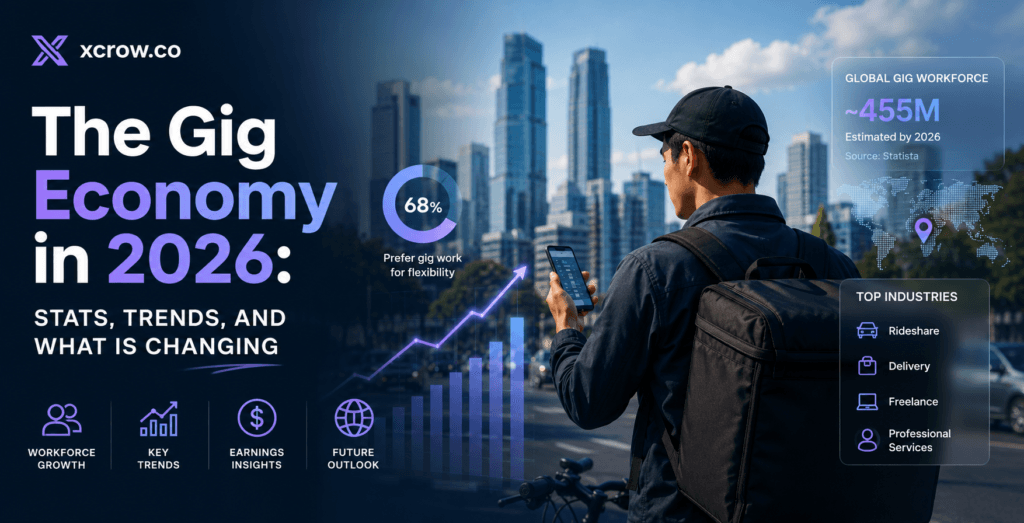
Global gig economy revenue is projected to reach $455 billion by 2026, driven by digital platforms and remote work adoption. Nearly 73% of freelancers say technology enables them to find work more easily compared with traditional job searches, and 79% of hiring managers plan to rely more on freelance talent in the coming years to manage project-based workloads. Diana Kelly Levey
The US freelance workforce stands at approximately 73 to 76 million workers, contributing an estimated $1.3 to $1.77 trillion to the US economy. GyaanVibes
4.7 million independent workers in the US earned over $100,000 in 2024, a significant increase from 3 million in 2020. OmarosaOmarosa This is not a poverty-level safety net for people who cannot find real jobs. It is, for a growing number of people, the most financially rewarding career structure available to them.
Globally, the picture is equally significant. Data from The World Bank shows that the online gig economy workforce is much larger than previously estimated, with gig work accounting for up to 12% of the global labor force. Jobbers
India’s gig workforce is on track to surpass 10 million workers in 2026, driven by a 21% compound annual growth rate as digital infrastructure reaches smaller cities across the country. Upwork
What the Gig Economy Actually Includes Now
One of the most persistent misunderstandings about the gig economy is the assumption that it primarily means low-paid, low-skill service work like ride-sharing, food delivery, and errand running. That picture was always incomplete, and in 2026 it is actively misleading.
Software development accounts for 42% of total freelance project demand globally. Digital marketing services represent 31% of freelance job postings worldwide. Graphic design and UX and UI projects make up 27% of creative freelance gigs. Data analysis and science roles increased by 58% year over year. Cybersecurity freelance demand grew by 46% due to rising business threats. Diana Kelly Levey
In 2026, the gig economy is no longer limited to low-skill or service roles. Highly skilled professionals, from consultants to software engineers, are increasingly participating in project-based work arrangements. OmarosaOmarosa
This matters because it changes the economic profile of the average gig worker significantly. The average hourly rate for a freelance worker in North America is currently $48 in 2026, and the total income generated by freelancing in 2026 sits at $1.5 trillion. Usefreelance
The gig economy in its current form encompasses at least five distinct categories of work. There is on-demand service work, the delivery drivers, rideshare operators, and task-based workers that most people picture first. There is project-based professional work, the developers, designers, writers, and marketers who work on defined engagements for business clients. There is consulting and advisory work, where experienced professionals provide strategic guidance on a contract basis. There is content creation and the creator economy, where individuals build audiences and monetize their knowledge or entertainment value directly. And there is platform-based skilled labor, encompassing everything from online tutoring to remote healthcare consultations to legal services delivered through digital platforms.
Each of these categories operates differently, attracts different types of workers, and is shaped by different economic forces. Treating them as a single monolithic category leads to confused thinking about both the opportunities and the challenges the gig economy presents.
The Forces Driving the Growth
Understanding why the gig economy is growing requires looking at the motivations of both the workers choosing it and the businesses adopting it. These are two separate stories that happen to be running in parallel and reinforcing each other.
From the worker side, the primary drivers are flexibility, autonomy, and in many cases higher earning potential for specialized skills.
Flexibility means workers want control over schedules and workload. Multiple income streams allow gig workers to diversify earnings instead of relying on one employer. Remote work normalization has meant companies now hire contractors globally. Technology platforms make it easy to find work instantly. Economic uncertainty has pushed workers to turn to gig work to supplement income or bridge job gaps. Iprofitwithyudistira
Around 70% of freelancers in the US are under age 35, showing how younger workers are leading the shift toward flexible, online-based careers. Bestjobsearchapps This generational dimension is important. Workers who entered the labor market after 2010 grew up with digital tools, global connectivity, and a different relationship to institutional employment than previous generations. For many of them, the idea of committing to a single employer for a decade feels less like security and more like unnecessary constraint.
86% of freelancers think that the best days for freelancers are yet to come. OmarosaOmarosa That level of optimism among people who have actually experienced independent work is a meaningful signal that the day-to-day reality of gig work, for skilled practitioners at least, is broadly positive.
From the business side, the calculus is about cost efficiency, access to specialized talent, and workforce flexibility.
Hiring a full-time employee is expensive in ways that extend well beyond the salary. Payroll taxes, benefits, onboarding, training, equipment, office space, and the legal and administrative overhead of employment all add up. For work that is project-based, seasonal, or highly specialized, the economics of hiring a full-time person to do it rarely make sense. Bringing in a skilled freelancer for exactly the duration and scope needed is almost always more efficient.
Beyond cost, the talent access argument is compelling for companies that operate in specialized fields. These roles often pay 20 to 40% more than equivalent salaried positions due to project-based pricing, which reflects the premium businesses are willing to pay for access to skills they genuinely need. Iprofitwithyudistira
Technology has made all of this dramatically more practical. Digital platforms, remote communication tools, project management software, and online payment systems have reduced the friction of hiring and managing distributed workers to the point where geographic location has largely stopped being a barrier to engagement.
The Rise of Africa in the Global Gig Economy
One of the most significant and underreported developments in the gig economy over the past several years is the rapid growth of independent work across Africa.
Africa’s freelancing sector is booming, particularly in Nigeria, Kenya, and South Africa, driven by rapid internet growth and a young, increasingly digitally skilled population. Diana Kelly Levey
This matters for several reasons. Africa has the youngest population of any continent, with a median age significantly below that of Europe, North America, or East Asia. A large proportion of young people who are highly educated, digitally fluent, and unable to find formal employment commensurate with their skills in local labor markets are turning to global freelance platforms as a way to access international clients and international pay scales.
For these workers, the gig economy is not a fallback option. It is often the most direct route to competitive earnings and professional development. A software developer in Nairobi or Lagos who connects with clients in Europe or North America through a freelance platform can earn rates that are difficult or impossible to achieve through local employment, while building a portfolio of international work experience that strengthens their position over time.
The infrastructure supporting this growth is improving steadily. Internet penetration rates are rising across the continent, mobile payment systems are sophisticated and widely adopted in many markets, and the number of young people with relevant digital skills is growing rapidly. The trajectory is clear.
For businesses globally, Africa represents a rapidly expanding pool of skilled freelance talent that is still significantly underpriced relative to equivalent talent in other regions. Finding and engaging that talent securely, particularly for cross-border payment arrangements, is where platforms that provide transaction protection become genuinely valuable. Xcrow is designed specifically for this kind of cross-border engagement, using escrow-based payment protection to ensure that both clients and freelancers in international transactions are protected throughout the project.
How the Gig Economy Is Changing Business Models
The growth of independent work is not just changing individual careers. It is changing how businesses are structured and how they think about their relationship with talent.
The traditional model of the firm, where a company owns all of its workforce, houses them in a central location, and manages them through hierarchical reporting structures, is being replaced by something more fluid. Many businesses today operate with a relatively small core team of permanent employees and a much larger network of freelancers, contractors, and specialist partners who are engaged as needed.
This model is sometimes called the liquid workforce, and it has significant advantages in terms of adaptability. A company with a fluid talent model can scale up quickly when demand increases, bring in niche expertise for specific projects, and reduce overhead during slow periods without the legal and human complexity of layoffs. It can access global talent rather than being limited to whoever lives within commuting distance of the office.
For workers, this creates a corresponding shift in the employment relationship. Rather than being permanently attached to a single employer, skilled professionals increasingly think of themselves as service providers who maintain portfolios of client relationships. The security model changes: instead of relying on one employer not to let you go, you build a diverse enough client base that losing any one client does not threaten your income.
Many workers will blend freelance and full-time work as part of a hybrid career path, with gig work coexisting alongside traditional employment rather than replacing it entirely. Self Employed
This blended model is already common. People hold full-time jobs while building freelance practices on the side, gradually transitioning to full independence as their client base grows. Others maintain anchor clients that provide stable core income while supplementing with additional project work. The strict binary between employed and self-employed is becoming less relevant as the actual structure of people’s working lives grows more complex.
What Is Changing in 2026 Specifically
While the broad growth trajectory of the gig economy has been consistent for years, several specific developments in 2026 are worth paying attention to.
AI integration is reshaping which gig work is growing and which is shrinking. The skills with the fastest growing freelance demand are almost all related to artificial intelligence in some form. AI and machine learning skills saw demand surge by 1,200% since 2022. Diana Kelly Levey
Meanwhile, certain categories of routine, templated work have seen their rates decline as AI tools have reduced the time and skill required to produce basic outputs. The net effect is a polarization: highly skilled, specialized, creative, and judgment-intensive freelance work is in high demand at premium rates, while commodity work is under increasing price pressure.
Cross-border hiring is becoming standard rather than exceptional. The normalization of remote work has removed the last remaining cultural hesitation many businesses had about hiring internationally. Companies that previously restricted freelance hiring to domestic workers because of uncertainty about communication, quality, or legal compliance are now routinely engaging talent from across the world. This is expanding opportunity significantly for freelancers in emerging markets and creating a genuinely global market for skilled services.
Platform diversification is giving workers more options. The era of two or three dominant platforms controlling access to clients is gradually giving way to a more fragmented landscape, where specialized platforms serve particular industries, skills, or geographic markets. This fragmentation is broadly positive for workers, reducing dependence on any single platform and creating more competitive conditions for client acquisition.
Payment infrastructure is improving. One of the longstanding frustrations of cross-border freelance work has been the difficulty, cost, and uncertainty of international payments. Fintech innovation, including better international transfer services, digital wallets, stablecoin payrolls, and escrow-based payment platforms, is reducing these friction points significantly. Companies managing international teams are gaining new flexibility in financial transactions, with platforms introducing features that simplify cross-border funding and reduce reliance on traditional banking systems. Upwork For both workers and clients, the practical experience of getting paid or paying across borders is becoming meaningfully less painful than it was even three years ago.
The Real Challenges the Gig Economy Has Not Solved
It would not be honest or useful to write about the gig economy in purely celebratory terms. The growth is real, the opportunity is real, but so are the structural problems that have followed this model from its beginning and that remain largely unresolved in 2026.
The absence of benefits and social protection is the most fundamental challenge for gig workers. Traditional employment comes bundled with health insurance, paid leave, pension contributions, unemployment protection, and workers’ compensation. None of those things follow you automatically when you go independent. You become responsible for your own health coverage, your own retirement savings, your own emergency fund for periods of low income, and your own management of tax obligations. For workers who understand these implications and plan for them, it is manageable. For those who do not, it represents genuine financial vulnerability.
Most gig workers lack access to healthcare, pensions, or unemployment protection. This leaves them vulnerable to income volatility, illness, or economic downturns. There is a growing call for a portable benefits system that can follow workers from one gig to another. Sertifier
Income volatility is a persistent reality of independent work that requires ongoing management. A freelancer with three clients today might have one client next month. Projects end. Clients reduce budgets. Slow seasons affect demand. The psychological and financial discipline required to manage this volatility is real, and many people who enter freelancing underestimate how demanding it can be.
Worker classification and legal protection remain contested and inconsistent. One of the most critical compliance issues for gig workers involves worker classification. The distinction between independent contractors and employees determines the level of legal protections and benefits a worker is entitled to. Misclassification can lead to severe penalties and state laws vary significantly. iMocha
The regulatory landscape continues to evolve in ways that create uncertainty for both businesses and workers. Different jurisdictions take different approaches to classifying gig workers, and the rules continue to change as governments try to balance the genuine flexibility that makes gig work attractive with the need to prevent exploitation of workers who lack the bargaining power to protect themselves.
Payment security and fraud remain real concerns, particularly for cross-border transactions. Freelancers get scammed by clients who take work and disappear without paying. Clients get scammed by freelancers who take advances and deliver nothing. Without a trust infrastructure in place, every new client relationship involves a degree of financial risk that discourages people from engaging across geographic and cultural distance.
This is precisely why escrow-based payment protection has become increasingly standard practice in professional freelance arrangements. When funds are held by a neutral third party and only released upon confirmed delivery of agreed work, the financial risk on both sides is dramatically reduced. Xcrow provides exactly this kind of protection for digital transactions, making cross-border freelance work safer and more trustworthy for both parties. If you want to understand more about how escrow works and why it matters for online transactions, read our guide on what escrow is and how it protects buyers and sellers online.
Platform dependency is a structural risk that many freelancers do not take seriously enough until something goes wrong. When a significant portion of your income comes through a single platform, that platform has enormous leverage over your livelihood. Algorithm changes, fee increases, policy shifts, or account suspensions can eliminate income overnight. Building direct client relationships outside of any single platform is one of the most important strategies for long-term stability as a freelancer.
The Gig Economy and the Developing World
The global dimension of this story is important and often underemphasized in coverage that focuses predominantly on the US and European experience.
For workers in developing economies, digital freelancing platforms represent something genuinely transformative: direct access to global markets for their skills. A talented developer, writer, or designer who previously had limited options for earning competitive wages in their local economy can now connect with clients paying international rates. The income differential between what can be earned locally versus internationally through platforms is often dramatic, which creates powerful incentives for skill development and platform participation.
This is part of why growth rates in countries like India, Nigeria, Kenya, Brazil, and the Philippines have been so significant. It is not just that there are more freelancers. It is that freelancing is providing economic mobility in ways that local labor markets frequently cannot.
At the same time, workers in these markets face additional challenges. Currency conversion costs and exchange rate risk eat into earnings. Payment infrastructure may be less reliable or more expensive. Access to certain platforms is restricted in some regions. Building international client relationships requires navigating cultural and communication differences without the institutional support that comes with traditional employment.
These challenges are solvable, and they are being solved incrementally by the continued improvement of financial technology, the expansion of platform access, and the growing sophistication of freelancers in emerging markets who understand how to position themselves for international clients.
What This Means for Businesses Hiring Freelancers
For businesses, the maturing gig economy represents an expanding and improving resource for accessing skills on demand. A few strategic principles are worth keeping in mind as this landscape continues to evolve.
The pool of high-quality freelance talent is genuinely global, and limiting your search to familiar platforms or geographic areas means missing a significant portion of the best options available to you. Building the capability to effectively evaluate and engage talent from different countries and cultural backgrounds is a competitive advantage.
Treating freelancers as expendable transactional resources is shortsighted. The best freelancers, like the best employees, have options. They choose clients who treat them professionally, communicate clearly, pay on time, and engage with them as collaborators rather than just task executors. Building a reputation as a good client attracts better talent and generates referrals.
Managing the financial and legal dimensions of freelance engagement properly is increasingly important as the regulatory environment evolves. Using platforms or services that handle contract documentation, payment processing, and compliance reduces risk for both parties. For international engagements specifically, using payment protection tools is simply good risk management.
If you want a detailed guide on how to effectively bring freelancers onto your projects, read our practical walkthrough on how to hire a freelancer online for small businesses.
What This Means for Freelancers
If you are currently a freelancer or seriously considering becoming one, the data suggests you are entering the market at a moment of genuine structural opportunity. But opportunity and outcome are not the same thing. Here are the dimensions that matter most for making independent work sustainable and rewarding over the long term.
Specialization drives earnings more than any other single factor. Generalist freelancers compete on price. Specialists compete on value. The data consistently shows that freelancers who develop deep expertise in a specific skill area, and position themselves clearly around that expertise, command significantly better rates and attract more reliable clients.
Building direct client relationships, not just platform profiles, is essential for long-term stability. Platforms are tools for finding clients, not a substitute for genuine professional relationships. The goal should always be to convert platform-acquired clients into direct relationships that reduce your dependence on any single intermediary.
Financial discipline is non-negotiable. Set aside a consistent percentage of every payment for taxes. Build an emergency fund equivalent to at least three months of operating expenses before you go fully independent. Invest in retirement savings from the beginning. These habits are unglamorous but they are the foundation of a freelance career that remains viable over years and decades rather than burning out in the first cycle of income volatility.
Protect your income with the right tools. Get written agreements for every project, no matter how informal the working relationship feels. Use escrow-based payments for significant engagements. Learn the basics of invoicing, contracts, and intellectual property to understand your rights and protect them. Xcrow is a platform that takes the guesswork out of payment protection for digital work, giving both you and your clients confidence that the financial side of the engagement is handled fairly.
Looking Ahead
The gig economy in 2026 is not the disruptive upstart it was a decade ago. It is a mature, large-scale component of the global labor market that is growing, diversifying, and becoming more sophisticated in how it operates.
The fundamental forces driving it are not weakening. The desire for flexible, autonomous work is not going away. The business case for accessing specialized talent on demand is not disappearing. The technology that enables global remote collaboration is not retreating. And the economic pressures that make independent work attractive in developing economies are not resolved.
What is changing is the infrastructure around gig work. Regulatory frameworks are developing, however slowly and inconsistently. Financial technology is making payments easier and safer. Platform competition is improving conditions for workers. And the professional norms of the gig economy are maturing, with better practices around contracts, intellectual property, and dispute resolution becoming more widespread.
The future of work is likely to be a hybrid model, combining traditional employment with gig-based arrangements. Rather than replacing traditional employment, the gig economy is reshaping it into something more flexible and dynamic.
That reshaping is already well underway. The question is not whether the gig economy will be a central feature of how work operates in the decades ahead. It is how individuals and businesses will position themselves to benefit from it, and how societies will build the policy frameworks needed to make it work fairly for everyone who participates in it.
Final Thoughts
The gig economy story in 2026 is bigger, more diverse, and more consequential than most casual observers realize. It is not a story about people doing odd jobs between real employment. It is a story about a fundamental restructuring of the relationship between people and work, driven by technology, economics, and a genuinely changing set of values about what professional life should look like.
For the individuals and businesses that understand this shift and adapt to it thoughtfully, the opportunities are significant. For those who treat it as a peripheral phenomenon or a temporary deviation from the normal order of things, the risk is being overtaken by a change that is already here and accelerating.
Whether you are building a freelance career, growing a business that depends on flexible talent, or simply trying to make sense of the labor market you are operating in, the gig economy deserves your full attention. It is not the future of work. In large and growing measure, it is the present.
If you are navigating the gig economy as either a freelancer or a business and want to understand how to protect yourself financially in cross-border transactions, read our article on how to safely pay freelancers internationally without getting scammed, and explore how Xcrow makes digital work agreements safer for everyone involved.

Israel Otoijamun is the founder of Xcrow, a freelance marketplace that connects businesses with remote talent through secure escrow-protected payments. He writes about freelancing, remote work, hiring, digital payments, and the future of online work.

Leave your comment