Connect with other freelancers and employers on Xcrow.co Whatsapp Community. Use this link to join!

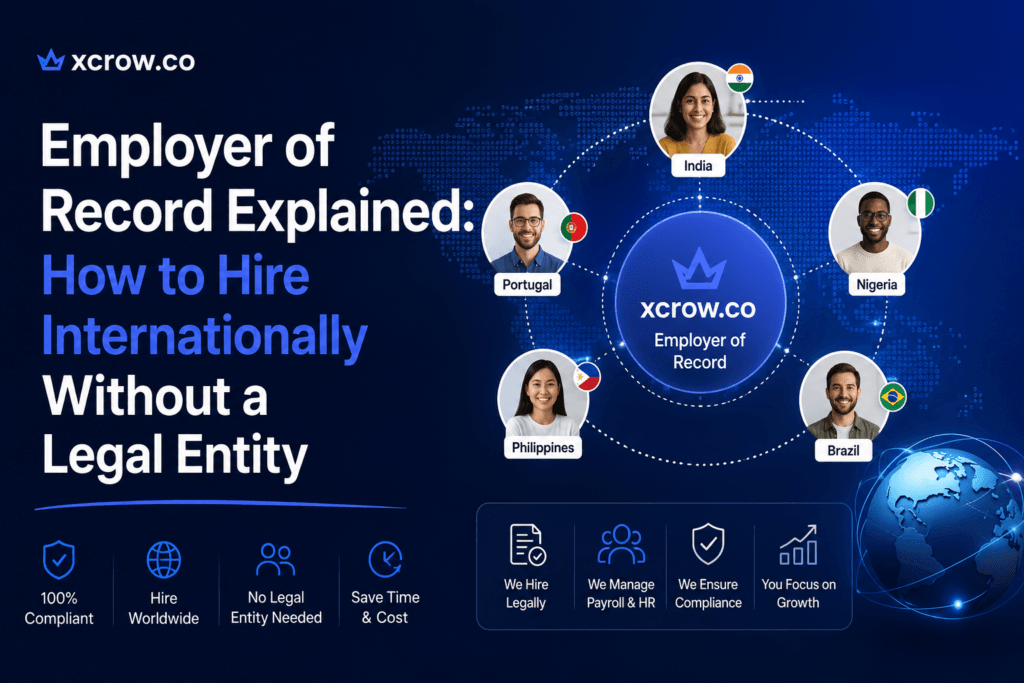
Employer of Record Explained: How to Hire Internationally Without a Legal Entity

The first time I encountered the phrase “employer of record,” I was on a call with a founder who had just found the perfect candidate for a senior engineering role. The candidate was based in Nigeria.

The company was registered in the United States. The founder knew the person was exactly right for the job but had no idea how to legally bring them on without spending months and tens of thousands of dollars setting up a Nigerian entity.

Someone on the call mentioned an EOR almost in passing. Within two weeks, the hire was done, compliant, and fully onboarded.

That conversation captures exactly why EOR has gone from being a niche HR acronym to one of the most practically important tools in global hiring.


What an Employer of Record Actually Is

An Employer of Record is a third-party organization that legally employs workers on your behalf in a foreign country. The EOR handles payroll, tax withholding, benefits administration, and employment compliance while you retain day-to-day management of the employee’s work. Gloroots

The relationship has three parties, not two.

You are the company that finds the candidate, sets the role, manages the work, and pays the EOR. The EOR is the legal employer of record in the worker’s country. The worker holds a real employment contract, receives local benefits, and is protected by local labor law.

The process is simpler than the legal complexity behind it suggests. You find your candidate. Recruiting stays with you. You send the offer details to the EOR: salary, country, role, start date. The EOR handles compliance, statutory leave, benefits, end-of-service, and terminations. Your new hire feels like a full employee because legally, they are. Just employed by your EOR partner instead of you. Useme


The Problem It Solves: Why Setting Up a Foreign Entity Is Not Always the Answer

Many growing businesses assume that hiring internationally means incorporating in every country where they hire. This assumption is expensive and slow.

Setting up a foreign entity costs between $15,000 and $50,000 upfront, with ongoing annual expenses of $20,000 to $80,000. Traditional incorporation takes months, while hiring through an EOR typically takes days. Fixnhour

If you are hiring one to twenty-five people in any country, EOR is mathematically the right call. Entity setup costs $20,000 to $150,000 one-time plus $15,000 to $30,000 per year ongoing. EOR has no setup cost and costs approximately $2,400 to $14,400 per year per employee. Infotech Wayout

The break-even only shifts when you have fifteen to twenty-five employees in a single country and the administrative overhead of running a local entity becomes justified by the scale of operations there.

For anyone below that threshold, entity setup is an expensive and slow way to solve a problem that EOR solves in days.


EOR Versus Hiring a Contractor: The Compliance Risk People Underestimate

The cheaper-looking alternative to EOR is often to classify international workers as independent contractors. It costs less upfront. It requires less process. And it carries a risk that many businesses do not fully appreciate until it lands on them.

Misclassification risk can hit $50,000 to $500,000 or more per worker if a tax authority reclassifies an independent contractor as an employee. For full-time, single-employer relationships, EOR is the safer and often cheaper-once-you-account-for-risk option. Infotech Wayout

By some estimates, $3 to $4 billion is lost annually to worker misclassification. When misclassifying workers, employers may not withhold the correct amount of employment taxes required by law. iHire

The practical trigger for misclassification risk is when a contractor works exclusively for one company, follows the company’s direction on how work is done, and works set hours on an ongoing basis. That describes a large proportion of “contractors” working for remote-first companies right now.

An EOR removes this risk entirely because the worker is a genuine, compliant employee in their home country from day one.


What Happens When You Use an EOR: The Step by Step

Companies can engage workers as contractors, through an Employer of Record, or by setting up a local entity. The right option depends on how many hires you plan to make and how quickly you need them on board. Hiring contractors can take only a few days, while working through an EOR generally takes two to four weeks. Establishing a foreign entity may take several months or more. U.S. Chamber of Commerce

The typical EOR process runs as follows.

You identify and select the candidate independently. The EOR does not recruit for you. You send the EOR the role details, agreed salary, country, and start date. The EOR drafts a locally compliant employment contract in the worker’s language and jurisdiction. The contract is signed. The EOR runs payroll, withholds taxes, administers statutory benefits, and manages compliance on an ongoing basis. You manage the employee’s actual work directly.

From the employee’s perspective, the experience is largely seamless. They receive a legitimate employment contract, statutory benefits, and legal protections. The EOR relationship sits mostly in the background.


What EOR Actually Costs in 2026

Pricing has become more competitive as the market has matured.

EOR costs range from $199 to $800 or more per employee monthly, averaging $400 to $600 for international hiring. Location is the biggest cost driver. Complex markets like France or Brazil cost significantly more than simpler ones. Hidden costs like foreign exchange markups, onboarding fees, and benefit add-ons can inflate your EOR bill by 20 to 30%. iHire

The EOR market in 2026 includes 31 active providers ranging from $199 flat startup-friendly vendors through enterprise white-glove platforms and regional specialists. Osdire

The major providers worth evaluating include:

Deel is the most widely known and covers 150 or more countries. It has strong product infrastructure, transparent pricing for most markets, and good contract management tooling.

Remote.com has a reputation for strong worker experience and supports equity grants to international employees, which is meaningful for startups that want to offer consistent compensation packages globally.

Rippling integrates EOR with broader HR, payroll, and IT management in a single platform, which reduces the number of tools required for teams already using it domestically.

Remofirst is one of the more competitive pricing options, with entry-level tiers starting below $200 per month.

When comparing providers, ask three specific questions: Do they use owned entities in your target country or rely on third-party local partners? The owned entity model is faster and typically cleaner. What is their approach to currency conversion and are markups included or separate? And what does their termination process look like in the specific country you are hiring in, because this varies significantly by jurisdiction?


EOR and Africa: A Specific Opportunity Worth Naming

In 2026, more than 73% of remote-first companies use an Employer of Record to hire internationally without setting up local legal entities. Indeed

For companies specifically looking at African talent, EOR has become the default access mechanism.

Nigeria, Kenya, South Africa, Ghana, and Rwanda each have different labor laws, tax frameworks, and statutory benefit requirements. Building internal compliance capability for each of them is not realistic for a growing startup. An EOR that has owned entities or established local partners in these markets makes compliant hiring straightforward.

The companies I have spoken with that are building distributed teams across Africa consistently report that the compliance complexity, not the talent availability, was the thing that previously held them back. EOR removes that blocker specifically.

For businesses using freelancers and contractors in these markets rather than full-time employees, the payment and protection infrastructure is equally important.

Xcrow provides escrow-based payment security for cross-border digital transactions, holding client funds until work is delivered and confirmed. For companies that are not yet ready to formalize a contractor relationship through an EOR but want to protect project-based payments, it is the practical first layer of financial protection.

You can read more about how this works in our article on what escrow is and how it protects buyers and sellers online.


When EOR Is the Right Choice and When It Is Not

EOR is the right tool for specific situations, not every international hiring scenario.

It makes the most sense when you are hiring your first employee in a country and do not have the scale to justify entity setup. It is the right call when speed matters and a two to four week hire beats a six month incorporation process. It suits companies that want to test a market before making a permanent structural commitment. And it is clearly right when the alternative is misclassifying a long-term, single-employer worker as an independent contractor.

Most teams do not get into trouble because they chose the wrong model. They get into trouble because they chose a model that does not match their headcount trajectory, revenue footprint, risk tolerance, and internal capacity to run local operations. Alliance Virtual Offices

EOR becomes less economically attractive once you have fifteen or more employees in a single country. At that point, the monthly EOR fees may exceed what it would cost to run a local entity, and the strategic commitment to that market may justify the infrastructure investment.

It is also not a solution for genuinely independent contractor relationships where the worker serves multiple clients, controls their own methods, and is not functionally integrated into one company’s operations. For those situations, a well-structured contractor agreement combined with secure payment infrastructure is the more appropriate setup.


What EOR Does Not Cover: The Gaps to Know About

A few things that confuse businesses encountering EOR for the first time.

The EOR does not recruit for you. Finding and selecting the right candidate is entirely your responsibility. The EOR only steps in once you have decided who you want to hire.

The EOR does not manage the work. The employee’s day-to-day responsibilities, performance management, and professional development remain with your team. Some businesses mistakenly assume that outsourcing the employment relationship means outsourcing management accountability.

The EOR relationship does not eliminate all compliance obligations on your side. You still need to understand the basics of the employment terms in the worker’s country, particularly around termination, because how you communicate and handle an exit has to align with local requirements even though the EOR processes it.

If the EOR is in a different country than your tax residence, you may owe taxes in both jurisdictions. Most EORs use local entities, so the EOR should be in the worker’s country of residence. If not, both parties may face additional tax complications. Indeed

This is a point worth checking explicitly with any EOR provider before you sign. Ask them directly: where is your legal entity for this country, and what are the tax implications for a worker based specifically in the city or region we are hiring in?


The EOR and Remote Team Management: What Changes

Bringing on an EOR-employed worker changes a few operational realities that are worth knowing upfront.

Termination is slower and more structured than with a contractor. Local labor law governs notice periods, severance obligations, and the grounds on which employment can be ended.

This is not unique to EOR arrangements; it is true of any legitimate employment relationship in most countries. But it is a meaningful difference from contractor relationships where you can typically end the arrangement on much shorter notice.

Benefits administration runs through the EOR rather than directly through your HR team. Statutory benefits like paid leave, health coverage mandates, and social contributions are handled by the provider. Supplemental benefits that you want to offer above the statutory minimum need to be agreed with the EOR upfront and factored into the pricing.

Onboarding logistics are shared. The EOR handles the legal and payroll side. You handle the practical integration: access to tools, team introductions, role orientation, and the working relationship setup that determines whether the hire succeeds. Our guide on how to onboard a remote contractor without the chaos covers this side of the process in detail, and most of it applies directly to EOR-employed workers as well.


Red Flags When Evaluating EOR Providers

Not every EOR is equally trustworthy, and the market has enough providers now that quality varies meaningfully.

Avoid providers that cannot clearly confirm whether they have owned entities or third-party partners in your specific country. Third-party networks add compliance risk and processing time.

Watch for opaque pricing on foreign exchange conversions. This is a common hidden cost. Providers that apply undisclosed markups to currency conversion can meaningfully increase your real cost beyond the quoted monthly fee.

Hidden costs like foreign exchange markups, onboarding fees, and benefit add-ons can inflate your EOR bill by 20 to 30%. iHire

Ask specifically about termination fees and processes before you sign. Some providers charge separately for terminations, and in countries with complex severance requirements, the financial exposure can be significant.

Finally, check their customer support structure for your target country. A provider with excellent coverage in Western Europe but limited on-the-ground knowledge in West Africa is not the right choice if you are primarily hiring in Lagos or Accra.


Connecting EOR to Your Broader International Hiring Strategy

EOR is one tool in a broader set of options for international hiring. Understanding how it fits with the others makes it easier to choose the right approach for each specific situation.

For short-term, project-based work with a genuinely independent professional, a direct contractor engagement with a clear contract and secure payment protection is often sufficient. For that kind of arrangement, our guide on how to hire a freelancer online for small businesses covers the full process.

For longer-term work with someone who will effectively be integrated into your team, EOR is the compliant path that avoids the misclassification risk that contractor arrangements carry in that context.

For markets where you have built significant scale and plan to maintain a long-term operational presence, entity setup eventually makes more structural sense than EOR fees at scale.

The decision tree is genuinely not complicated once you know the variables. Headcount, timeline, and the nature of the working relationship determine which model makes sense.

The mistake most businesses make is defaulting to whichever model they encountered first rather than choosing based on the actual situation.


Final Thoughts

EOR has changed what international hiring looks like for companies of almost every size. The ability to bring on a full-time compliant employee in Nigeria, Kenya, or anywhere else in the world within two to four weeks, without months of entity setup and tens of thousands in upfront legal costs, is genuinely significant.

Entity setup is brutal at $20,000 to $80,000 per country, three to six months of process, and ongoing legal and accounting costs. Compliance has gotten harder.

Pay transparency laws, AI hiring rules, and worker classification crackdowns are everywhere. Speed wins markets. A two-week hire beats a six-month entity setup every time. For agencies scaling delivery teams, this is not a nice-to-have anymore. It is the default playbook. Useme

The companies building distributed, globally-sourced teams most efficiently in 2026 are the ones that have internalized this logic and built their talent strategy around it.

If you want to understand how to structure your broader remote hiring process alongside EOR, read our guide on how to onboard a remote contractor without the chaos. And for the payment protection side of cross-border engagements, Xcrow handles escrow-based security for digital transactions throughout the project lifecycle.


Related reads you might find useful:
How to Hire a Freelancer Online: A Step by Step Guide for Small Businesses
How to Onboard a Remote Contractor Without the Chaos
Skills Based Hiring: Why Companies Are Dropping Degree Requirements

Leave your comment