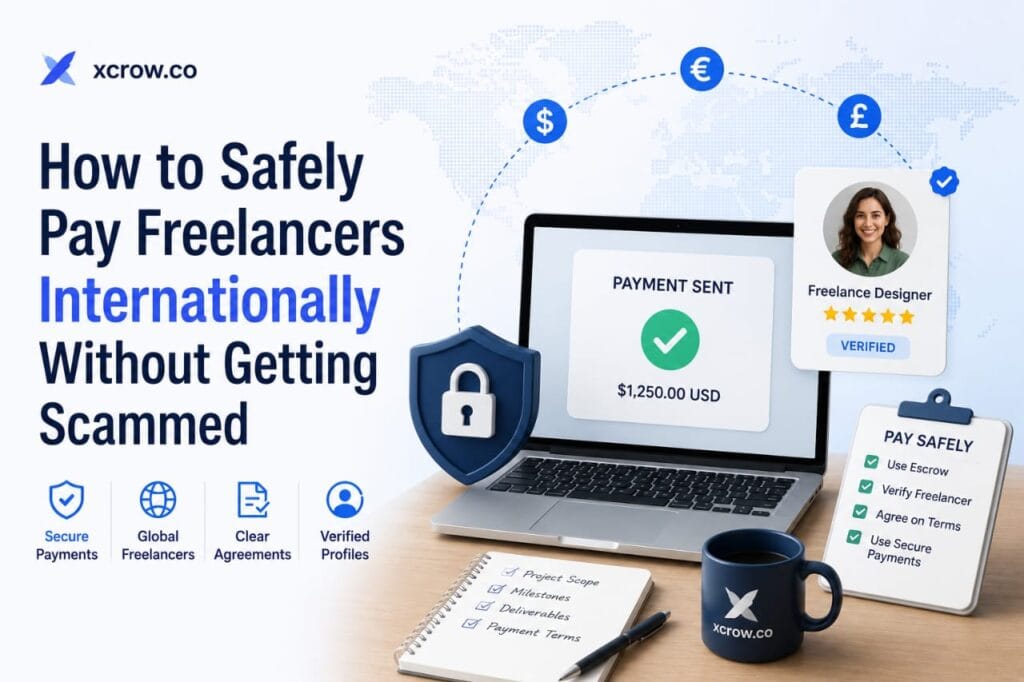
The first time I wired money to a freelancer I had never worked with before, I held my breath for three days. Not because I had any specific reason to doubt the person. They had a solid profile, good communication, and references that checked out. But there was something about sending a significant sum across an international bank transfer to someone on the other side of the world, with no safety net between the money leaving my account and the work arriving in my inbox, that felt genuinely uncomfortable. Like trust without infrastructure.
That discomfort turned out to be well-founded instinct, even if it did not bite me on that particular occasion. Because cross-border freelance payments, done without the right tools and the right processes, represent one of the most avoidable financial risks in modern business. Not because most freelancers are dishonest. The vast majority are not. But because the payment infrastructure that most businesses use for international transactions was not designed with this kind of relationship in mind, and the gaps it leaves are where both honest mistakes and deliberate fraud tend to occur.
As of 2026, freelancers make up over 46.6% of the global workforce, and that figure is expected to hit 50% by 2027. The global freelance economy now generates $1.5 trillion annually. More businesses are hiring internationally, which means more companies are dealing with cross-border payment challenges. The main issues include exchange rate fluctuations that can cost 3 to 5% in hidden fees, and transaction fees ranging from $0.50 to $50 or more per payment. Indeed
This guide is the one I wish I had when I started working with international freelancers. It covers the payment methods that actually work, the red flags that signal trouble before it costs you, the scams that are running right now in 2026, and the tools that protect both sides of the transaction so that paying internationally feels as safe as paying someone down the street.
Why International Freelancer Payments Are Genuinely Riskier Than Domestic Ones
Before getting into solutions, it is worth being honest about the specific risks involved. Understanding precisely what can go wrong is the foundation of protecting yourself against it.
The most fundamental risk is irreversibility. Paying freelancers internationally is not as straightforward as domestic payments. Multiple friction points can slow down transactions. Indeed Unlike a credit card payment that can be disputed or reversed, an international bank wire transfer is essentially final once it processes. If the recipient does not deliver what was agreed, or disappears entirely, recovering those funds through banking channels is extraordinarily difficult and often impossible.
The second risk is identity uncertainty. When you hire a freelancer through a platform that has done identity verification, you have some reasonable confidence that the person on the other end is who they say they are. When you hire someone directly, through a referral or a cold approach, that confidence is less established. Sophisticated scammers build convincing personas, maintain detailed fake portfolios, and invest in positive initial interactions specifically to establish enough trust to extract a payment before disappearing.
The third risk is legal jurisdiction complexity. If a dispute arises with a domestic contractor, you have relatively clear legal recourse through small claims courts, professional associations, or platform dispute resolution. When the contractor is in another country, those pathways become complicated, expensive, and often impractical for the amounts involved in typical freelance projects.
The fourth risk is the hidden cost layer that erodes the actual value of what you send. Exchange rate fluctuations can cost 3 to 5% in hidden fees on top of transaction fees. Hidden currency conversion markups make transparent platforms more cost-effective than traditional banking channels. Indeed
None of these risks mean you should avoid hiring internationally. They mean you should hire internationally with the right infrastructure in place.
The Most Common Scams Targeting Businesses and Freelancers in 2026
Understanding the specific scams that are active right now helps you recognize them before they cost you. These are not hypothetical risks. They are documented patterns that occur regularly across every major freelance platform and in direct international hiring.
The Overpayment Scam
This one targets freelancers, but understanding it protects you too because it can be used to implicate well-meaning businesses in fraud inadvertently. A client claims they will send a check upfront but accidentally overpays and asks you to wire the excess amount back. Later, the check bounces, and you are left out of pocket. This is a common scam designed to trick freelancers into sending real money before realizing the initial payment was fraudulent. CareerBldr
The variation that targets businesses involves a freelancer who receives a payment, claims there was an error or double payment, and asks for a partial refund to a different account before the original payment has actually cleared. The refund goes out while the original payment reverses, and the business is out both amounts.
The protection is straightforward: never send money back to a payee before confirming that their original payment has fully and irrevocably cleared. Pending does not mean cleared.
The Ghost Freelancer Scam
Some fake clients ask freelancers to complete large test projects, then disappear without paying. The parallel scam targeting businesses involves freelancers who accept a deposit or advance payment, deliver nothing, and become unreachable. FreeUp
This is the most direct form of freelance fraud and the one that escrow-based payment systems most directly address. When funds are held by a neutral third party and only released upon confirmed delivery, there is no deposit to take and run with. The freelancer cannot access the money until the work is delivered, and the business cannot access the work until the money is secured.
The Fake Portfolio Scam
Warning signs that indicate someone is being scammed include refusing to make video calls, demanding advanced payments, avoiding contracts, or using general portfolios that could belong to anyone. Capital on Tap
Sophisticated versions of this scam involve portfolios assembled from the work of real professionals found online, presented as the scammer’s own. The fraudster wins the project based on impressive but stolen samples, collects payment, and then either delivers work of dramatically lower quality or disappears.
Protecting against this involves verification steps that go beyond the portfolio itself. Request a brief video introduction. Ask the freelancer to describe specific decisions they made on a portfolio piece. Ask a technical question about the process used to produce the work. Someone who actually created the portfolio will answer these questions naturally. Someone presenting stolen work will struggle.
The Scope Expansion and Ransom Scam
Constant revisions, additions, and changing timelines are unfair practices. Clients may request free assignments or add new tasks to exploit freelancers’ time and efforts. iHire
The client-side version of this involves a contractor who delivers an incomplete or flawed first version of the work, then demands additional payment to fix it or complete it, knowing that the business has already invested time in the project and faces the cost and delay of starting over if they do not comply. This is not technically fraud in all jurisdictions but it is a form of bad faith dealing that a well-written contract prevents.
The Platform Migration Scam
Scammers often try moving conversations outside the platform immediately. Keeping communication and payments on trusted platforms initially is one of the most effective protections. Jobbers
The setup is a convincing profile on a legitimate platform, followed by pressure to move the conversation and payment to a different channel quickly, usually with an explanation like lower fees, a preferred payment method, or platform limitations. Once outside the platform’s protections, the scammer operates without accountability and without any record that the platform’s customer service team can access.
The protection is a simple rule: never move the financial side of a new client relationship off a platform until you have an established track record with that specific person. Platform fees exist partly because they fund the trust and protection infrastructure that makes transacting with strangers safer.
The Fake Escrow Scam
This one is worth specific attention because it exploits the very safety instinct that should protect you. A scammer, playing either the client or the freelancer role, insists on using a specific escrow service that they recommend enthusiastically. The site looks entirely legitimate, with professional design, legal-sounding documentation, and an official-seeming process. Funds are sent to what appears to be a neutral third-party account. They are actually going directly to the scammer.
Avoid using untraceable payment methods like direct crypto transfers, especially with first-time clients. Instead, use secure platforms that allow you to track payments and lodge disputes if necessary. Alliance Virtual Offices
The protection against fake escrow scams is to independently verify any escrow service before sending funds to it. Research the company, find independent reviews from real users, verify the business registration, and check that the domain and company details match. Never use an escrow service that the other party strongly insists on without being able to explain why that specific service rather than a more widely known one. And always navigate to the escrow platform yourself through independent search rather than clicking a link the other party provides.
How to Vet an International Freelancer Before Sending a Single Dollar
Prevention is consistently more effective than recovery, and the vetting process before a project begins is where most payment disasters are prevented or enabled.
Verify identity through multiple channels
A portfolio is a starting point, not a verification. Some warning signs include refusing to make video calls, which is a significant red flag because legitimate professionals have no reason to avoid a brief video introduction. Capital on Tap
A 10-minute video call accomplishes multiple things simultaneously. It confirms that the person exists and is who they claim to be. It lets you assess their communication competency in real time, which matters for working together across time zones. And it gives you information that a written profile and portfolio cannot: how they speak about their work, whether their answers to specific questions feel genuinely experienced or rehearsed, and whether they understand the actual requirements of your project.
Beyond a video call, check their presence independently. A professional with genuine experience typically has a LinkedIn profile that matches their stated career history, work samples accessible from multiple sources rather than just the ones they sent you, and some visible professional presence outside of the single platform where you found them. Absence of any independent digital footprint is worth noting.
Check reviews with healthy skepticism
On platforms with review systems, look for patterns rather than just averages. A freelancer with 47 reviews averaging 4.9 stars is more credible than one with 3 reviews averaging 5 stars. Read the actual text of reviews rather than just the scores. Look for specificity: reviews that describe particular aspects of the experience are more genuine than generic praise that could describe anyone.
Be aware that review manipulation exists. Clusters of reviews arriving within a short time window, reviews from accounts with no other activity, and suspiciously identical language across multiple reviews are all patterns that warrant caution.
Request relevant samples from real projects
For technical or creative work, ask for portfolio pieces specifically relevant to your project type. Then ask the freelancer to walk you through one of those samples: what was the brief, what decisions did they make and why, what feedback did they incorporate, what would they do differently now. Someone who actually created the work answers these questions with the natural specificity of recalled experience. Someone presenting work that is not theirs tends toward vagueness and generality.
Start with a small paid test
For higher-value engagements with new contractors, a small paid test project is one of the most reliable vetting tools available. Not a free test, which signals distrust and attracts the wrong dynamic. A paid assignment of meaningful but limited scope that gives you genuine work product to evaluate before committing to a larger engagement.
This approach filters for both quality and reliability. A freelancer who delivers excellent work on a small paid assignment on time and with good communication is demonstrating exactly what you need to see before a larger commitment. One who delays, over-promises, or delivers below the standard they presented is telling you something important before the stakes are high.
The Best Payment Methods for International Freelancers
Once you have decided to work with someone, the payment method you choose determines how protected you are if something goes wrong.
Escrow-Based Payment Protection
Escrow is the single most important tool for protecting international freelance payments, and it is the one that most businesses and freelancers underuse. The principle is simple: a neutral third party holds the client’s funds until the agreed work is delivered and confirmed, then releases them to the freelancer. Neither party takes a financial risk on the other’s trustworthiness.
Xcrow is built specifically for this purpose, providing escrow-based payment protection for digital and freelance transactions. The client deposits funds before work begins. The money is held securely. It releases to the freelancer when the client confirms delivery. If a dispute arises, there is a structured resolution process rather than two parties arguing across international borders with no recourse.
Using escrow payments, where funds are held until the work is delivered and approved, is one of the most effective ways to stay safe when working with new freelancers found on or off a marketplace. It helps protect against scams, fake profiles, and lost payments and is a smart, secure way to handle international freelancer payments with confidence. Useme
For African freelancers and businesses working across borders within Africa and internationally, the value of escrow-based protection is particularly significant given the additional complexity of cross-border payment infrastructure in the region. Our article on what escrow is and how it protects buyers and sellers online explains the full mechanics of how this protection works in practice.
Wise
Wise is the most cost-effective option for direct international transfers and has become the standard recommendation for cross-border freelance payments where escrow is not in use. It uses the mid-market exchange rate with transparent fees displayed upfront, rather than the hidden markup embedded in the exchange rates that most banks and PayPal apply. For regular international payments, the fee savings relative to bank wire transfers compound meaningfully over time.
Wise also allows businesses to hold balances in multiple currencies, which is useful for companies that pay freelancers in different countries regularly. The business account integrates reasonably well with accounting software and provides clean transaction records for bookkeeping purposes.
The limitation is that Wise provides no payment protection. It is a transfer tool, not a protection tool. If you send money to a freelancer via Wise and they do not deliver the work, Wise cannot help you recover it. It should be used for ongoing relationships with established trust, or in combination with a contract that creates legal recourse.
Payoneer
Payoneer is the most broadly accessible cross-border payment solution for freelancers in Africa, Asia, and Latin America, and for businesses that regularly hire from these regions it is worth understanding how it works from the contractor’s perspective.
Payoneer integrates directly with major freelance platforms including Upwork, Fiverr, Freelancer.com, and several others, which means contractors can receive platform earnings directly into their Payoneer accounts and withdraw to local banks. For businesses hiring outside of platforms, Payoneer also supports direct payment requests where the contractor sends you an invoice through the Payoneer system and you pay it from a linked account or card.
Like Wise, Payoneer provides no payment protection against non-delivery. It is a payment infrastructure tool, not a trust infrastructure tool.
Platform-Based Payments
When hiring through platforms like Upwork, Fiverr, or Freelancer.com, the platform’s built-in payment system is generally the safest payment mechanism available for that engagement. These systems include their own forms of escrow-like protection, dispute resolution processes, and the additional accountability of the contractor’s platform reputation being at stake.
Platforms like Upwork and Fiverr provide payment protection systems. Scammers often try moving conversations outside the platform immediately, which is why keeping communication and payments on trusted platforms is one of the most effective protections available. Jobbers
The tradeoff is platform fees, which are real and meaningful. For high-volume hiring relationships, the cost of platform fees versus the protection they provide is worth calculating explicitly rather than assuming either direction is always right. For new relationships with unknown contractors, the protection typically justifies the cost. For established, trusted contractor relationships, direct payment with good documentation may make more economic sense.
Bank Wire Transfers
Bank wire transfers are the most familiar payment method for most businesses and among the worst choices for new international freelance relationships. They are slow, expensive relative to modern alternatives, and completely irreversible once sent.
The one scenario where wire transfers make sense for international freelance work is when combined with a formal escrow arrangement or when the contractor has a long, well-established relationship with the business and the risk of non-delivery is negligible. In all other cases, the combination of cost, delay, and complete lack of recourse makes wires a poor choice relative to the alternatives available in 2026.
Cryptocurrency Payments
Avoid using untraceable payment methods like direct crypto transfers, especially with first-time clients. Alliance Virtual Offices
Cryptocurrency payments are genuinely useful in specific situations, particularly for contractors in markets with very limited banking infrastructure or for businesses with sophisticated treasury management. But for most typical freelance payment scenarios, crypto introduces complexity and volatility without adding meaningful protection. The irreversibility of most cryptocurrency transactions means that a misdirected or scam-related payment is as unrecoverable as a misdirected wire transfer. In some cases it is even harder to trace.
If you do use cryptocurrency for freelance payments, use stablecoins rather than volatile assets to eliminate exchange rate risk, use a smart contract-based escrow arrangement rather than a direct transfer, and only do so with contractors who have an established track record and verifiable identity.
Building a Payment Process That Protects You Every Time
The freelancers and businesses that operate in the international gig economy without getting burned are almost never those who got lucky with good clients or contractors. They are the ones who built a consistent process that applies the right protections to every new relationship, regardless of how trustworthy the person seems.
Here is the process that I have seen work consistently across different types of freelance relationships and transaction sizes.
Step one: Before signing anything, verify identity.
Video call, independent portfolio review, LinkedIn check, and one technical question about their work. This takes 30 minutes and filters out a significant proportion of bad-faith actors.
Step two: Get a written contract signed before work begins.
Transparency is key to any successful project. Clear terms protect everyone and having a written agreement covering scope, payment terms, and deliverables significantly reduces the risk of disputes arising from mismatched expectations. iHire
The contract does not need to be complex. A clear statement of what will be delivered, when, for how much, with how many revisions included, and who owns the final work upon payment is the minimum. Digital signature tools like DocuSign or HelloSign make this fast and legally enforceable. Never start work based on a verbal agreement or email thread alone. Our guide on freelance contract templates and what every freelancer needs to include covers every clause that protects you.
Step three: Use milestone-based payments with escrow protection for new relationships.
Structure payment around deliverables rather than time. For a project of any significant size, breaking payment into milestone-linked installments reduces the financial exposure at any single point in the project. Combining milestone structure with escrow protection through Xcrow means that each milestone payment is secured before the corresponding work begins and released upon confirmed delivery. The contractor works with confidence that funds are there. You work with confidence that payment is tied to actual delivery.
Step four: Keep all communication on record.
By communicating via the freelancer platform, you have peace of mind in the case of a customer service complaint or payment dispute that records of these conversations are accessible. If records are not available, only limited support can be provided. WorkMotion
Even when working outside of a platform, use email rather than messaging apps for any substantive project communication. Email creates a timestamped record that can be referenced in disputes. WhatsApp conversations are difficult to submit as evidence and easy for scammers to delete or claim they never occurred.
Step five: Never pay 100% upfront to a new contractor.
Clients should not have to pay to get started. Legitimate project structures never require full upfront payment from the client before any work has been produced. A reasonable deposit of 25 to 50% to secure the contractor’s time is standard. Full upfront payment to a new contractor with no established relationship is unnecessary risk. iHire
The milestone structure described above accomplishes this naturally. First payment upon project start and contract signing, subsequent payments tied to deliverables, final payment upon approved completion. This structure works in every direction: it protects the client from paying for work that is never delivered, and it protects the contractor from completing work and never getting paid.
What to Do When Something Goes Wrong
Despite best efforts, payment problems do occasionally occur even with careful vetting and good process. Knowing what to do when they arise determines whether a bad situation becomes a recoverable inconvenience or a significant financial loss.
If a contractor goes silent after receiving a deposit: Contact them immediately through all channels you have on record. If there is no response within 48 hours, escalate to the platform’s dispute resolution system if the engagement was on a platform. If it was off-platform, send a formal written notice of default via email referencing the contract terms. If funds were in escrow, contact the escrow provider to initiate a dispute.
If the delivered work does not meet the agreed standard: Document the specific discrepancies between the brief and the delivery in writing. Reference the contract terms. Give the contractor one formal opportunity to correct the issues within a defined timeframe. If they cannot or will not, proceed to dispute resolution. If escrow is in place, the dispute process prevents funds from releasing until the issue is resolved.
If a payment is sent to the wrong party through a bank transfer: Contact your bank immediately. While recovery is not guaranteed for international transfers, immediate reporting gives the bank the best chance of freezing the funds before they are withdrawn. Also report to your national cybercrime reporting body as soon as possible, since cross-border payment fraud is a criminal matter and early reporting sometimes enables international cooperation to recover funds.
If you realize a scammer has been masquerading as a legitimate professional: Report the profile on whatever platform they used to approach you. Report to the Internet Crime Complaint Center if you are in the US, Action Fraud in the UK, or your national equivalent elsewhere. Document everything: profile URLs, communication records, payment receipts. This information assists investigations that may recover funds or prevent the same pattern from victimizing others.
Protecting Freelancers on the Receiving Side
This guide has focused primarily on the business side of international payments, but freelancers face their own set of payment risks that deserve attention.
Freelancers often overlook their gut feelings, but instincts are an important first line of defence. If a job description feels vague, the communication is pushy, or something does not sit right, pause. Many scammers prey on desperation or urgency. It is better to miss out on a job than to chase a payment that will never come. Alliance Virtual Offices
For freelancers, the most important protection is never starting significant work without either a signed contract with a known and verifiable client, or payment in escrow. The anxiety about asking for a deposit or requiring escrow before starting is almost always smaller than the anxiety of having completed work that the client refuses to pay for.
Asking a new client to use escrow is not suspicious or demanding. It is professional. A legitimate client who wants good work has no reason to object to a payment structure that protects them as much as it protects you. A client who pushes back strongly against escrow or a deposit before any work has been done is providing early information about how they approach their obligations.
Our breakdown of the best freelance marketplaces for African professionals in 2026 covers the specific platforms that have the strongest built-in payment protections for freelancers in African markets, which is particularly relevant for professionals in Nigeria, Kenya, Ghana, and other high-growth freelance markets where cross-border payment security matters most.
The Role of Escrow in Making International Freelancing Trustworthy
The deep problem that all of the above tools and tactics are solving is fundamentally a trust problem. When two parties who have never met, operating across different countries, different legal systems, and different cultural contexts, try to do business together, there is an inherent trust deficit that traditional payment infrastructure does not address.
Escrow-based payment systems are the most direct and complete solution to this problem. They do not require either party to trust the other. They require both parties to trust the system, and the system is designed specifically to be trustworthy.
Escrow protection performs a required verification check on every contractor. That means you are working with verified individuals using real identities and legitimate bank accounts. It helps protect against scams, fake profiles, and lost payments. It is a smart, secure way to handle international freelancer payments with confidence. Useme
This is the direction the international freelance payment ecosystem is moving in. As cross-border work becomes more standard and the volume of international freelance transactions continues to grow, the expectation of payment protection is moving from being a feature that sophisticated businesses use to being the default standard that professional freelancers and clients expect from any significant engagement.
Xcrow is built around exactly this vision, providing the escrow infrastructure that makes cross-border digital transactions trustworthy for both sides. For businesses that regularly hire internationally and want a consistent, professional payment protection layer for every new contractor relationship, it removes the leap of faith that makes those relationships unnecessarily risky.
Quick Reference: International Freelancer Payment Safety Checklist
Before starting any new international freelance engagement, run through this checklist.
Have you verified the contractor’s identity through a video call and independent profile research? Have you confirmed that their portfolio samples are genuinely theirs through direct conversation about the work? Have you checked platform reviews for patterns of specificity and genuine experience? Have you signed a written contract covering scope, payment terms, deliverables, revision limits, and intellectual property? Have you set up milestone-based payment with the first payment tied to project start rather than project completion? Have you used escrow protection or a platform-based payment system rather than a direct bank transfer? Have you kept all substantive communication in email or platform messaging rather than off-record messaging apps? Have you confirmed that the escrow service, if used, is independently verifiable and not recommended solely by the other party?
If the answer to all of these questions is yes, you have done everything practical to protect yourself from the most common failure modes in international freelance payments. The risk is never zero, but it is reduced to the level that any reasonable professional international engagement involves.
Final Thoughts
Paying freelancers internationally without getting scammed is not a matter of luck or of avoiding international work out of caution. It is a matter of building a consistent payment process that applies the right protections systematically, understanding the specific risks and scams that are active right now, and using the tools that were designed for exactly this challenge.
The businesses and freelancers that navigate international work most successfully are not the ones with the highest tolerance for risk. They are the ones who have reduced that risk to a manageable level through good process and good tools, and then operate confidently within that protected framework.
The global freelance opportunity is genuinely significant. The talent available internationally, the cost advantages relative to domestic hiring in many markets, and the quality of work that skilled professionals around the world produce are all real. The risks are real too, but they are manageable with the right approach.
Build your verification process. Use your contracts consistently. Put escrow protection in place for new relationships. And let the systems do what they are designed to do, so that you can focus on the work rather than on wondering whether you are about to get burned.
For a complete understanding of how escrow-based payment protection works and why it has become the standard for professional online transactions, read our guide on what escrow is and how it protects buyers and sellers online. And if you are building out your broader process for engaging international contractors, our guide on how to hire a freelancer online for small businesses covers the full journey from finding the right person to getting the engagement running safely.
Related reads you might find useful:
What Is Escrow and How Does It Protect Buyers and Sellers Online?
Best Freelance Marketplaces for African Professionals in 2026

Israel Otoijamun is the founder of Xcrow, a freelance marketplace that connects businesses with remote talent through secure escrow-protected payments. He writes about freelancing, remote work, hiring, digital payments, and the future of online work.

Leave your comment