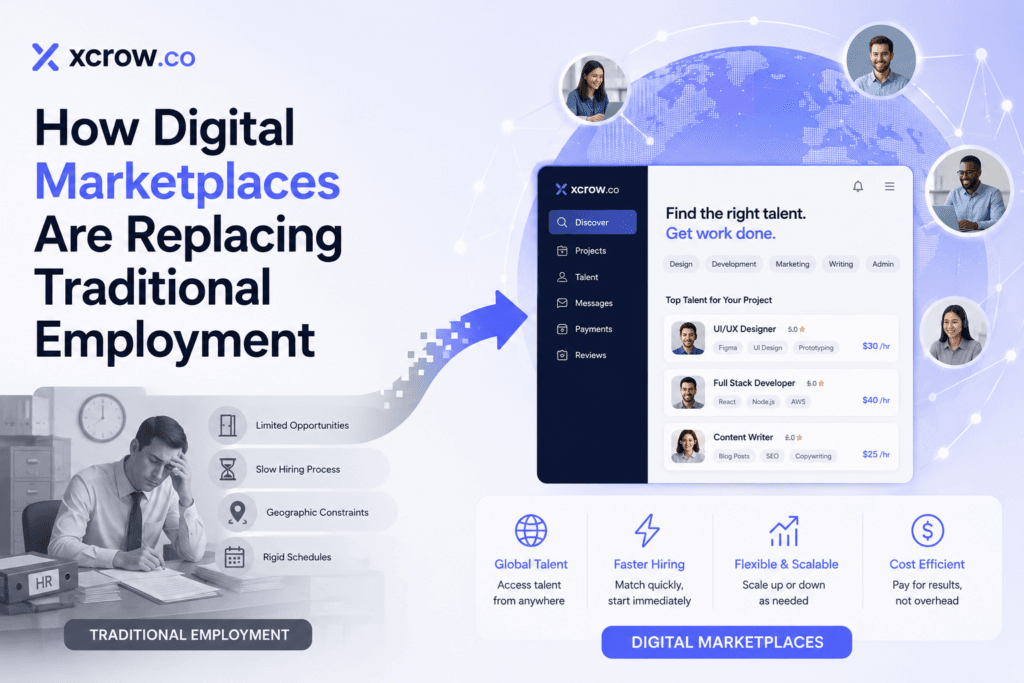
How Digital Marketplaces Are Replacing Traditional Employment

Something significant has been building quietly for the better part of a decade. Millions of people around the world have stopped waiting for a job offer letter. They have stopped sending applications into the void, sitting through interviews, and accepting salaries that come with invisible strings attached like mandatory office hours, fixed vacation days, and career paths that someone else designed. Instead, they have opened a laptop, built a profile, and started working for themselves, on their terms, for clients they chose, from wherever they happen to be.

This is not a niche lifestyle experiment. It is an economic restructuring happening at a scale that few people are fully grasping. Digital marketplaces, platforms that connect skilled workers directly with businesses that need them, are fundamentally changing what employment looks like, how businesses access talent, and what it means to have a career in 2026. And the pace of that change is accelerating, not slowing down.

Understanding what is driving this shift, how far it has already gone, and what it means for businesses and workers on both sides of the equation is increasingly important for anyone participating in the modern economy. Which, at this point, is essentially everyone.


The Numbers Behind the Shift

Before getting into the why and the how, it is worth establishing how significant the scale of this transformation actually is, because the numbers are frequently more dramatic than people expect.

The global freelance platforms market reached USD 5.15 billion in 2025 and is expected to grow to USD 5.97 billion in 2026, rising further to USD 6.92 billion by 2027. Neighborhood Escrow That growth trajectory reflects not just more people using these platforms but more businesses building their core operational strategy around them.

Over 1.6 billion people worldwide use online job platforms to search for employment opportunities as of 2025 and 2026. Approximately 70% of U.S. job seekers rely on online job marketplaces as their primary search method. Slashdot

Globally, more than one billion people participate in freelance or gig related work, and in several major economies freelancers represent 30 to 40% of the workforce in some capacity. Businesses increasingly rely on freelancers to access specialized skills, reduce fixed labor costs, and scale teams quickly for short-term projects. Surveys among SMEs and startups show that over 60% have hired freelancers at least once, particularly in digital roles. Slashdot

Global gig economy transactions are expected to exceed $873 billion by 2030, according to market projections. Technavio

These are not the numbers of a marginal trend finding its footing at the edges of the economy. They are the numbers of a structural change that has already reached the mainstream and is continuing to deepen.


What Digital Marketplaces Actually Are

To understand how digital marketplaces are replacing traditional employment, it helps to be clear about what these platforms actually do.

Freelance platform companies are digital marketplaces that connect businesses and individuals with independent professionals who provide services on a project, contract, or hourly basis. These platforms enable organizations to hire talent for functions such as software development, graphic design, writing, marketing, consulting, and administrative support without traditional full-time employment. They typically offer profiles, ratings, skill verification, messaging tools, and secure payment systems, creating a structured environment for remote and cross-border work. Topbusinesssoftware

The critical innovation these platforms brought to the labor market is that they eliminated the geographic and institutional constraints that previously shaped who you could work for and who you could hire. A business no longer has to hire someone who lives within commuting distance. A worker no longer has to limit their options to employers in their city or country. The platform creates the infrastructure for connection, verification, communication, and payment that previously required institutional structures like staffing agencies, employment contracts, and physical offices to provide.

Traditional recruitment often feels slow and outdated in today’s digital economy. Companies used to rely heavily on recruitment agencies, job boards, and internal HR teams to fill technical positions. That process consumed valuable time and money. Modern talent platforms changed everything by creating instant access to pre-vetted professionals ready to work remotely. Instead of waiting months for hiring cycles, companies can now onboard developers within days. It is similar to switching from dial-up internet to fiber optics: everything becomes faster and more efficient. Hudsonts

The major platforms each serve slightly different parts of the market. Upwork is the largest general-purpose freelance marketplace in the world, covering development, marketing, writing, design, data work, and professional services across virtually every industry. Fiverr operates on a gig-packaging model where freelancers list defined services that clients purchase directly, making it particularly effective for faster, more standardized tasks. Toptal sits at the premium end, screening rigorously and providing businesses with access to senior technical and financial talent. LinkedIn’s Services Marketplace sits within the world’s largest professional network, connecting consultants and service providers with clients who can see their full professional history and mutual connections.

Beyond these general platforms, hundreds of specialist marketplaces have emerged to serve particular industries and skill types, from legal services and medical consulting to architecture, music production, and financial modeling. The ecosystem is becoming increasingly sophisticated, with platforms investing heavily in verification systems, quality signals, and matching algorithms that reduce the friction of finding the right person for the right work.


The Business Case for Moving Away From Traditional Hiring

For businesses, the decision to rely more heavily on digital marketplace talent rather than traditional full-time employment is rarely ideological. It is economic and practical, and the logic becomes more compelling the more carefully it is examined.

Hiring a full-time employee is expensive in ways that extend far beyond the monthly salary. Payroll taxes, health insurance contributions, paid leave entitlements, equipment, office space, onboarding time, training investment, and the legal complexity and cost of eventual separation all add up to a total employment cost that is typically 1.5 to 2 times the base salary, and often more for senior roles in high-cost locations.

Traditional job descriptions and rigid structures are being replaced by dynamic, skills-based models. Organizations increasingly rent skills and expertise on demand, or opt to get work projects delivered. The workforce becomes a fluid ecosystem, not a static organization chart. This strategic change addresses real business pressures, with 51% of companies needing specialized skills and 45% citing digital transformation as prompting leaders to rethink how workforces are planned, sourced, and deployed. FlexJobs

Research shows that 36% of businesses cite access to specialist skills and cost efficiency as the top benefit of a blended workforce model. The impact is more noticeable among smaller organizations, where 47% say these advantages give them a competitive edge. Upwork

The access-to-specialization argument is particularly powerful. A small business that needs a data scientist for eight weeks, a cybersecurity auditor for two weeks, and a video producer for a product launch cannot realistically hire three full-time specialists for work that will not sustain those positions long-term. Digital marketplaces allow that business to access exactly the expertise it needs for exactly the duration it needs it, without any of the overhead of permanent employment. The output is the same or better. The cost is a fraction.

About 59% of hiring managers say freelancers help reduce operational costs by avoiding long-term employment expenses. Diana Kelly Levey

For larger enterprises, the picture is more nuanced but the direction is the same. Traditional workforce models built around permanent employees no longer provide the flexibility or speed required to meet evolving demands. Organizations must embrace agility, bringing together full-time employees, contingent workers, freelancers, gig talent, and even AI to create a truly blended workforce. OmarosaOmarosa

The concept of the blended workforce, a core team of permanent employees handling long-term strategy and institutional knowledge surrounded by a flexible layer of specialist talent engaged as needed, has moved from being a progressive idea discussed at HR conferences to being operational reality in thousands of organizations across every major industry.


The Worker Side: Why People Are Choosing Platforms Over Payroll

The shift toward digital marketplace work is not only being driven by businesses seeking efficiency. It is equally being driven by workers who are making deliberate choices about how they want to structure their professional lives, and in increasing numbers, they are choosing independence over employment.

Surveys show 63% of freelancers started freelancing by choice, seeking flexibility rather than because traditional employment was unavailable. Freelancing participation among professionals aged 18 to 34 is nearly double that of workers over 55, highlighting the generational dimension of this shift. Jobbers

Research by online freelance platform Malt finds that 62% of highly educated freelancers in Europe are satisfied with self-employment and are not interested in returning to full-time employment. Usefreelance

The motivations are understandable when you look at what independent work actually offers compared to traditional employment. Flexibility over working hours and location. Control over which clients and projects to take on. The ability to work for multiple clients simultaneously rather than having a single employer control your income. The opportunity to charge rates that reflect the market value of your skills rather than being bound by an employer’s internal salary bands. And increasingly, earning potential that competes with or exceeds what traditional employment can offer.

Independent workers now generate roughly 5% of total U.S. GDP, demonstrating the scale of the freelance sector. Nearly 73% of freelancers say technology enables them to find work more easily compared with traditional job searches. Bestjobsearchapps

4.7 million independent workers in the US earned over $100,000 in 2024, a significant increase from 3 million in 2020. Bestjobsearchapps This is not a picture of workers scraping by in the gig economy as a last resort. It is a picture of skilled professionals building genuinely prosperous careers outside the traditional employment structure, and doing so deliberately.


The Role of Technology in Making This Possible

Digital marketplaces did not create the desire for flexible, independent work. That desire has existed for as long as traditional employment has imposed constraints on it. What marketplaces did is create the infrastructure that makes independent work practical, safe, and economically viable at scale.

Three technological developments in particular have been central to this transformation.

The first is remote collaboration infrastructure. Tools like Zoom, Slack, Notion, GitHub, and Figma have made it possible for workers in different countries to collaborate on complex projects in real time with the same effectiveness as co-located teams. The office stopped being necessary for collaborative work, which removed the most fundamental constraint that had historically tied workers to local employers.

The second is reputation and trust infrastructure. One of the reasons traditional employment worked as a dominant model for so long is that it created accountability structures. An employer knew who they were hiring through references, interviews, and institutional relationships. Digital marketplaces have rebuilt those accountability structures in a decentralized way, through verified reviews, work sample portfolios, completion rates, and skill assessment scores. A client in London hiring a developer in Lagos can assess that developer’s track record with meaningful confidence because the platform has aggregated verified evidence of past performance.

The third is payment infrastructure. Digital infrastructure, remote collaboration tools, AI-powered productivity systems, and cross-border payment solutions have eliminated traditional barriers to freelance engagement. GyaanVibes Getting paid across borders used to be slow, expensive, and complicated. Fintech innovation has changed that significantly. International transfers are faster and cheaper than they were five years ago. Digital wallets have simplified currency management. And escrow-based payment systems have solved the trust problem that previously made financial transactions between strangers risky for both parties.

Xcrow is built specifically for this last piece of the infrastructure. By holding funds in escrow until agreed work is delivered and confirmed, it removes the financial risk from cross-border freelance and digital transactions entirely. The client knows their money is protected until they receive what was agreed. The contractor knows the funds are secured before they start work. Neither party has to take a leap of faith, which is why escrow is rapidly becoming the standard mechanism for professional online transactions. You can read more about how this works in our article on what escrow is and how it protects buyers and sellers online.


How Industries Are Being Reshaped

The impact of digital marketplaces is not uniform across industries. Some sectors have already experienced dramatic transformation while others are in earlier stages. Understanding where the change is most advanced helps illustrate where it is headed.

Technology was the first and most extensively transformed sector. The shortage of qualified developers, data scientists, and cybersecurity professionals was severe enough that companies had to look beyond traditional hiring pipelines to meet demand. Remote work in technology was normalized earlier than in most other fields, which accelerated adoption of platform-based hiring. Today, it is entirely standard for technology companies of all sizes to maintain a significant proportion of their technical workforce as contractors engaged through platforms rather than as full-time employees.

The digital economy has undergone a seismic transformation over the past decade, but 2026 marks a turning point. Remote work, once considered a temporary adjustment forced by global circumstances, has cemented itself as the default operating model for millions of businesses worldwide. At the heart of this shift lies an increasingly sophisticated ecosystem of freelance talent that now competes head-to-head with traditional agencies and in-house teams on quality, reliability, and cost-effectiveness. For small and medium-sized enterprises especially, the ability to tap into on-demand expertise has eliminated one of the most significant barriers to growth: the cost of full-time specialist hires. Self Employed

Creative industries including marketing, design, content production, video, and photography were transformed almost as quickly. The combination of purely digital output and highly developed remote collaboration tools made these fields natural fits for platform-based work. Most marketing agencies and in-house marketing teams now maintain a mix of permanent staff and specialist contractors engaged for specific campaigns, channels, or creative directions.

Professional services including legal, financial, consulting, and HR work have moved more gradually but are following the same trajectory. The complexity and sensitivity of this work created natural hesitation about moving it outside traditional employment structures. But the talent shortages and cost pressures are significant enough that platform-based professional service delivery is now well established and growing.

Manufacturing, logistics, and physical services have been transformed through on-demand labor platforms at the lower end and specialist contractor platforms at the technical and managerial end. The gig economy in its most visible form, the delivery drivers and on-demand service workers, represents the high-volume, lower-skill end of this spectrum. But the same structural logic applies all the way up the value chain.


The Africa Dimension

One of the most significant and underreported dimensions of the digital marketplace transformation is its impact across Africa.

Africa’s freelancing sector is booming, particularly in Nigeria, Kenya, and South Africa, driven by rapid internet growth and a young, increasingly digitally skilled population. Upwork

For millions of young, skilled professionals across the continent, digital marketplace platforms represent something genuinely transformative: direct access to global markets for their skills at international pay rates. A developer in Nairobi or a graphic designer in Lagos working through global platforms can earn multiples of what equivalent local employment would pay, building portfolios of international work that strengthen their competitive position over time.

India’s freelance workforce is on track to surpass 10 million workers driven by a 21% compound annual growth rate as digital infrastructure reaches smaller cities across the country. Universe Discovery A similar dynamic is playing out across Africa, where the combination of a young, educated population, improving internet infrastructure, and the global reach of digital platforms is creating economic mobility that local labor markets frequently cannot provide.

This is why cross-border payment infrastructure matters so much in this context. The ability to receive international payments reliably, affordably, and with appropriate security is not just a convenience for African freelancers. It is a foundational requirement for participation in the global digital economy. Platforms like Xcrow that provide secure, escrow-based payment protection for cross-border digital transactions are directly enabling this participation by removing the financial risk that would otherwise make international clients hesitant to engage remote talent.

For businesses globally, Africa represents a rapidly expanding pool of skilled freelance talent that remains significantly underpriced relative to equivalent capability in North America or Europe. Building the ability to identify, engage, and pay African freelancers effectively is an emerging competitive advantage for companies willing to invest in it.

If you want to understand how to do this safely and professionally, our guide on how to hire a freelancer online covers the full process from finding the right person to protecting your payments throughout the engagement.


Why Traditional Employment Has Not Disappeared

With all of the evidence pointing toward the growth of digital marketplace work, it is worth being clear about something important: traditional employment has not disappeared and is unlikely to disappear entirely. The question is not whether it will be replaced completely but how the balance between it and platform-based work will shift, and over what timeframe.

The future of work is likely to be a hybrid model, combining traditional employment with gig-based arrangements. Rather than replacing traditional employment entirely, the gig economy is reshaping it into something more flexible and dynamic. Iprofitwithyudistira

Traditional employment retains genuine advantages for certain types of work and certain types of workers. Jobs that require deep integration with a company’s culture and institutional knowledge over many years, roles that involve access to highly sensitive information and systems requiring long-term trust relationships, and positions that genuinely benefit from the proximity and spontaneous collaboration of co-location are all areas where traditional employment still makes sense.

From the worker side, traditional employment offers stability and benefits that independent work does not automatically provide. Health insurance, paid leave, pension contributions, unemployment protection, and the social structure of a workplace are all things that matter to many people, particularly those with families or health considerations that make income predictability important.

Strategic workforce planning is now a priority for 62% of leaders, while 66% focus on workforce agility. The workforce becomes a fluid ecosystem, not a static organization chart. OmarosaOmarosa

What is changing is not that employment is being eliminated but that it is no longer the default assumption. Businesses are making conscious choices about which roles make sense as permanent employment and which make more sense as project-based or contractor arrangements. Workers are similarly making conscious choices about whether the security and benefits of employment outweigh the autonomy and earning potential of independence. And the answer is increasingly specific to the individual and the situation rather than being a cultural default that everyone simply accepts.


The Trust Infrastructure That Makes Marketplaces Work

One of the less obvious but critically important dimensions of how digital marketplaces are replacing traditional employment is the development of trust infrastructure that makes it possible for strangers to do business with each other reliably at scale.

Traditional employment solved the trust problem through institutions: employment contracts, established companies with reputations to protect, labor laws that defined rights and obligations, and physical presence that created accountability. Digital marketplaces have had to rebuild equivalent trust mechanisms in a decentralized, global context where none of those institutional backstops exist by default.

The primary mechanism is reputation: the accumulation of verified reviews from real clients that build a track record of reliability and quality over time. Platforms invest heavily in making these review systems accurate and manipulation-resistant because the entire value of the marketplace depends on buyers and sellers being able to trust the signals they receive.

Specialist platforms have emerged that vet providers rigorously, enforce quality standards through review systems and performance metrics, and create accountability mechanisms that rival traditional employment contracts. WealthAdemy

The secondary mechanism is payment protection. The introduction of escrow-based payment systems into digital marketplace transactions addresses the most fundamental trust problem: the risk that one party takes an irrecoverable financial loss because the other does not fulfill their obligation. When funds are held by a neutral third party and only released upon confirmed delivery of agreed work, the financial risk of transacting with an unknown counterparty is dramatically reduced. This is the function that platforms like Xcrow provide, and it is increasingly being recognized not just as a nice-to-have feature but as a necessary component of professional online commerce.

The third mechanism is identity and skill verification. Platforms are investing in verified identity checks, credential validation, and skills assessments that give buyers greater confidence that the person they are engaging is who they claim to be and can do what they claim to be able to do. This kind of infrastructure, which previously existed only within institutional employment structures, is being rebuilt at the platform level to support the digital marketplace economy.


The Challenges That Have Not Been Fully Solved

It would not give a complete picture to write about the rise of digital marketplaces without acknowledging the real challenges that remain unresolved and that have genuine consequences for workers, businesses, and policymakers.

Worker protection is the most significant ongoing challenge. Traditional employment comes with a bundle of legal protections, ranging from minimum wage guarantees and anti-discrimination protections to workers’ compensation and the right to organize collectively. None of those protections follow workers automatically when they move to independent marketplace work. For highly skilled professionals earning strong rates, this is manageable through personal financial discipline and professional negotiating power. For lower-paid gig workers with less bargaining power, the absence of those protections creates genuine vulnerability.

Most gig workers lack access to healthcare, pensions, or unemployment protection. This leaves them vulnerable to income volatility, illness, or economic downturns. There is a growing call for a portable benefits system that can follow workers from one gig to another. Topteny

Worker classification and regulatory clarity remain contested. Different jurisdictions take different approaches to classifying digital marketplace workers, and the rules are actively evolving in ways that create uncertainty for both platforms and the businesses that use them. Some governments are moving toward greater protections for platform workers while others are prioritizing the flexibility that independent classification provides. The regulatory landscape will continue to shift, and businesses that rely heavily on marketplace talent need to monitor it carefully.

Platform dependency is a structural risk that deserves more attention than it typically receives. When a worker’s income is primarily channeled through a single platform, that platform has significant leverage over their livelihood. Algorithm changes, fee increases, policy shifts, and account disputes can have severe financial consequences for workers who have not built diversified client relationships outside any single platform. Building direct client relationships that reduce dependence on platform intermediaries is one of the most important strategic priorities for independent workers who want long-term stability.

For businesses, the challenge is building effective processes for managing distributed teams of contractors who are not subject to the same management structures as employees. The investment in clear scope definition, professional onboarding, structured communication, and payment protection that makes these relationships work well is real. Our guide on how to onboard a remote contractor without the chaos covers the practical steps for doing this effectively.


What This Means Going Forward

The direction of travel is clear. Digital marketplaces will continue to grow their share of how work is organized and how talent is accessed. The platforms will become more sophisticated in their matching algorithms, their verification systems, their dispute resolution processes, and their payment infrastructure. The range of work types that can be effectively delivered through platform-based arrangements will expand as remote collaboration tools improve and as cultural norms around independent work continue to normalize.

The World Economic Forum anticipates that by 2030, global employment will see a net gain of approximately 78 million jobs, supported by 170 million new roles created and 92 million displaced. The years between 2025 and 2030 represent a turning point where job creation and automation-driven displacement coexist, yet the overall trajectory remains positive. iMocha

Automation, AI, and digital platforms are reshaping how work is done, while demographic shifts, talent shortages, and evolving employee expectations are redefining what people need from work itself. The challenge for organizations is not whether workforce transformation will occur, but how intentionally, inclusively, and sustainably it is designed. Opti Staffing

For workers, the message is to take skills development and portfolio building seriously, because the digital marketplace increasingly rewards demonstrated competence over institutional credential. For businesses, the message is to build the processes, payment infrastructure, and management practices that allow effective engagement with distributed independent talent, because access to that talent pool is increasingly a competitive advantage. And for policymakers, the message is that the regulatory frameworks for work were designed for a world that is rapidly changing, and updating them to protect workers without eliminating the flexibility that makes independent work valuable is one of the most important economic policy challenges of the decade.


Protecting Yourself in the Digital Marketplace Economy

Whether you are a worker, a business, or both, operating effectively in the digital marketplace economy requires attention to the practical dimensions of making these arrangements work safely and fairly.

For workers, the most important financial protection is using escrow-based payment arrangements for significant projects, particularly with new clients. Sending work to someone you have never met and hoping they pay on the other side is a risk that no professional should take unnecessarily. Platforms and services that hold client funds until work is confirmed protect you without requiring you to distrust every client individually.

For businesses, the equivalent protection runs in both directions: protecting your payments by using milestone-based or escrow-protected arrangements, and protecting the quality of your output by investing in proper onboarding, clear scope definition, and structured communication with the contractors you engage.

Xcrow exists precisely to make the financial side of digital marketplace transactions safer and more transparent for everyone involved. In a world where more and more significant professional work is happening between parties who have never met in person, across borders, and through digital platforms rather than institutions, having reliable payment protection infrastructure in place is not optional. It is the foundation that makes the whole system work with integrity.


Final Thoughts

The replacement of traditional employment by digital marketplace models is not happening overnight. It is happening steadily, at different speeds in different sectors and geographies, and it is producing a world of work that is genuinely more complex than what came before it. More options, more flexibility, more opportunity, and more responsibility for individuals to manage their own careers, finances, and professional development.

The businesses and workers who are navigating this transition most successfully are not the ones resisting it or waiting for it to stabilize into a new normal. They are the ones who are actively engaging with it, building the skills, processes, platforms, and financial infrastructure needed to operate effectively in a world where the marketplace, not the employer, is increasingly the organizing unit of professional life.

That marketplace is global, it is digital, and it is growing. The question is not whether to participate in it but how to do so wisely, securely, and with your professional and financial interests properly protected.

If you are a freelancer trying to understand how to compete in this environment, read our guide on the best freelance skills to learn in 2026 that pay $50 or more per hour. And if you are a business building your digital marketplace talent strategy, start with understanding how to protect your transactions through Xcrow and then work backward from there.


Related reads you might find useful:
What Is Escrow and How Does It Protect Buyers and Sellers Online
The Gig Economy in 2026: Stats, Trends, and What Is Changing

Leave your comment