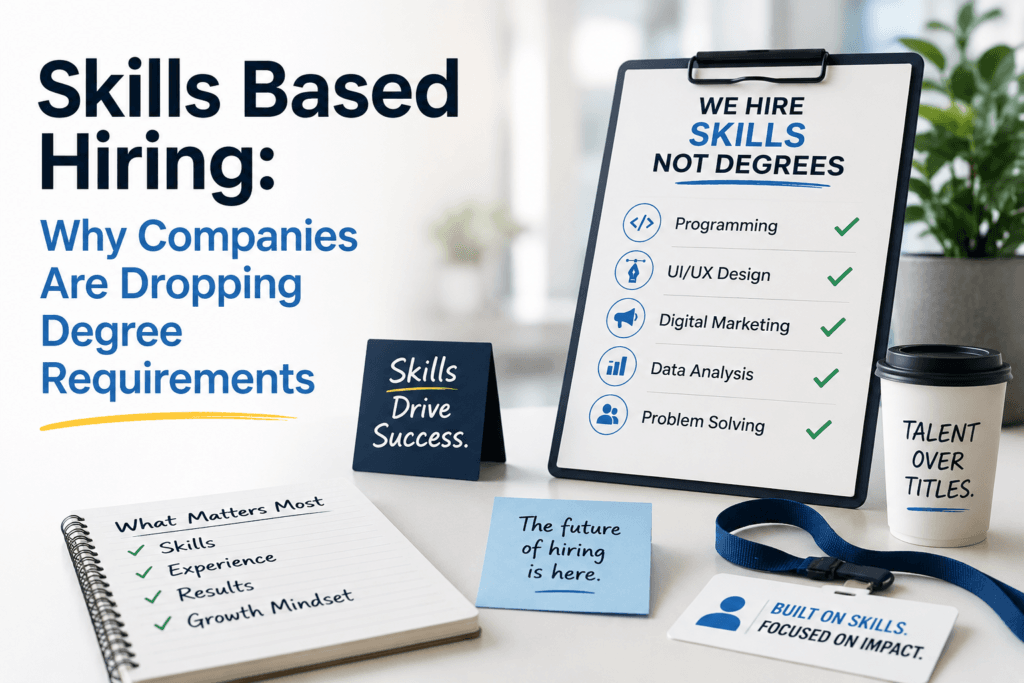
Skills Based Hiring: Why Companies Are Dropping Degree Requirements

For most of the last half century, a college degree was the unofficial entry ticket to professional employment. It did not matter whether the role actually required the kind of knowledge taught in a four-year university program. If your resume did not show a bachelor’s degree, your application rarely made it past the first filter. Hiring managers used the credential as a shortcut, a signal of baseline intelligence, work ethic, and social reliability that saved them the trouble of evaluating candidates more carefully.

That shortcut is breaking down. Quietly at first, and now quite visibly, some of the most respected employers in the world are tearing up that assumption and rebuilding how they identify, evaluate, and hire talent. The shift has a name: skills based hiring. And in 2026, it has moved from being a progressive idea discussed at HR conferences to a mainstream practice that is actively reshaping the labor market for both employers and job seekers.

If you are an employer trying to build better teams, or a professional trying to understand how to compete in a job market where the old rules no longer apply, this article explains everything you need to know about why this change is happening, what it means in practice, and how to navigate it successfully.


What Skills Based Hiring Actually Means

Skills based hiring is a straightforward concept with significant implications. Instead of using a degree or a prestigious job title as a proxy for ability, employers evaluate candidates directly on whether they can do the specific work required by the role.

This means the question shifts from “Where did you go to school?” to “Can you demonstrate that you can do this job?” The answer to the second question can come from many places: a portfolio of completed work, performance on a practical assessment, a GitHub repository full of real projects, relevant certifications, a track record of measurable results in a previous role, or proof of competence built through self-directed learning.

In practical terms, it means shifting from “Where did you work?” to “What can you do?” This approach aligns hiring decisions with business outcomes by focusing on measurable skills such as problem solving, communication, technical expertise, and adaptability. GoCardless

It is important to understand what skills based hiring is not. It is not the same as removing all standards. Skills based hiring is not about lowering standards. It is about improving how you define and measure them. Enterprise Nation A company that switches to skills based hiring is not taking a gamble on unproven candidates. It is replacing an imprecise, often biased selection filter with a more accurate one.


Why the Traditional Approach Stopped Working

To understand why this shift is happening now, it helps to understand what went wrong with credential-based hiring in the first place.

The core problem is that a degree is a very indirect signal of job readiness. A degree tells you that someone spent three or four years studying a curriculum that was designed years before they enrolled, at an institution that may or may not have kept its content current with industry demands. It tells you very little about whether that person can perform the specific tasks your open role requires today.

The skills gap exists because the pace of technological change is outpacing the ability of traditional education systems to keep up. Schools and universities often fall behind in updating their courses, leaving students unprepared for the latest industry demands. At the same time, entirely new job roles are emerging, often without a clear educational path. Escrow

There is also the problem of degree inflation, where roles that historically required no degree gradually accumulated degree requirements not because the work changed but because it became a convenient way to reduce the applicant pool. Many of the strongest performers in industries like supply chain, manufacturing, and skilled trades developed their expertise on the job, through apprenticeships, or by way of certifications that are far more current than a degree completed a decade ago. Infotech Wayout

The financial reality of higher education has made this increasingly difficult to justify. College is expensive, and in many parts of the world it is inaccessible to large portions of the population for reasons that have nothing to do with intelligence or capability. Requiring a degree for roles where it is not genuinely necessary has been screening out talented people based on their socioeconomic background rather than their ability to do the work.

By removing unnecessary degree requirements, companies can tap into a significantly wider talent pool. LinkedIn research indicates that a skills based approach can expand talent pools by up to 15.9 times in the United States alone. Osdire


The Scale of the Shift

This is not a fringe movement. The numbers tell a clear story about how mainstream skills based hiring has become.

In 2024, around 45% of organizations stopped requiring a bachelor’s degree for some jobs, in addition to the 55% that already did so in 2023. According to a poll among 800 US employers, about 80% said when it comes to hiring, they would rather consider a person with relevant experience than a college graduate. Indeed

Leading companies like IBM and Boston Consulting Group are at the forefront of this trend, removing degree requirements from many job postings and prioritizing skills over degrees. These organizations have recognized that valuable skills can be acquired through alternative credentials like bootcamps, certifications, and on-the-job training. Useme

Companies like IBM, Google, Delta Air Lines, and Bank of America have eliminated the requirement of a four-year degree for a large number of job positions. This trend has already begun to expand from just technology into finance, aviation, and retail. Indeed

Over the past ten years, the adoption rate of skills first hiring has increased from 30% to 85%, with a staggering 40% jump between 2020 and 2025 alone. Jobbers

The breadth of industries involved is perhaps the most telling indicator that this is a permanent shift rather than a passing trend. It is not just tech companies looking for developers. It is finance firms, healthcare organizations, logistics companies, and retailers all concluding that the degree filter has been costing them good people.


Why Skills Based Hiring Produces Better Outcomes

Beyond the philosophy, the business case for skills based hiring is grounded in measurable results that employers who have made the shift consistently report.

Better prediction of job performance. Skills based methods are five times more predictive of job performance than resumes. Checkout.com When you evaluate someone on their ability to actually do the work, you get a far more accurate picture of how they will perform in the role than when you evaluate them on where they studied ten years ago.

Higher retention rates. 89% of employers using skills based hiring reported improvements in employee retention compared to their previous hiring methods. The likely mechanism is better job-person fit: candidates selected for demonstrated ability to do the work tend to stay longer than candidates selected for credentials that may or may not relate to the actual job demands. Slashdot

Reduced cost of bad hires. The US Department of Labor estimates that a bad hire can cost an organization at least 30% of the employee’s first-year earnings. For a corporate role with an $80,000 salary, that is a direct loss of $24,000. Skills based vetting reduces mis-hires by 88% by catching mismatches early in the recruitment cycle. Osdire

Improved workforce diversity. Skills based hiring is a fairer practice. 90% of employers using this method reported a measurable improvement in diversity within their workforce. Osdire When the filter shifts from “what credential do you have” to “what can you do,” people from underrepresented backgrounds who developed their skills outside of traditional educational pathways get a fair shot.

Faster onboarding and productivity. Employees hired based on demonstrated skills tend to ramp up faster and contribute more effectively from day one. GoCardless Because the hiring process validated their ability to perform the actual work, there is less gap between what was promised and what the role requires.


What Employers Are Looking For Instead of Degrees

When degree requirements come down, something has to take their place. Understanding what employers are actually evaluating in a skills based hiring process is useful for both companies designing their approach and candidates preparing to compete in this environment.

Portfolios and work samples are among the most powerful signals in a skills based evaluation. A portfolio shows what someone has actually built, written, designed, or delivered. It removes the distance between the credential and the capability. In creative and technical fields, employers now ask candidates to provide tangible proof of ability, like GitHub contributions, product case studies, or project portfolios. For candidates, this means it is no longer enough to list job duties. You must show outcomes. Codecontrol

Practical assessments and work simulations have become standard tools for evaluating candidates more objectively. Rather than asking interview questions that can be prepared for with generic answers, companies give candidates a realistic task representative of the actual work and evaluate how they approach and solve it. Opting for work samples that show a candidate’s practical logic, followed by structured interviews to ensure every profile measures up against the same set of questions, is a recommended best practice for skills based hiring implementation. Capital on Tap

Certifications and micro credentials have gained significant ground as alternative signals of competency. IT certifications are increasingly emphasizing practical, real-world assessments instead of theory-heavy testing. Instead of asking what a command does, exams are starting to ask candidates to actually run it, troubleshoot it, or deploy something with it. That evolution reflects how employers now care most about applied skill. WorkMotion

Demonstrable results in prior roles remain important, but the framing shifts. Instead of “five years of experience required,” skills based job descriptions ask candidates to show what they achieved in previous roles, specific outcomes, numbers, projects completed, problems solved.

Soft skills and behavioral competencies are becoming more explicitly evaluated as part of skills based hiring. Employers are increasingly valuing soft skills and dropping traditional degree requirements, making adaptability and skills based assessments central to hiring decisions. Jobbers Communication, critical thinking, collaboration, and the ability to learn quickly are difficult to fake in a well-designed skills assessment, which is why they have become more prominent in the evaluation process.


How Companies Are Implementing Skills Based Hiring

Making the transition from credential-based hiring to skills based hiring is not as simple as deleting “bachelor’s degree required” from every job posting. That is the beginning of the process, not the end of it. Companies that do it well follow a more systematic approach.

Step one is rewriting job descriptions around competencies. One of the first steps in shifting to a skills based approach is revisiting how job descriptions are written. Instead of listing degree requirements and long lists of qualifications, focus on the specific competencies needed. Neighborhood Escrow A job description that previously said “degree in marketing required” might become “demonstrated ability to manage paid social campaigns, analyze performance data, and improve conversion rates.” The second version attracts people who can actually do the job. The first version attracts people who have a piece of paper.

Step two is building a skills assessment framework. Without a structured way to evaluate skills, removing degree requirements simply widens the candidate pool without improving the quality of hiring decisions. Companies need to identify the core competencies required for each role, then design assessments that test those competencies in realistic conditions. Identifying the five core skills a candidate needs to excel in their first 90 days, and then setting out a clear assessment strategy using work samples and structured interviews, is a sound practical framework for getting started. Capital on Tap

Step three is training hiring managers. Some hiring managers remain attached to traditional credentials as a proxy for quality. They may worry that removing degree requirements will flood them with unqualified candidates. Sharing the research showing that skills based hiring leads to better retention and performance, and starting with managers who are already open to experimentation, typically reduces resistance over time. GoCardless

Step four is standardizing the evaluation process. One of the most common pitfalls in hiring is inconsistency, where different candidates for the same role are evaluated on different criteria depending on who is interviewing them. Setting the record straight with a standardized scorecard, shutting out the likability factor to stay focused on objective evaluation, is essential for skills based hiring to deliver consistently better results than credential-based screening. Capital on Tap

Step five is measuring outcomes over time. Skills based hiring should be evaluated on business results: quality of hire, time to productivity, retention rates, and performance ratings at the three month, six month, and one year marks. Companies that track these outcomes consistently find confirmation that the approach works, and the data helps sustain organizational commitment when the inevitable questions about standards arise.


The Freelance and Remote Work Connection

Skills based hiring is not just relevant to full-time employment. It is the default operating model of the freelance and remote work economy, and has been for years.

When a business hires a freelancer, they almost never ask for a degree. They ask for a portfolio, a track record of results, references from past clients, and sometimes a short test project. The entire freelance economy runs on proof of skill rather than credentials, which is one reason why it has produced such an efficient matching mechanism between buyers and sellers of professional services.

The growing adoption of skills based hiring in traditional employment is essentially an acknowledgment that the freelance model got something right. Remote work has expanded the talent pool globally, and in this context companies focus on output and skills regardless of where the education came from. iHire When you can hire from anywhere in the world, the constraint of hiring only degree holders from local universities starts to look not just unnecessary but actively counterproductive.

This also has significant implications for professionals who want to compete in the modern job market. Building a visible, compelling body of work is now more important than the institution on your diploma. The person who has spent three years freelancing, building real projects, accumulating client testimonials, and developing genuine expertise in a high-demand area is increasingly competitive with, and in many cases more competitive than, a recent graduate with a relevant degree and no practical track record.

For businesses that hire freelancers regularly, platforms that facilitate secure engagements and protect both parties through the transaction process are essential tools. Xcrow provides escrow-based payment protection for exactly this kind of arrangement, ensuring that when you hire a skilled professional for a specific project, the financial risk on both sides is managed transparently and fairly.


What This Means If You Are a Job Seeker

If you are building a career in 2026 and beyond, the shift to skills based hiring is genuinely good news for anyone willing to take it seriously. It means the gatekeeping function of expensive degrees is weakening, and that what you can demonstrate matters more than what you can show on a certificate.

But it also places a new responsibility on you. If employers are no longer filtering by credential, you need to be your own advocate in making your skills visible and verifiable.

Build a portfolio that shows outcomes, not just activity. Whether you are a developer, a marketer, a designer, a writer, or a data analyst, the most valuable thing you can invest your time in is creating a documented record of real work with real results. The best way to prove your skills is through a portfolio of work, relevant online certifications, and hands-on projects. Documenting your work on platforms like LinkedIn or GitHub gives employers tangible proof of your abilities. FreeUp

Invest in certifications that have practical weight. Not all certifications are equal. The ones that carry genuine value in the job market are those that require you to demonstrate applied skill rather than simply pass a multiple-choice exam. Google’s professional certificates on Coursera, AWS certifications, HubSpot’s marketing certifications, and CompTIA’s security credentials are examples of credentials that employers in their respective fields recognize as meaningful signals of competence.

Reframe how you present your experience. Skills based hiring means that how you describe your past work matters enormously. The shift is from listing responsibilities to showcasing results. Instead of “managed social media accounts,” consider “grew Instagram following from 3,000 to 22,000 in eight months through consistent content strategy and engagement.” Numbers and specific outcomes are far more compelling than job duty descriptions.

Prepare for practical assessments. If you are applying to companies that have adopted skills based hiring, expect to demonstrate your skills during the interview process, not just talk about them. Practice working through real problems in your field under time pressure. The candidates who perform best in skills assessments are those who have spent time actually doing the work, not rehearsing interview answers.

Use platforms that showcase competency. LinkedIn now has skills assessments built into profiles. GitHub is a portfolio tool for developers. Behance works for designers. Medium or a personal blog works for writers. Identify the platform where your target employers look for evidence of skill in your field and make sure your presence there is substantive.


What This Means If You Are an Employer

For hiring managers and business owners, the practical takeaway from the skills based hiring movement is straightforward: your current hiring process is probably filtering out excellent candidates for the wrong reasons, and keeping that filter in place is costing you both quality and diversity.

The transition does not need to be immediate or total. Start by auditing your most common job descriptions and identifying where degree requirements have been applied reflexively rather than because they are genuinely necessary. For roles where the actual work does not require knowledge specific to a formal degree, removing that requirement and replacing it with a skills-based evaluation is a change you can make today.

According to McKinsey, skills based hiring practices could be among the definitive hiring trends that help companies maximize their recruiting and gain access to a wider pool of talent. Technavio

For businesses that rely on freelance or contract talent in addition to full-time staff, the principles are the same. Evaluate based on demonstrated work and relevant results. Ask for portfolio samples. Use structured briefs so that candidates are assessed on their ability to respond to your specific context rather than on generic credentials. And use secure payment and contract tools so that once you find the right person, the engagement runs cleanly and professionally. Xcrow is one such tool, designed to protect both clients and contractors through escrow-based payment protection that ensures work is delivered and payments are released fairly.


Industries Leading the Charge

While skills based hiring is spreading broadly, some industries have moved faster and further than others, and their experience provides useful proof points for sectors still in the early stages of adoption.

Technology has been at the forefront from the beginning. The shortage of qualified developers, data scientists, and cybersecurity professionals has been acute enough that companies could no longer afford the luxury of degree requirements. Google, Apple, IBM, and Amazon all made headlines by removing degree requirements from large categories of roles, and many smaller tech companies followed.

In advertising and marketing, 91% of employers place more value on candidates’ actual abstract and analytic reasoning skills than they do on their degree. In finance and accounting, 89% of firms have transitioned to skills first hiring to evaluate candidates for analytical positions. In healthcare, 88% of organizations are using skills based hiring to identify talent for support and medical roles. Escrow

Even traditionally conservative sectors are moving in this direction as talent shortages force a reassessment of filtering criteria that were never well-justified in the first place.


The Honest Challenges

It would not be fair to present skills based hiring as a perfect solution without acknowledging the genuine difficulties involved in implementing it well.

The most significant challenge is that many organizations publicly commit to skills based hiring without actually changing how they screen candidates in practice. 85% of employers claim skills based hiring, yet Harvard data shows that fewer than 1 in 700 new hires were workers without a bachelor’s degree, suggesting the practice trails the policy by a wide margin. Alliance Virtual Offices Removing the degree requirement from a job posting while keeping the same screening process produces no real change in outcomes.

According to SHRM, 62% of HR professionals find skill validation challenging. How do you know if someone truly has the skills they claim? The recommended solution is to combine multiple assessment methods: technical tests for hard skills, work samples for applied abilities, and structured interviews for soft skills. No single method is perfect, but triangulating across approaches improves accuracy considerably. GoCardless

There is also the question of how to evaluate soft skills at scale. Technical skills can be tested with relative objectivity. But collaboration, adaptability, communication under pressure, and the ability to learn quickly are harder to measure consistently. This is an area where structured behavioral interviews, reference checks, and extended trial projects have become increasingly common tools.

None of these challenges are insurmountable. They are implementation problems, not fundamental flaws in the concept. And the evidence from companies that have invested seriously in making skills based hiring work consistently shows that the results justify the effort.


The Bigger Picture

Stepping back from the mechanics of hiring processes, the shift toward skills based evaluation reflects something important about how work and learning have changed.

The idea that a four-year degree completed in your early twenties adequately prepares you for a multi-decade career in a rapidly evolving economy has always been questionable. In a world where the most valuable skills in 2026 barely existed in 2016, it is essentially untenable. The most effective professionals today are those who treat learning as continuous, who build skills deliberately throughout their careers, and who can demonstrate what they know through work rather than waiting for a credential to speak for them.

Skills based hiring is not just a trend. It is a fundamental shift in how organizations identify, evaluate, and grow talent. For job seekers, it is a wake-up call and an invitation: to take ownership of their skills, prove their value, and seize opportunities that were once closed off by outdated hiring models. The degree may get your foot in the door, but your skills will open it wider. PayPal

For employers, the companies that build genuinely skills-first hiring processes will consistently access a better, more diverse, and more adaptable talent pool than those still filtering by credential. That advantage compounds over time. The teams built through skills based hiring perform better, stay longer, and adapt more readily to change.

For professionals, the news is genuinely encouraging. The barriers that once protected mediocre candidates with prestigious degrees while keeping talented people without them on the outside are coming down. What you can do, not where you studied, is increasingly what matters.

The question is whether you are ready to show your work.


Final Thoughts

Skills based hiring is not a fad. It is a correction to a system that was always more about convenience than accuracy, and the companies leading this shift are doing so because the evidence, both in terms of performance data and workforce diversity, is compelling and consistent.

If you are an employer, the practical path forward involves auditing your job descriptions, designing competency-based evaluation processes, training your hiring team, and measuring outcomes over time. If you are a job seeker, the path forward involves building visible, documented proof of your skills through portfolios, certifications, real projects, and measurable results.

The world of work is becoming more meritocratic in the truest sense, not in the sense of who has the most impressive certificate, but in the sense of who can actually do the work. That is a change worth embracing, regardless of which side of the hiring table you sit on.

If you are also looking to hire freelance talent and want to do so securely across borders, read our guide on how to hire a freelancer online and learn how Xcrow protects your payments throughout the engagement.

Leave your comment